Lookalike modeling is one of the most effective tools for audience expansion. By identifying users who resemble high-value customers, marketers can scale acquisition without starting from scratch. However, rapid expansion often comes with a hidden cost: declining precision.
As audiences grow, the similarity between the original seed and new users weakens. This leads to lower conversion rates, increased acquisition costs, and inefficient budget allocation.
Understanding where and why this breakdown happens is critical for sustainable growth.
What Happens When Lookalikes Scale Too Fast
When expanding lookalike audiences, algorithms move from highly similar users to broader approximations. This shift introduces several issues:
-
Signal dilution: The further you move from the seed audience, the weaker the shared characteristics become.
-
Increased noise: A larger portion of users may match only superficial traits.
-
Lower intent alignment: Behavioral signals that indicate buying intent become less consistent.
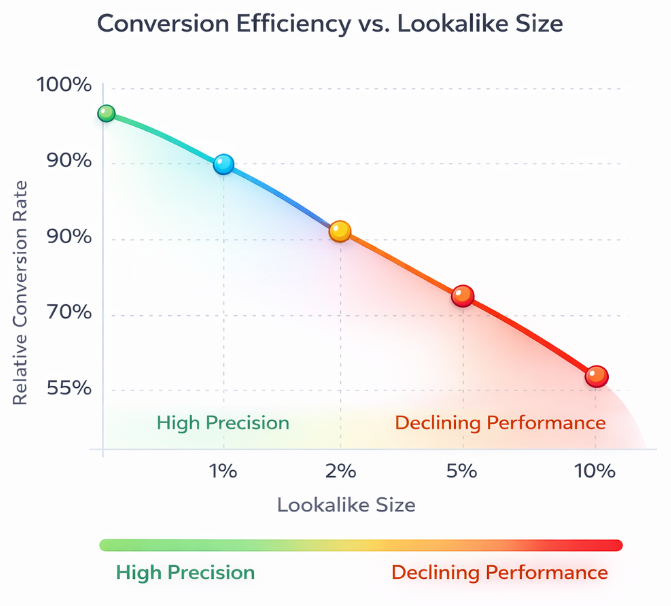
Conversion efficiency declines as lookalike audience size increases, illustrating the trade-off between scale and precision
According to industry benchmarks, campaigns that expand lookalike audiences beyond the top 5% similarity range often experience:
-
Up to 35–50% drop in conversion rates
-
20–40% increase in cost per acquisition (CPA)
-
Reduced return on ad spend (ROAS) by 15–30%
These effects are not immediate but compound over time, making them harder to diagnose.
Why Precision Declines
1. Weak Seed Data
Lookalike performance depends heavily on the quality of the seed audience. If the seed includes low-intent or mixed-quality users, scaling amplifies those weaknesses.
-
Small or inconsistent datasets produce unstable models
-
Including unqualified leads reduces predictive accuracy
2. Over-Aggressive Expansion
Expanding too quickly—such as jumping from a 1% to 10% audience—forces the model to prioritize reach over relevance.
-
High similarity thresholds maintain precision
-
Lower thresholds introduce broader, less relevant users
3. Lack of Segmentation
Using a single seed audience for multiple objectives (e.g., sign-ups, purchases, engagement) creates conflicting signals.
-
Mixed intent leads to diluted targeting
-
Segmented seeds improve clarity and outcomes
4. Platform Limitations
Algorithms optimize for scale when given broader constraints. Without proper boundaries, they prioritize volume over quality.
How to Detect Precision Loss Early
The key to maintaining performance is identifying early warning signs. Monitor the following metrics closely:
-
Conversion rate trends: A steady decline indicates weakening audience quality
-
CPA growth: Rising costs often signal reduced targeting efficiency
-
Frequency vs. performance: Higher frequency with lower returns suggests audience fatigue or mismatch
-
Engagement quality: Drops in time-on-site or depth of interaction reveal declining relevance
A 10–15% deviation from baseline performance should trigger investigation.
Best Practices to Maintain Precision While Scaling
1. Scale Incrementally
Expand audiences gradually (e.g., 1% → 2% → 3%) rather than making large jumps. This preserves similarity and allows for performance validation at each step.
2. Use High-Quality Seeds
Focus on:
-
Recent converters
-
High-value customers
-
Users with strong engagement signals
Studies show that high-quality seeds can improve lookalike performance by up to 60% compared to generic audiences.
3. Segment by Intent
Create separate lookalike audiences based on specific actions:
-
Purchasers
-
Trial users
-
Content engagers
This ensures the model optimizes for clear, consistent signals.
4. Combine with Exclusions
Exclude:
-
Existing customers
-
Low-quality leads
-
Irrelevant segments
This reduces overlap and keeps targeting focused.
5. Continuously Refresh Data
Update seed audiences regularly to reflect current behavior patterns. Static datasets become less predictive over time.
Strategic Approach to Sustainable Scaling
Scaling should not be treated as a one-time adjustment but as an ongoing optimization process.
A balanced approach includes:
-
Maintaining a core high-precision audience
-
Testing broader segments in controlled environments
-
Allocating budget dynamically based on performance
Organizations that follow structured scaling strategies report 25–40% higher long-term campaign efficiency compared to those that prioritize rapid expansion.
Conclusion
Lookalike audiences are powerful—but only when managed carefully. Expanding too quickly introduces noise, weakens targeting signals, and ultimately reduces campaign effectiveness.
By focusing on data quality, incremental scaling, and continuous monitoring, marketers can grow their reach without sacrificing precision.
Recommended Reading