
Modern B2B purchasing journeys are increasingly self-directed. According to Gartner research, B2B buyers spend only 17% of their purchase journey meeting with potential suppliers, while the rest is spent researching independently or discussing internally. Social media plays a critical role in this research phase.
However, explicit buying signals such as demo requests or pricing inquiries represent late-stage intent. The real competitive advantage lies in identifying hidden buying signals — subtle behavioral and contextual indicators that suggest a prospect is moving toward a purchasing decision.
This article outlines a systematic approach to identifying, validating, and acting on those signals.
What Are Hidden B2B Buying Signals?
Hidden buying signals are indirect indicators of purchase intent that do not explicitly state readiness to buy. They often appear as:
-
Executive posts about operational challenges
-
Hiring announcements for roles tied to specific technologies
-
Engagement with competitor content
-
Discussions about scaling, compliance, or cost reduction
-
Participation in niche industry conversations
These signals require contextual interpretation rather than surface-level keyword monitoring.
Why Social Media Is a High-Value Intent Source
LinkedIn reports that 75% of B2B buyers use social media to inform purchasing decisions. Additionally, Demand Gen Report states that 52% of B2B buyers rely on social content to evaluate vendors.
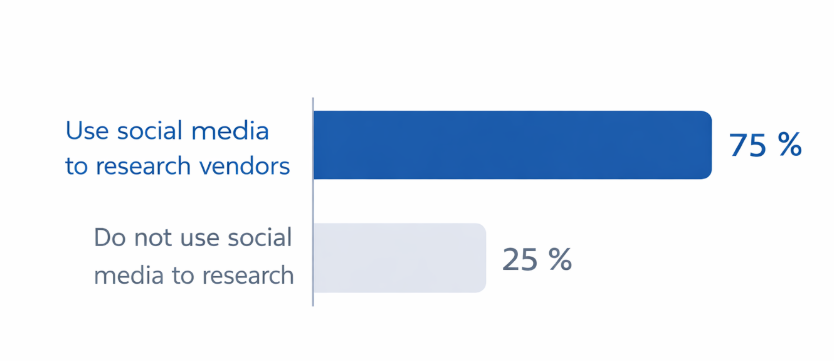
Majority of B2B buyers (75%) rely on social media platforms when researching vendors and making purchase decisions
Unlike traditional intent data sources, social media reveals:
-
Strategic priorities directly from decision-makers
-
Budget shifts reflected in hiring patterns
-
Technology stack changes
-
Competitive dissatisfaction
-
Expansion plans and geographic growth
These are early-stage indicators that typically precede formal vendor evaluation.
Types of Hidden Buying Signals to Monitor
1. Problem Framing by Leadership
When executives publicly discuss inefficiencies, missed KPIs, or scaling bottlenecks, they are signaling strategic pain points. For example:
-
"We’re struggling to maintain outbound performance at scale."
-
"Customer acquisition costs are rising faster than expected."
These statements often precede technology investment or vendor exploration.
2. Hiring Pattern Shifts
Job postings can indicate operational transformation. If a company begins hiring:
-
Revenue operations specialists
-
Data enrichment analysts
-
Sales automation managers
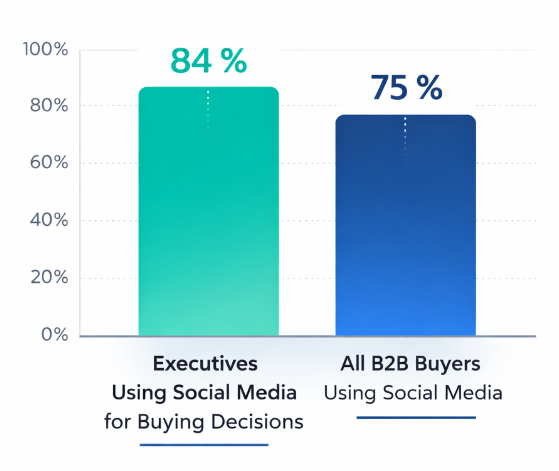
Social media plays a significant role throughout the B2B buying cycle — with up to 84 % of executives and 75 % of buyers using it as an information source
It may suggest infrastructure expansion and potential tooling upgrades.
3. Competitor Engagement Behavior
Monitoring likes, comments, or shares on competitor posts can surface prospects actively evaluating alternatives.
High-signal behaviors include:
-
Repeated engagement with product update posts
-
Comments asking about integrations or pricing
-
Following competitor company pages
4. Community Participation
Active engagement in industry groups or discussions about specific operational challenges can reveal urgency.
Repeated engagement around terms such as:
-
Pipeline predictability
-
Data accuracy
-
Account-based strategies
-
Lead qualification frameworks
Often indicates solution exploration.
5. Funding and Expansion Announcements
Companies that announce funding rounds, acquisitions, or market expansion are statistically more likely to invest in new tools. CB Insights data shows that recently funded companies increase SaaS spending within 6–12 months post-funding.
Behavioral Signal Weighting Framework
Not all signals carry equal intent value. A structured scoring model improves prioritization.
Consider weighting signals based on:
-
Seniority of the individual posting
-
Frequency of related interactions
-
Recency of activity
-
Combination of multiple signals
-
Alignment with your ideal customer profile
For example, a VP of Sales discussing pipeline challenges and simultaneously hiring RevOps roles represents a higher-intent scenario than a junior employee engaging with a general industry post.
Using Data Enrichment to Validate Signals
Raw social activity is insufficient without enrichment.
Effective validation includes:
-
Verifying company size and growth trajectory
-
Identifying decision-making authority
-
Mapping technology stack indicators
-
Cross-referencing hiring trends
Combining behavioral signals with firmographic and technographic data significantly increases qualification accuracy.
Operationalizing Social Buying Signals
To convert signals into pipeline, teams must operationalize detection and response.
Step 1: Define ICP-Centric Keywords
Avoid generic keywords. Focus on high-intent operational language tied to your value proposition.
Step 2: Monitor Decision-Maker Activity
Prioritize C-level, VP, and Director-level engagement over broad audience monitoring.
Step 3: Automate Signal Aggregation
Manual tracking does not scale. Implement structured workflows to capture engagement, job postings, and strategic announcements in a centralized system.
Step 4: Trigger Contextual Outreach
Outreach should reference the context that created the signal. Messaging aligned with a publicly discussed challenge yields significantly higher response rates.
According to HubSpot, personalized outreach improves reply rates by up to 32% compared to generic messaging.
Common Mistakes in Social Signal Detection
-
Treating all engagement as equal intent
-
Ignoring negative sentiment toward competitors
-
Failing to validate budget authority
-
Overreacting to one-time engagement
-
Not aligning sales and marketing interpretation of signals
Precision and consistency are essential.
Strategic Advantage of Early Signal Identification
Organizations that identify intent before competitors enter the evaluation cycle gain measurable advantages:
-
Reduced sales cycle length
-
Higher win probability
-
Improved outbound efficiency
-
Better timing alignment with budget allocation
Forrester research suggests that vendors who engage buyers early in the journey are more likely to shape purchase criteria.
Conclusion
Hidden B2B buying signals on social media represent a competitive intelligence layer that most organizations underutilize. By combining behavioral monitoring, enrichment, signal weighting, and contextual engagement, companies can identify high-intent prospects earlier and convert insight into predictable revenue growth.
The key is not collecting more data, but interpreting the right signals with strategic discipline.