
Meta’s Event Match Quality (EMQ) score directly affects how accurately your conversion events are attributed and optimized. If your campaigns rely on Pixel or Conversions API data, improving EMQ can significantly enhance targeting precision, reduce data loss, and increase return on ad spend.
Event Match Quality is a diagnostic score in Meta Events Manager that evaluates how effectively your customer event data (from the Meta Pixel or Conversions API) matches Meta user profiles.
The score ranges from 0 to 10 and is based on the quantity and quality of customer information parameters (such as email, phone number, external ID, etc.) sent with each event.
Meta uses this data to:
-
Match conversion events to real users
-
Improve attribution accuracy
-
Strengthen optimization algorithms
-
Enhance custom and lookalike audience performance
A higher EMQ score means better matching. Better matching means better optimization.
Why Event Match Quality Matters
Meta’s delivery system depends heavily on event signals. According to Meta’s published guidance and advertiser case studies:
-
Advertisers using Conversions API alongside Pixel have reported up to 13% improvement in cost per result compared to Pixel-only setups.
-
More complete customer information parameters can increase match rates by 10–20%.
-
Signal loss caused by browser restrictions (e.g., iOS privacy updates) can significantly reduce event attribution without server-side tracking.
If EMQ is low, Meta receives weak or incomplete signals. As a result:
-
Attribution becomes less accurate
-
Campaign learning slows down
-
Cost per acquisition increases
-
Retargeting audiences shrink
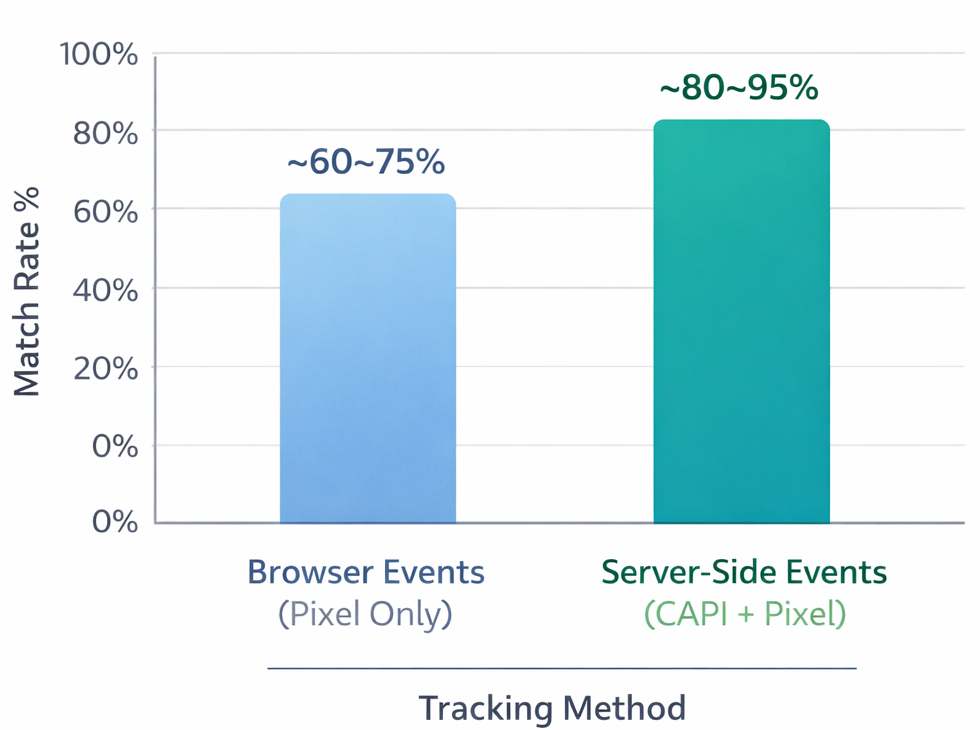
Comparison of event match rates between traditional browser-only tracking and server-side combined tracking
Improving EMQ is not a cosmetic optimization. It is a structural performance upgrade.
How Meta Calculates Event Match Quality
EMQ is based on:
-
The number of customer information parameters sent
-
The reliability and formatting of those parameters
-
Whether they are hashed correctly (SHA-256)
-
The consistency of identifiers across events
Common high-impact parameters include:
-
Email address
-
Phone number
-
First name and last name
-
City, state, ZIP/postal code
-
External ID (CRM ID or internal customer ID)
-
Client IP address and user agent
The more high-quality identifiers you provide, the stronger your match rate.
7 Practical Ways to Improve Event Match Quality
1. Send More Customer Parameters (Strategically)
Do not rely on email alone.
While email is powerful, combining it with phone number, external ID, and location data significantly improves match probability. Businesses that expand from 1–2 identifiers to 4–6 identifiers typically see noticeable EMQ improvements.
Best practice:
-
Collect structured data in forms
-
Normalize fields before sending
-
Ensure data is consistently formatted
2. Implement Conversions API Alongside Pixel
Browser-based tracking alone is vulnerable to data loss due to:
-
Ad blockers
-
Browser privacy policies
-
iOS tracking restrictions
-
Network interruptions
Server-side tracking via Conversions API:
-
Restores lost signals
-
Improves event deduplication
-
Enhances data stability
-
Increases EMQ consistency
Advertisers who combine Pixel + Conversions API frequently report stronger match rates and improved optimization stability.
3. Use a Consistent External ID
An external ID (such as a CRM ID) is one of the most underutilized but powerful identifiers.
It should:
-
Be unique per user
-
Remain stable across sessions
-
Be sent with every meaningful event
When Meta can tie multiple actions to a consistent identifier, event matching becomes significantly more reliable.
4. Ensure Proper Data Hashing and Formatting
Meta requires sensitive customer information to be SHA-256 hashed before transmission.
Common formatting errors that reduce EMQ:
-
Uppercase letters in emails
-
Extra spaces
-
Untrimmed phone numbers
-
Incorrect country codes
-
Missing international formatting
Normalize data before hashing:
-
Trim whitespace
-
Convert to lowercase
-
Standardize phone numbers with country code
Data hygiene directly affects EMQ.
5. Improve Data Collection at the Source
EMQ cannot exceed the quality of your input data.
If forms collect incomplete or incorrect information, your event match quality will suffer.
Optimization strategies:
-
Validate email formats in real time
-
Use phone input masking
-
Reduce optional critical fields
-
Enrich data post-submission
Improving data capture often increases both match quality and CRM performance.
6. Deduplicate Events Properly
When using both Pixel and Conversions API, deduplication is essential.
Send:
-
The same event ID from browser and server
-
The same event name
-
A consistent timestamp
Improper deduplication can inflate or suppress signals, indirectly impacting performance diagnostics.
7. Monitor EMQ by Event Type
Do not evaluate EMQ globally.
Different events (Purchase, Lead, AddToCart) may have different scores. Focus on:
-
High-value conversion events
-
Events used for optimization
-
Events driving lookalike audiences
Raising EMQ for critical revenue events yields the highest ROI.
Benchmarks: What Is a Good Event Match Quality Score?
While Meta does not publish strict benchmarks, in practice:
-
8–10: Strong match quality
-
6–7: Moderate, can be improved
-
Below 5: Weak signal strength
If your primary conversion event is below 6, there is substantial room for performance improvement.
Advanced Strategy: Combine Data Enrichment with Server-Side Tracking
Organizations that integrate CRM data, clean identifiers, and server-side infrastructure typically experience:
-
Higher match rates
-
More stable learning phases
-
Improved lookalike audience performance
-
Lower CPA over time
EMQ optimization is not a one-time fix. It is a data infrastructure strategy.
Common Mistakes That Reduce EMQ
-
Sending only one identifier (email only)
-
Not using Conversions API
-
Poor hashing implementation
-
Inconsistent external IDs
-
Not standardizing phone numbers
-
Ignoring server-side signal loss
Most low EMQ issues stem from implementation gaps, not platform limitations.
Conclusion
Improving Event Match Quality in Meta Ads is one of the most impactful technical optimizations available to performance marketers. Stronger match rates lead to better attribution, smarter optimization, and higher return on ad spend.
By expanding customer parameters, implementing server-side tracking, maintaining consistent identifiers, and improving data hygiene, advertisers can significantly increase EMQ and unlock stronger campaign performance.
In a privacy-first advertising environment, signal quality is competitive advantage.
Recommended Reading
To deepen your understanding of Meta tracking and performance optimization, explore these additional articles:
Each article expands on advanced tracking strategies that directly influence Event Match Quality and campaign results.