Most prospecting campaigns fail not because of creative or platforms, but because budget is spent on the wrong people. This article breaks down how to design prospecting campaigns that prioritize relevance, control costs, and consistently turn cold audiences into qualified leads.
Why Prospecting Campaigns Burn Budget
Prospecting is where advertisers lose the most money. Unlike retargeting, you’re dealing with cold audiences who have no prior relationship with your brand. When targeting is too broad or poorly defined, spend increases quickly while conversion rates collapse.
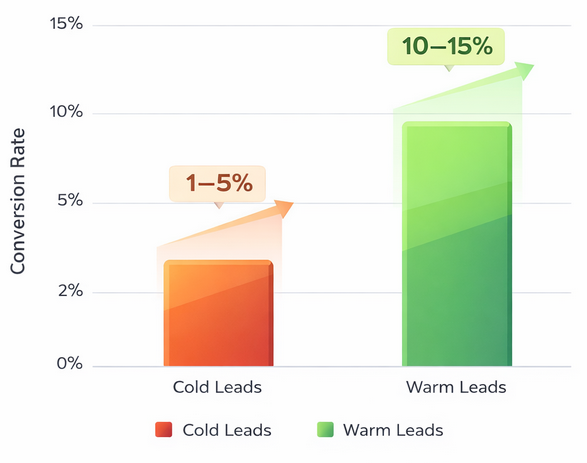
Industry data consistently shows that cold traffic converts significantly worse than warm audiences. On average, prospecting campaigns deliver conversion rates that are 2–3× lower than retargeting efforts, while cost per acquisition can be 30–50% higher when targeting lacks precision.
The goal of an efficient prospecting campaign is simple: reach people who behave like your best customers, not just people who vaguely match demographic interests.
Start With Buyer Signals, Not Interests
Interest-based targeting is one of the biggest sources of wasted spend. Interests are often outdated, inferred, or overly broad. Two people labeled with the same interest can behave very differently when shown an ad.
Behavioral data is far more predictive. Campaigns built on audience segments derived from real actions—such as content engagement, group participation, or platform activity—consistently outperform interest-based targeting.
According to multiple ad performance benchmarks, behavior-driven audiences can achieve:
-
Up to 70% higher conversion rates compared to interest-only targeting
-
20–35% lower cost per lead due to improved relevance and engagement
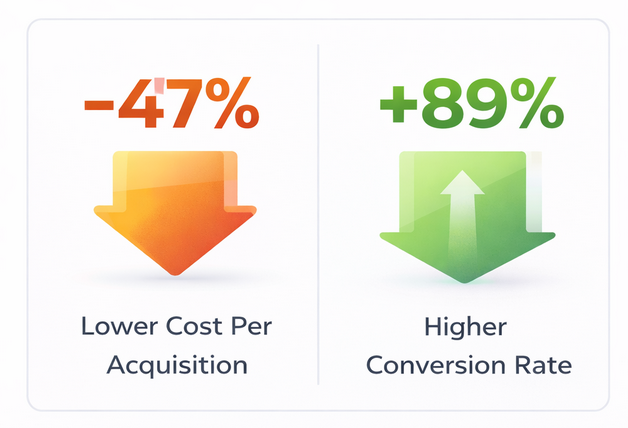
Behavioral targeting performance vs. traditional interest-based targeting — impactful improvements in CPA and conversions
Better signals mean fewer impressions wasted on users who were never likely to convert.
Keep Prospecting Audiences Tight
One of the most common mistakes in prospecting is scaling too early by expanding audience size. While larger audiences may reduce frequency, they often dilute intent.
Performance data shows a clear pattern:
-
Small, highly relevant prospecting audiences tend to convert more efficiently
-
As audience size increases, cost per conversion rises sharply
For example, advertisers frequently see cost per lead increase by 60–80% when moving from highly refined audience segments to broad prospecting pools.
Instead of chasing volume, structure campaigns around multiple smaller audience segments. This approach allows budgets to flow toward the segments that prove performance, rather than subsidizing underperforming traffic.
Control Spend With Structured Testing
Prospecting efficiency improves when testing is controlled and intentional. Randomly launching new audiences or creatives spreads budget too thin and makes optimization impossible.
A structured approach includes:
-
Isolating one variable at a time (audience, creative, or offer)
-
Setting strict daily spend limits during testing
-
Cutting underperforming segments quickly based on early indicators
Advertisers who implement structured testing frameworks often reduce wasted spend by 25–40% in the first 30 days, simply by reallocating budget away from low-intent traffic.
Align Creative With Prospecting Intent
Cold audiences require different messaging than warm ones. Creative that assumes familiarity often performs poorly in prospecting campaigns.
Effective prospecting creative:
-
Clearly communicates the problem being solved
-
Establishes credibility within the first few seconds
-
Avoids aggressive calls to action
Ads designed specifically for cold audiences can improve click-through rates by 40% or more, which directly impacts cost efficiency and delivery quality.
Measure the Right Metrics
Prospecting campaigns should not be judged solely on immediate conversions. Early-stage indicators provide better guidance when deciding whether to scale or cut.
Key metrics to monitor include:
-
Cost per qualified click
-
Engagement rate compared to account averages
-
Conversion rate trend over time
Campaigns that show strong engagement but slower initial conversion often outperform in the long run once optimized, while campaigns with weak engagement rarely recover.
Turning Prospecting Into a Predictable System
Prospecting does not have to be a budget drain. When campaigns are built around real buyer signals, controlled audience sizes, and disciplined testing, spend becomes predictable and scalable.
The most successful advertisers treat prospecting as a data-filtering process—one that continuously eliminates low-intent traffic and concentrates budget where relevance is highest.
Recommended Reading
To deepen your understanding of efficient prospecting and audience strategy, explore these related articles: