Ad targeting has traditionally relied on user-based signals such as interests, demographics, and behavioral data. However, the effectiveness of these signals is increasingly constrained by privacy limitations and signal loss. In this environment, context—where and in what situation an ad is shown—has re-emerged as a powerful driver of relevance, engagement, and conversion.
Contextual ad targeting focuses on aligning ad messages with the content, environment, and intent surrounding the user at the moment of exposure. Rather than asking “Who is this user?”, contextual targeting asks “What is happening right now, and how does this message fit?”
What Context Means in Modern Ad Targeting
Context in advertising extends beyond keywords on a page. It includes:
-
Content context: The topic, tone, and semantic meaning of the content being consumed
-
Platform context: Whether the user is in a feed, group, marketplace, or private community
-
Intent context: Signals that indicate what the user is trying to achieve in that moment
-
Timing context: When the ad appears relative to user behavior or lifecycle stage
Together, these elements create a situational framework that helps ads feel relevant rather than intrusive.
Why Context Is Gaining Importance
Several industry shifts are accelerating the value of contextual targeting:
-
Privacy-first policies limit cross-site and cross-app tracking
-
Cookie deprecation reduces the reliability of third-party behavioral data
-
User fatigue with overly personalized ads increases resistance to traditional targeting
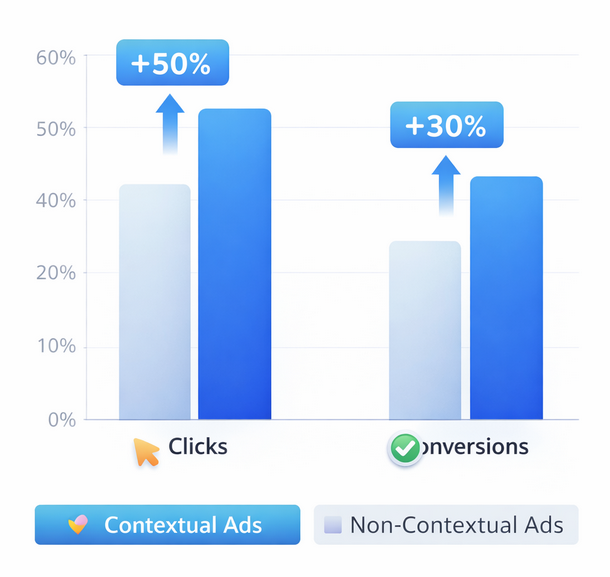
Contextual ads outperform non-contextual ads with 50% higher click likelihood and 30% higher conversion rates
According to industry research, contextually relevant ads can increase engagement rates by up to 63% compared to ads that rely solely on audience demographics. In addition, studies show that ads aligned with content context are remembered 2× more often than non-contextual ads.
Context vs. Audience-Based Targeting
Audience targeting and contextual targeting are not mutually exclusive, but they operate differently:
-
Audience-based targeting relies on historical data and inferred traits
-
Contextual targeting relies on real-time relevance and situational alignment
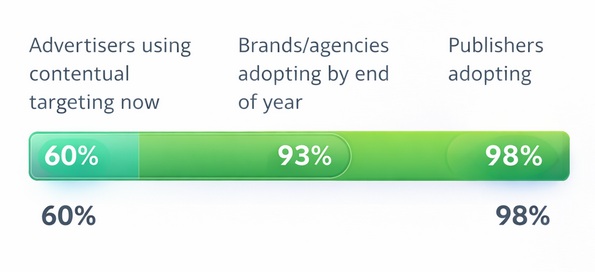
Adoption of contextual targeting is rising fast — 60% of advertisers use it today, with over 90% of brands and publishers embracing it by year’s end
Performance data consistently shows that context-rich placements improve efficiency. For example, campaigns optimized around content relevance often achieve 30–40% lower cost per engagement compared to broad interest targeting, particularly in prospecting campaigns.
Practical Applications of Contextual Targeting
Context can be applied across multiple campaign layers:
1. Content Alignment
Ads that mirror the language, problems, and tone of the surrounding content feel native and trustworthy. This reduces banner blindness and increases interaction.
2. Community and Group Context
Users behave differently in communities than in public feeds. Ads aligned with group topics or shared interests can outperform feed-based placements by up to 2× in conversion rate.
3. Funnel Stage Context
Matching ad messaging to the user’s awareness or decision stage improves relevance. Educational content performs best in early-stage contexts, while direct offers convert better in action-oriented environments.
Measuring the Impact of Context
To evaluate contextual performance, marketers should track:
-
Engagement rate compared to non-contextual placements
-
Cost per conversion by content category or placement type
-
Conversion lag and assisted conversions influenced by contextual exposure
Brands that actively optimize campaigns based on contextual signals report 20–25% higher return on ad spend over time.
The Strategic Advantage of Context
Contextual targeting shifts advertising from interruption to participation. Instead of forcing relevance through personal data, it earns relevance by fitting naturally into the user’s current experience. As platforms evolve and privacy standards rise, this approach provides a durable competitive advantage.
Related Articles
Conclusion
Context is no longer a secondary consideration in ad targeting—it is a core performance lever. By aligning messages with content, intent, and environment, advertisers can drive stronger engagement, better efficiency, and more sustainable results in a privacy-first advertising landscape.