Marketing teams invest significant budget and effort into generating leads, yet many organizations struggle with low sales acceptance rates (SAR). When sales teams reject or ignore marketing-qualified leads (MQLs), pipeline velocity slows, customer acquisition costs increase, and alignment between teams deteriorates.
What Is Sales Acceptance Rate (SAR)?
Sales Acceptance Rate is the percentage of marketing-qualified leads (MQLs) that are reviewed and accepted by the sales team as sales-qualified leads (SQLs) or viable opportunities.
Formula:
SAR = (Number of Accepted MQLs / Total MQLs Delivered to Sales) × 100
For example, if marketing delivers 1,000 MQLs in a month and sales accepts 420 of them, the sales acceptance rate is 42%.
While benchmarks vary by industry and sales model, many B2B organizations report SAR between 30% and 60%. According to industry research, companies with strong sales and marketing alignment achieve up to 36% higher customer retention and 38% higher sales win rates compared to misaligned organizations.
Why Sales Acceptance Rate Matters
Low SAR is not just a marketing metric problem. It has direct financial consequences:
-
Wasted marketing spend on unqualified or misaligned leads
-
Increased cost per opportunity
-
Slower pipeline development
-
Friction between marketing and sales teams
-
Poor forecasting accuracy
Improving SAR increases pipeline efficiency without necessarily increasing marketing budget. It is often one of the fastest ways to improve overall revenue performance.
1. Clearly Define MQL and SQL Criteria
One of the most common causes of low SAR is misaligned definitions.
Marketing may define an MQL based on engagement metrics (downloads, webinar attendance, website visits), while sales evaluates leads based on firmographics, buying intent, budget, authority, and timeline.
To improve acceptance rate:
-
Create a shared written definition of MQL and SQL
-
Include demographic, firmographic, and behavioral thresholds
-
Involve sales leadership in defining scoring rules
-
Review and refine criteria quarterly
Organizations with formal lead qualification frameworks experience significantly higher pipeline conversion rates than those relying on informal processes.
2. Improve Lead Data Quality and Completeness
Incomplete or inaccurate data is a primary reason sales rejects leads.
Common data issues include:
-
Missing job titles
-
Incorrect company size
-
Personal emails instead of business emails
-
Outdated contact information
Data-driven sales teams rely on accurate firmographic and contact information to prioritize outreach. According to industry studies, poor data quality costs companies an average of 12% of revenue annually.
To increase SAR:
-
Validate email addresses before routing leads
-
Enrich leads with company size, industry, and role data
-
Filter out students, competitors, and non-target accounts
-
Standardize required fields before MQL handoff
Higher data integrity leads directly to higher trust from sales teams.
3. Incorporate Account-Level Qualification
Individual engagement does not always indicate buying intent at the account level.
If a junior employee downloads a whitepaper, sales may reject the lead due to lack of authority. However, if multiple stakeholders from the same company show intent signals, the account becomes significantly more valuable.
Research shows that B2B buying decisions involve an average of 6 to 10 decision-makers. Aligning marketing qualification around account-level activity improves relevance and increases sales confidence in leads.
Consider:
-
Tracking multiple contacts from the same organization
-
Prioritizing target accounts over isolated contacts
-
Using intent signals across departments
Account-based qualification strategies consistently improve both SAR and conversion to opportunity.
4. Align on Service-Level Agreements (SLAs)
An effective SLA defines:
-
What qualifies as an MQL
-
How quickly sales must respond
-
What constitutes rejection and why
-
Feedback loops for improvement
Companies that respond to leads within the first hour are nearly 7 times more likely to have meaningful conversations with decision-makers compared to delayed follow-ups.
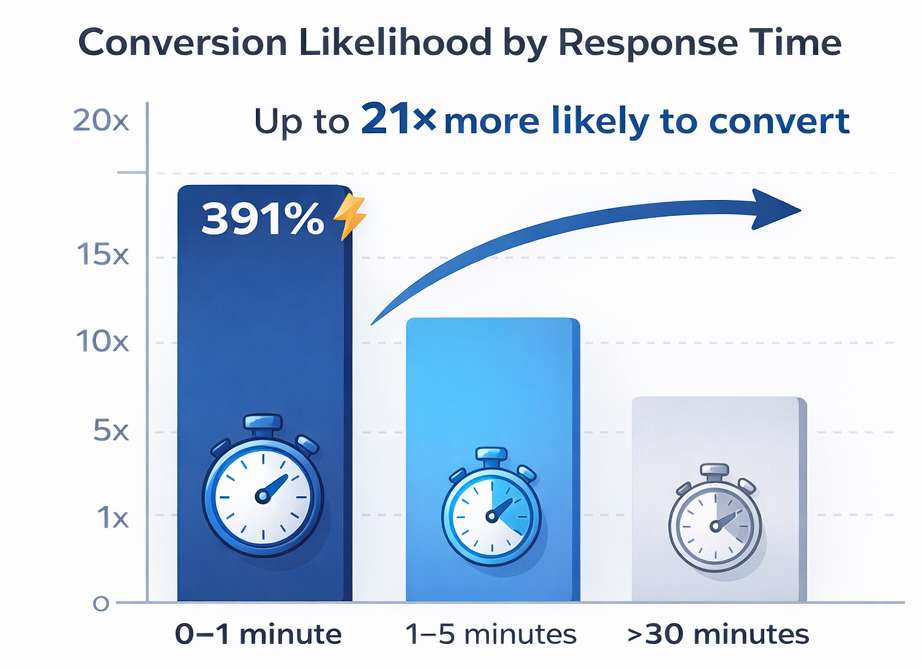
Faster responses dramatically increase conversion likelihood — leads contacted within five minutes are up to 21× more likely to convert than those contacted after 30+ minutes
Fast response times increase the perceived quality of leads and reduce rejection caused by lead decay.
5. Establish a Closed-Loop Feedback System
If sales rejects a lead, marketing must understand why.
Common rejection reasons include:
-
Outside target industry
-
Wrong company size
-
No budget or authority
-
Duplicate record
-
Existing customer
Categorizing and analyzing rejection reasons monthly allows marketing teams to refine targeting and scoring models.
Organizations with structured feedback loops improve marketing efficiency by up to 20% within a year.
6. Use Predictive and Behavioral Signals
Behavior-based scoring alone can inflate MQL volume without improving quality.
Enhance scoring models by incorporating:
-
Company growth signals
-
Hiring trends
-
Technology stack indicators
-
Funding announcements
-
Product comparison research behavior
Predictive data layers help identify accounts with higher probability of purchase, increasing sales confidence and acceptance rates.
7. Optimize Lead Volume vs. Lead Quality
High lead volume can overwhelm sales teams, leading to lower acceptance rates.
It is often more effective to:
-
Reduce MQL volume by tightening scoring thresholds
-
Prioritize ICP-matched accounts
-
Deliver fewer but higher-quality leads
Revenue-focused marketing organizations prioritize conversion efficiency over vanity metrics like total leads generated.
8. Conduct Regular Alignment Meetings
Weekly or biweekly alignment meetings between marketing and sales leadership help:
-
Review acceptance rate trends
-
Analyze rejected leads
-
Identify pattern gaps
-
Adjust targeting strategy
Companies with tightly aligned teams grow revenue up to 19% faster and achieve higher profitability than organizations with siloed functions.
Key Metrics to Monitor Alongside SAR
Improving SAR should not happen in isolation. Monitor:
-
MQL-to-SQL conversion rate
-
SQL-to-opportunity rate
-
Opportunity win rate
-
Cost per accepted lead
-
Revenue per MQL
A holistic view ensures that increasing acceptance rate also increases revenue impact.
Final Thoughts
Increasing sales acceptance rate is not about generating more leads. It is about generating the right leads.
The most effective organizations treat SAR as a shared accountability metric between marketing and sales. By improving qualification criteria, enhancing data quality, aligning on SLAs, and implementing structured feedback loops, companies can significantly increase pipeline efficiency without increasing acquisition costs.
Optimizing sales acceptance rate transforms marketing from a lead generator into a predictable revenue driver.
Recommended Reading
To further improve marketing-to-sales performance, explore these related articles: