Paid social campaigns can generate a high volume of leads, but volume does not always translate into revenue. Many organizations rely on Meta’s native optimization signals—such as form submissions or landing page conversions—to guide ad delivery. However, these signals rarely reflect the true quality of leads.
CRM systems contain a much richer picture of the buyer journey: engagement history, deal stage progression, customer lifetime value, and sales outcomes. By integrating CRM lead scoring data into campaign optimization workflows, marketing teams can shift their focus from generating more leads to generating better leads.
According to HubSpot research, only 27% of leads generated by marketing teams are actually qualified for sales. Meanwhile, companies that align marketing and sales data experience up to 36% higher customer retention rates and 38% higher win rates.
Understanding CRM Lead Scoring
Lead scoring is a methodology used to rank prospects according to their likelihood of becoming customers. Scores are typically calculated using behavioral signals, demographic information, and engagement data.
Common factors used in CRM lead scoring include:
-
Website behavior such as page visits or product interactions
-
Form submissions and content downloads
-
Company size, industry, or job title
-
Email engagement metrics
-
Sales team interactions
Modern CRMs often apply both rule‑based scoring models and predictive scoring powered by machine learning.
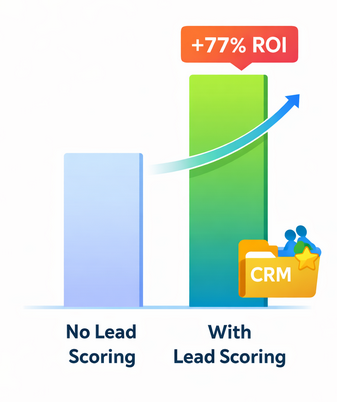
Lead scoring significantly improves marketing efficiency, with organizations reporting up to a 77% increase in lead generation ROI
Research from MarketingSherpa indicates that organizations using lead scoring experience a 77% improvement in lead generation ROI. The reason is straightforward: marketing teams spend less budget targeting low‑quality prospects and more budget attracting individuals who match their ideal customer profile.
Why Meta Campaign Optimization Needs CRM Data
Meta’s advertising platform optimizes campaigns using machine learning models trained on user behavior and conversion signals. These algorithms are extremely effective—but they depend entirely on the quality of the signals they receive.
If the platform only receives signals about form submissions or landing page visits, the algorithm will prioritize users who are most likely to perform those actions. Unfortunately, these users are not always the ones most likely to convert into customers.
A study by Forrester found that up to 60% of marketing leads never convert into sales due to poor qualification or lack of intent. Feeding CRM lead scoring signals into campaign optimization helps correct this problem by providing the algorithm with richer feedback.
Key Benefits of Integrating CRM Lead Scoring With Meta Campaigns
Improved Lead Quality
When campaign optimization uses CRM scores instead of raw lead volume, the system begins targeting audiences similar to your highest‑value prospects.
Organizations that use advanced lead qualification report up to 45% higher marketing ROI according to Gartner.
More Accurate Optimization Signals
Integrating CRM data ensures that optimization reflects actual sales outcomes rather than shallow engagement events.
This reduces the risk of campaigns optimizing toward users who convert cheaply but rarely become paying customers.
Better Budget Allocation
High‑quality signals allow Meta’s algorithms to identify profitable audiences faster. This can reduce wasted spend on low‑intent segments and accelerate the learning phase of campaigns.
According to Meta’s own performance benchmarks, campaigns with stronger event signals can improve cost per acquisition by 20–30%.
Stronger Marketing and Sales Alignment
Integrating CRM scoring creates a unified measurement framework. Both marketing and sales teams evaluate performance using the same definition of lead quality.
This alignment helps reduce friction between departments and ensures that campaign success is measured in terms of revenue impact.
Steps to Integrate CRM Lead Scoring With Meta Campaign Optimization
1. Define Lead Quality Criteria
Start by determining which CRM events represent meaningful business outcomes. These may include:
-
Sales qualified leads
-
Opportunity creation
-
Closed deals
-
High lifetime value customers
The more closely the signal reflects revenue generation, the more valuable it becomes for optimization.
2. Map CRM Events to Advertising Signals
The next step is translating CRM events into signals that can be used for campaign optimization.
For example, when a lead reaches a certain score threshold or moves to a qualified pipeline stage, that event can be sent back as a conversion signal.
This feedback loop allows campaign algorithms to learn which audience segments generate high‑quality prospects.
3. Segment Leads by Score
Rather than using a single threshold, many teams create multiple lead quality tiers. Examples might include:
-
High‑value leads
-
Medium‑quality leads
-
Low‑intent leads
Segmenting data provides more granular insights into which campaigns attract the most valuable prospects.
4. Use High‑Value Audiences for Optimization
Once CRM scoring data flows into campaign reporting, high‑value segments can be used to guide optimization strategies.
This may include:
-
Building lookalike audiences from high‑scoring leads
-
Optimizing campaigns toward high‑value conversion events
-
Excluding low‑score leads from retargeting segments
5. Continuously Refine the Scoring Model
Lead scoring models should evolve over time. As more conversion data becomes available, teams can adjust scoring weights and thresholds to better reflect real customer behavior.
Organizations that regularly refine their lead scoring frameworks report up to 20% higher marketing productivity according to Aberdeen Group.
Common Challenges and How to Overcome Them
Data Silos
Many organizations store marketing and sales data in separate systems. This prevents campaign optimization from using the full dataset.
The solution is creating automated data synchronization between CRM platforms and advertising tools.
Inconsistent Lead Definitions
Marketing teams often define a lead differently than sales teams. This inconsistency leads to misleading performance metrics.
Establishing a shared lead qualification framework helps eliminate these discrepancies.
Delayed Feedback Loops
Sales cycles can take weeks or months, meaning valuable optimization signals may arrive too late.
Using intermediate milestones—such as sales qualification or opportunity creation—helps provide earlier signals for campaign algorithms.
Measuring the Impact of CRM‑Driven Campaign Optimization
To evaluate the effectiveness of CRM lead scoring integration, marketers should monitor several key performance indicators:
-
Cost per qualified lead
-
Sales acceptance rate
-
Opportunity creation rate
-
Pipeline revenue generated from campaigns
Companies that integrate CRM and advertising data often see significant improvements across these metrics. According to Salesforce research, businesses with strong marketing‑sales alignment achieve 208% higher marketing revenue contribution.
Conclusion
Integrating CRM lead scoring with Meta campaign optimization fundamentally changes how advertising performance is measured and improved. Instead of optimizing campaigns for the cheapest leads, organizations begin optimizing for the most valuable customers.
This shift allows marketing teams to maximize the efficiency of their advertising budgets, improve collaboration with sales teams, and generate more predictable revenue outcomes.
As advertising platforms continue to rely on machine learning algorithms, the quality of the data signals feeding those systems becomes increasingly important. CRM lead scoring provides exactly the type of high‑value feedback needed to guide smarter campaign optimization strategies.