
Testing is at the core of modern performance marketing. Yet many teams struggle not because they test too little, but because they test the wrong things. Limited budgets, traffic constraints, and execution time mean every experiment must justify its place in the roadmap. Prioritizing tests that matter helps teams learn faster, reduce wasted spend, and turn insights into scalable growth.
Why Test Prioritization Is Critical
Not all tests are created equal. Changing a button color and testing a new audience strategy both count as “tests,” but their potential impact is vastly different.
According to industry benchmarks, only around 20–25% of A/B tests produce statistically significant lifts. The rest consume budget and time without changing outcomes. Teams that rank and filter experiments before launch consistently report faster performance improvements and clearer insights.
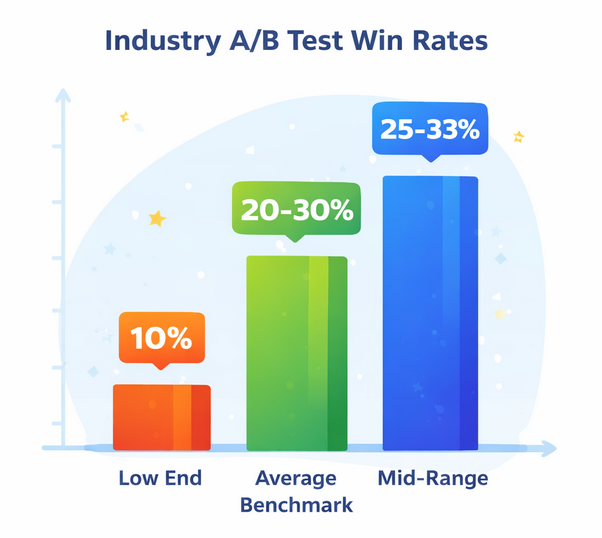
Industry benchmarks indicate that only a small portion of A/B tests produce statistically significant improvements—highlighting the need to prioritize tests with high potential impact
When tests are prioritized correctly:
-
Budget is concentrated on high-impact hypotheses
-
Learning cycles become shorter
-
Results are easier to interpret and scale
Start With Business Impact, Not Curiosity
The first filter for any test should be its potential business impact. Ask one question: If this test wins, what changes?
High-priority tests directly influence core metrics such as cost per acquisition, conversion rate, or lifetime value. Lower-priority tests may be interesting, but they rarely justify immediate execution.

Most businesses see conversion improvements from A/B testing, and statistically significant tests can deliver substantial conversion rate lifts
A practical way to frame impact:
-
High impact: Audience selection, offer structure, pricing, funnel steps
-
Medium impact: Creative concepts, messaging angles, formats
-
Low impact: Minor design tweaks, micro-copy changes
Industry data shows that audience and offer-related tests account for more than 60% of meaningful performance gains in paid media experiments, while cosmetic changes rarely exceed single-digit improvements.
Use a Simple Scoring Model
To avoid subjective decisions, apply a lightweight scoring framework. One of the most effective models evaluates each test across three dimensions:
-
Impact – Expected effect on key metrics
-
Confidence – Strength of data or insight behind the hypothesis
-
Effort – Time and resources required to run the test
Each dimension can be scored on a scale from 1 to 5. Tests with the highest combined score move to the top of the roadmap.
Teams that adopt structured scoring models report up to 30% faster test execution cycles, largely because decision-making friction is reduced.
Prioritize Tests With Clear Learning Value
A test that fails can still be valuable—if it teaches something meaningful. Prioritize experiments that answer strategic questions, not just tactical ones.
Examples of high learning value tests:
-
Identifying which audience segments respond to different value propositions
-
Understanding which funnel stage creates the biggest drop-off
-
Comparing intent-based versus interest-based targeting approaches
Avoid tests where the outcome does not influence future decisions. If a result won’t change what you do next, it should not be a priority.
Sequence Tests to Build on Each Other
Effective testing roadmaps are sequential, not random. Each experiment should inform the next.
For example:
-
Start by validating the strongest audience or traffic source
-
Then test messaging and creative within that audience
-
Finally, optimize landing pages or conversion paths
Data from performance teams shows that sequenced testing strategies can improve overall campaign efficiency by 15–25% compared to running unrelated experiments in parallel.
Know When Not to Test
Sometimes the smartest decision is not to test at all. If traffic volume is too low or external conditions are unstable, results may be misleading.
As a general rule:
-
Avoid testing when weekly conversions are below statistical thresholds
-
Pause tests during major seasonal or budget shifts
-
Don’t test multiple major variables at the same time
Clear prioritization includes knowing when to wait.
Turning Priorities Into a Testing Culture
Prioritization is not a one-time exercise. High-performing teams revisit their test backlog regularly, removing outdated ideas and adding new hypotheses based on fresh data.
Maintaining a living testing roadmap ensures focus stays on experiments that matter most, even as markets and platforms evolve.
Further Reading
To deepen your understanding of structured experimentation and optimization, you may find these related articles helpful:
Conclusion
Prioritizing tests that matter is less about running more experiments and more about running the right ones. By focusing on business impact, using structured scoring, and sequencing tests strategically, teams can turn experimentation into a reliable growth engine rather than a guessing game.