
Stable campaigns are the backbone of consistent marketing performance. However, structural changes—such as reorganizing ad sets, modifying audience definitions, or adjusting campaign objectives—can disrupt algorithmic learning and lead to performance volatility. According to industry data, significant changes to campaign structure can temporarily reduce performance efficiency by up to 20–40% during the relearning phase.
Understanding how to implement changes without destabilizing results is critical for maintaining ROI and avoiding unnecessary setbacks.
Why Structural Changes Can Harm Performance
Advertising platforms rely heavily on historical data and machine learning. When you make substantial changes, the system often resets its learning phase. This can lead to:
-
Increased cost per acquisition (CPA)
-
Lower click-through rates (CTR)
-
Reduced conversion volume
Research shows that campaigns entering a new learning phase may require 3–7 days to stabilize, depending on traffic volume and budget levels.
Key Strategies to Protect Stable Campaigns
1. Avoid Making Multiple Changes at Once
Implement changes incrementally. Altering budget, audience, and creatives simultaneously makes it difficult for algorithms to adapt effectively.
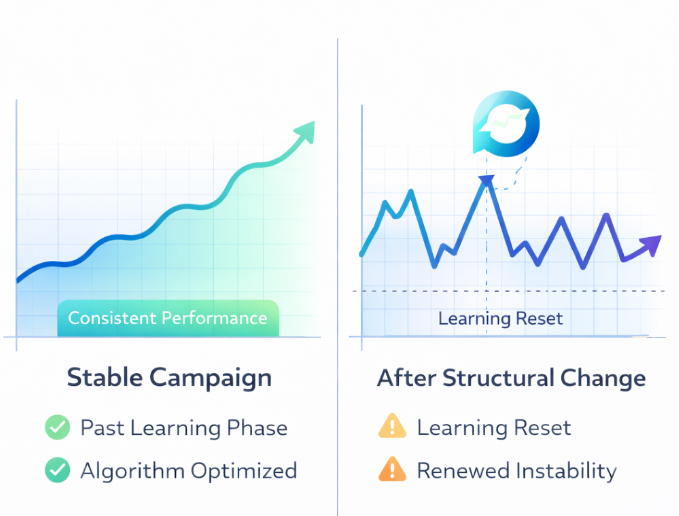
Major campaign changes can reset algorithmic learning, causing performance volatility and delayed optimization
Best practice: Introduce one variable change at a time and monitor results for at least 48–72 hours.
2. Duplicate Instead of Editing Core Campaigns
Instead of modifying a high-performing campaign directly, create a duplicate and apply changes to the new version. This preserves the original campaign’s stability while allowing controlled testing.
Statistic: A/B testing through duplication can improve decision accuracy by up to 30% compared to direct edits.
3. Maintain Budget Stability
Large budget fluctuations can destabilize performance. Sudden increases or decreases may trigger relearning.
Guideline: Adjust budgets gradually—no more than 15–20% per day.
4. Preserve High-Performing Audiences
Audience changes are one of the most impactful structural modifications. Removing or significantly altering proven segments can reduce conversion efficiency.
Tip: Keep top-performing audiences active while testing new segments in parallel.
5. Monitor Key Metrics Closely
After any structural adjustment, closely track:
-
CPA
-
CTR
-
Conversion rate
-
Frequency
Early detection of negative trends allows for quick corrective action.
6. Use Controlled Testing Frameworks
Implement structured experiments rather than ad hoc changes. Controlled testing minimizes risk and provides clearer insights.
Insight: Marketers using structured testing frameworks report up to 25% faster optimization cycles.
7. Respect the Learning Phase
Avoid judging performance too quickly. Algorithms need sufficient data to optimize delivery.
Benchmark: Most campaigns require at least 50 conversions per week to exit the learning phase effectively.
Common Mistakes to Avoid
-
Pausing campaigns too early during temporary fluctuations
-
Overreacting to short-term performance dips
-
Changing multiple variables simultaneously
-
Ignoring historical performance data
These mistakes can compound instability and extend recovery time.
Practical Workflow for Safe Changes
-
Identify the goal of the structural change
-
Duplicate the existing campaign
-
Apply a single controlled modification
-
Run both versions in parallel
-
Compare performance over a defined period
-
Scale the winning variation gradually
This workflow ensures minimal disruption while enabling continuous improvement.
Conclusion
Protecting stable campaigns during structural changes requires a disciplined, data-driven approach. By implementing incremental adjustments, preserving high-performing elements, and allowing sufficient time for learning, marketers can minimize risk and maintain consistent results.
Strategic patience and structured testing are the keys to evolving campaign performance without sacrificing stability.
Further Reading