
Campaign volatility refers to the degree of fluctuation in key performance metrics such as cost per click (CPC), cost per acquisition (CPA), conversion rates, and return on ad spend (ROAS). In stable markets, these metrics tend to remain relatively predictable. However, as competition increases, volatility becomes a defining characteristic of campaign performance.
Understanding the drivers behind this volatility is critical for maintaining consistent outcomes and optimizing marketing strategies under pressure.
Increased Auction Pressure
In digital advertising ecosystems, most platforms operate on auction-based pricing models. As more advertisers compete for the same audience segments, bid pressure intensifies.
-
According to industry benchmarks, CPCs can increase by 20%–50% in highly competitive verticals.
-
During peak seasons, some industries experience CPC spikes of over 100% within short timeframes.
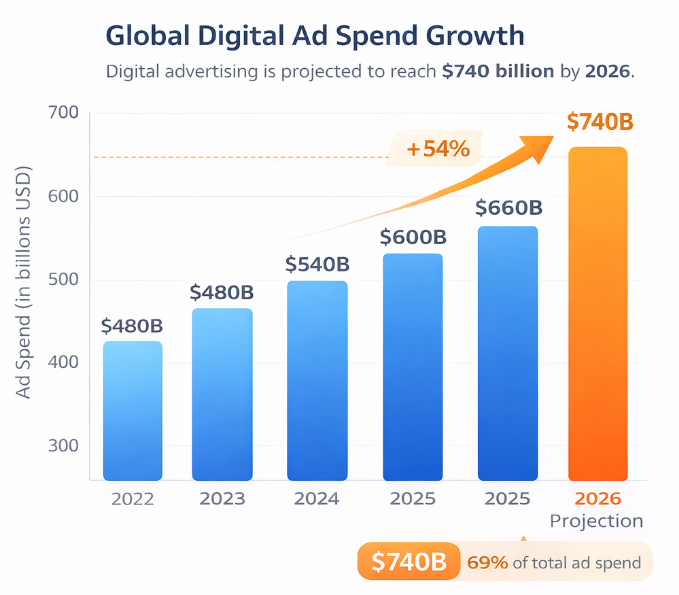
Rising global ad spend intensifies competition, increasing pressure on auction-based pricing systems
This increased competition leads to rapid cost fluctuations, making it harder to maintain stable acquisition costs.
Audience Saturation and Overlap
As more companies target similar audiences, overlap becomes inevitable. This leads to several consequences:
-
Higher frequency exposure, which can reduce engagement over time
-
Increased competition for identical user segments
-
Diminishing returns from previously high-performing audiences
Studies show that audience overlap in competitive industries can exceed 30%–40%, significantly impacting performance consistency.
Algorithmic Instability
Advertising platforms rely heavily on machine learning algorithms to optimize delivery. In competitive environments, these algorithms must constantly adapt to:
-
Changing bid landscapes
-
Shifts in user behavior
-
Competitor strategy adjustments
Frequent changes in these inputs cause learning phases to reset more often, resulting in performance swings. Campaigns may experience sudden drops or spikes as algorithms recalibrate.
Creative Fatigue Acceleration
In saturated markets, users are exposed to a higher volume of ads, which accelerates creative fatigue.
-
Engagement rates can decline by up to 25% within the first 7–10 days in competitive niches
-
Click-through rates (CTR) often drop sharply when users repeatedly see similar messaging
This forces advertisers to refresh creatives more frequently, adding another layer of variability to campaign performance.
Budget Fragmentation
As competition increases, advertisers often diversify budgets across multiple campaigns, audiences, and platforms to maintain reach. While this strategy can mitigate risk, it also introduces volatility:
-
Smaller budget allocations reduce data stability
-
Learning phases take longer due to limited signal volume
-
Performance becomes less predictable across segments
External Market Dynamics
Competitive markets are more sensitive to external factors such as:
-
Seasonal demand spikes
-
Economic shifts
-
Industry-specific trends
For example, during major shopping periods, conversion rates may increase while acquisition costs simultaneously rise due to heightened competition.
Strategic Implications
Understanding volatility is not just about identifying problems—it is about adapting strategies accordingly. In competitive markets, success depends on flexibility and responsiveness rather than rigid optimization frameworks.
Marketers must anticipate fluctuations and build systems capable of adjusting quickly to maintain efficiency.
Conclusion
Campaign volatility is a natural outcome of increased competition. Auction pressure, audience overlap, algorithmic shifts, creative fatigue, and external market dynamics all contribute to rapid changes in performance metrics.
Rather than attempting to eliminate volatility, marketers should focus on managing it through adaptive strategies and continuous monitoring.
Recommended Reading