Lead fraud is no longer a marginal issue. It directly impacts ROI, sales productivity, and forecasting accuracy.
-
Studies estimate that invalid traffic (IVT) accounts for over $80 billion in digital ad losses globally each year.
-
In some high-volume lead generation verticals, 10–30% of submitted leads may be fraudulent or low-intent.
-
Sales teams report that up to 25% of contacted inbound leads provide false phone numbers or disconnected lines.
-
Paid social and display campaigns are particularly vulnerable due to automated form fills and bot-driven submissions.
The financial damage extends beyond wasted ad spend. Fraudulent leads:
-
Inflate customer acquisition cost (CAC)
-
Reduce sales team efficiency
-
Distort attribution models
-
Corrupt CRM data quality
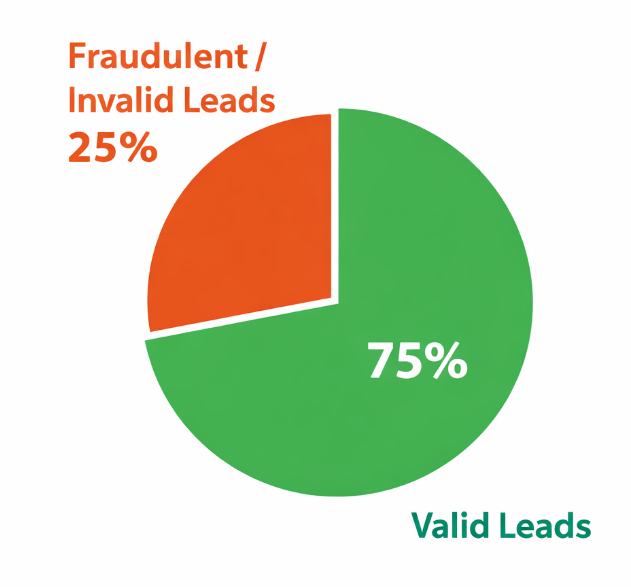
Estimated proportion of lead generation traffic that is fraudulent and invalid in paid campaigns
Without proper controls, scaling paid campaigns often amplifies the fraud problem.
Common Types of Lead Fraud in Paid Campaigns
Understanding how fraud occurs is essential for mitigation.
1. Bot-Generated Form Submissions
Automated scripts complete landing page forms using fabricated data. These submissions often pass basic validation checks and mimic human behavior.
2. Incentivized or Arbitrage Traffic
Some traffic sources use low-quality publishers or incentivized users to generate leads. These users submit forms solely for rewards, with no purchase intent.
3. Click Farms and Manual Fake Entries
Human operators are paid to complete forms at scale, often rotating IP addresses and devices to avoid detection.
4. Competitor or Malicious Spam
In competitive markets, fraudulent submissions may be generated deliberately to exhaust budgets or overload sales teams.
Warning Signs Your Campaigns May Have a Fraud Problem
Marketers should monitor key indicators that signal lead quality degradation:
-
Sudden spikes in lead volume without proportional engagement
-
High bounce rates from paid traffic sources
-
Identical email patterns or naming structures
-
Invalid or unreachable phone numbers exceeding 15–20%
-
Short form completion times that are statistically improbable
-
Mismatch between ad geography targeting and lead IP location
If conversion rates increase while downstream sales performance declines, fraud may be the root cause.
Strategies to Reduce Lead Fraud
1. Strengthen Form-Level Validation
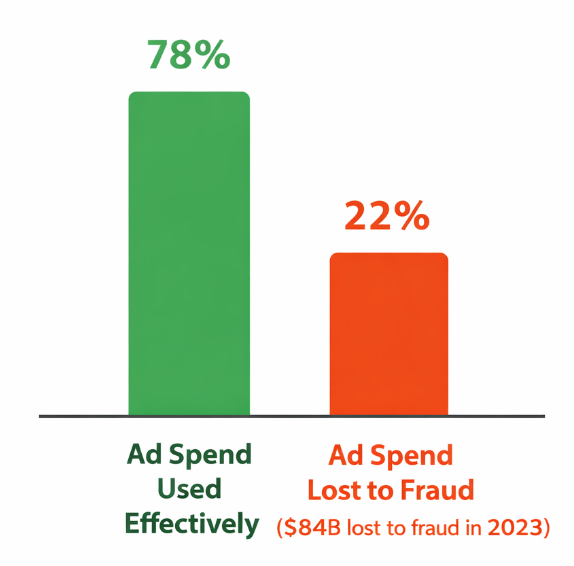
Estimated share of total digital advertising spend lost to fraud versus used effectively
Implement multi-layer validation:
-
Real-time email verification
-
Phone number validation with carrier lookup
-
IP reputation screening
-
Device fingerprinting
-
CAPTCHA or invisible bot detection tools
Advanced behavioral analytics can flag abnormal typing speed, cursor patterns, and submission timing.
2. Audit Traffic Sources Aggressively
Not all traffic is equal.
-
Segment campaigns by source and compare close rates, not just CPL.
-
Eliminate placements that generate high submission rates but low contact rates.
-
Monitor geographic inconsistencies.
-
Use server-side tracking to reduce spoofed attribution.
Fraud often concentrates in specific publishers, sub-IDs, or placements.
3. Score Leads Before Sending to Sales
Implement automated lead scoring that incorporates:
-
Behavioral signals (time on page, scroll depth)
-
Data completeness and consistency
-
Email domain analysis
-
Historical conversion patterns
Only route high-confidence leads to sales representatives. This preserves team efficiency and morale.
4. Apply Post-Submission Verification Workflows
A simple but effective control is double opt-in confirmation:
-
SMS confirmation codes
-
Email verification links
-
Automated validation calls
While this may slightly reduce top-line lead volume, it significantly improves qualified lead rates.
5. Monitor Downstream Performance Metrics
Lead fraud cannot be measured solely at the form submission stage.
Track:
-
Contact rate
-
Meeting booking rate
-
Opportunity creation rate
-
Revenue per lead by source
When 20% of leads generate 80% of revenue, granular source-level evaluation becomes mandatory.
Balancing Protection with Growth
Overly aggressive filters may block legitimate prospects. The objective is precision, not restriction.
A sustainable anti-fraud strategy combines:
-
Preventive validation
-
Ongoing traffic audits
-
Data enrichment and scoring
-
Continuous performance monitoring
Campaign scaling should follow demonstrated lead quality stability, not just volume growth.
Final Thoughts
As paid acquisition costs rise year over year, reducing lead fraud is no longer optional. Even a 10% improvement in lead validity can materially reduce customer acquisition cost and increase sales productivity.
Organizations that treat lead quality as a measurable performance metric — rather than a downstream sales issue — consistently outperform competitors in both efficiency and revenue predictability.
Recommended Reading
By implementing systematic validation, source transparency, and behavioral analysis, marketers can protect paid budgets and ensure that growth is built on genuine opportunity rather than artificial volume.