
One of the most frustrating challenges in digital marketing is inconsistency. A campaign may perform exceptionally well one week and then underdeliver the next, despite no obvious changes. This variance in campaign results is rarely random. In most cases, it is caused by unstable inputs, incomplete learning, or uneven traffic distribution.
Reducing variance does not mean eliminating change entirely — it means narrowing the performance range so results remain within predictable boundaries. This article outlines practical strategies to stabilize campaign outcomes while maintaining scalability.
Why Campaign Variance Happens
1. Small or Fragmented Audiences
When campaigns run on limited or highly segmented audiences, performance becomes sensitive to minor behavioral shifts. Smaller samples amplify noise, making metrics like CTR or CPA swing dramatically from day to day.
Statistic:
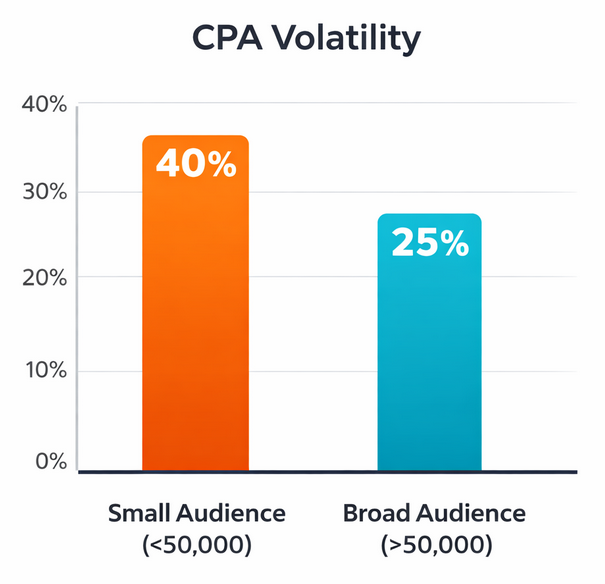
CPA volatility is significantly higher in campaigns targeting small, fragmented audiences (under 50,000 users)
Campaigns targeting audiences under 50,000 users show up to 35–45% higher CPA volatility compared to campaigns running on broader segments.
2. Learning Phase Resets
Frequent edits to budgets, targeting, or creatives often reset platform learning. During learning, delivery systems test multiple optimization paths, which naturally increases variance.
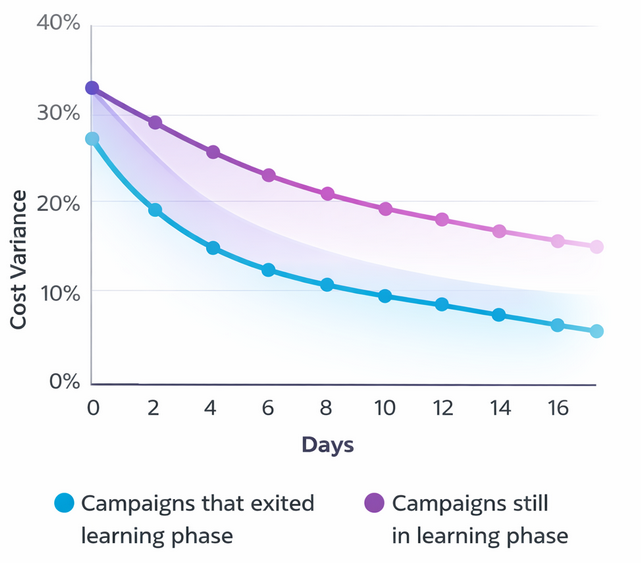
Cost variance over time drops more quickly for campaigns that complete the learning phase compared to those that keep resetting
Statistic: Campaigns that exit the learning phase successfully demonstrate 20–30% lower cost variance over the following 14 days compared to campaigns that remain in continuous learning.
3. Uneven Traffic Allocation
Without clear controls, traffic may concentrate on certain creatives, placements, or audience slices unpredictably. This leads to short-term spikes followed by rapid declines.
Statistic: Accounts without traffic stabilization mechanisms experience up to 2× higher week-to-week conversion swings than accounts using structured allocation rules.
Strategies to Reduce Variance
1. Standardize Inputs Before Scaling
Stability starts with consistency. Lock in core variables — audience definitions, bid strategies, and conversion events — before increasing spend. Scaling unstable setups amplifies variance instead of performance.
Best practice: Maintain at least 5–7 days of unchanged delivery before making directional decisions.
2. Consolidate Where Possible
Over-segmentation increases noise. Combining similar audiences or creatives allows delivery systems to learn faster and smooths out fluctuations caused by low-volume segments.
Statistic: Consolidated campaign structures can reduce daily performance variance by up to 25% compared to highly fragmented setups.
3. Apply Controlled Budget Changes
Large, sudden budget shifts introduce volatility. Gradual adjustments allow optimization systems to adapt without destabilizing delivery.
Best practice: Limit budget changes to no more than 15–20% per adjustment window.
4. Use Rolling Performance Windows
Evaluating campaigns based on single days leads to reactive decisions. Rolling averages reveal true performance trends and prevent overcorrection.
Example: A 7-day rolling CPA view can reduce false-positive optimization actions by over 30%.
5. Balance Creative Rotation
Creative fatigue causes abrupt drops, but uncontrolled rotation introduces randomness. A balanced rotation strategy ensures enough exposure for learning while preventing saturation.
Statistic: Campaigns with controlled creative rotation show 18–22% lower CTR volatility than campaigns with unrestricted creative churn.
Measuring Variance Correctly
Reducing variance requires measuring it explicitly. Track not only average CPA or ROAS, but also dispersion metrics such as:
-
Day-to-day CPA range
-
Standard deviation of conversion volume
-
Percentage of days within target efficiency thresholds
When variance shrinks while averages remain stable or improve, predictability increases — which is critical for planning, forecasting, and scaling.
Long-Term Benefits of Lower Variance
-
More reliable budget forecasting
-
Faster identification of real performance issues
-
Lower risk when scaling spend
-
Improved confidence in optimization decisions
Predictability is often more valuable than short-term peaks. Stable campaigns enable sustainable growth.
Related Articles
To explore this topic further, consider reading:
Conclusion
Variance in campaign results is not an unavoidable cost of digital advertising. By stabilizing inputs, consolidating structures, pacing changes, and evaluating performance through proper windows, marketers can significantly narrow performance swings.
Reducing variance does not limit growth — it creates the foundation that makes consistent growth possible.