Most campaigns generate valuable insights—about audiences, creatives, timing, and offers. Yet many teams treat each new campaign as a fresh start, repeating tests that were already run and relearning lessons that were already paid for. Reusing learnings across campaigns is one of the most effective ways to improve efficiency and scale results without increasing budgets.
This article breaks down how to identify reusable insights, structure them for future use, and apply them systematically across new campaigns.
Why Reusing Learnings Matters
Digital advertising platforms reward efficiency. Campaigns that reach stability faster tend to achieve better delivery and lower costs over time. When learnings are reused intentionally, teams reduce the number of variables they need to test from scratch.
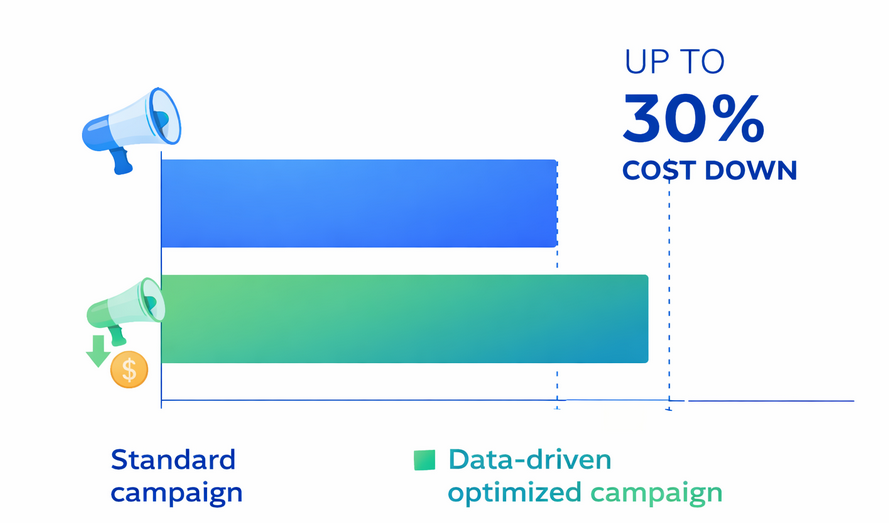
Comparing average campaign costs: traditional approach vs optimized data-driven campaigns showing up to 30% cost reduction
Industry benchmarks highlight the impact:
-
Campaigns that exit the learning phase faster can see cost-per-result reductions of 15–25% compared to campaigns that restart learning repeatedly.
-
Advertisers who standardize creative and audience insights across campaigns report up to 30% shorter testing cycles.
Reusing learnings is not about copying campaigns—it is about transferring proven components into new contexts.
Identify Learnings That Are Actually Reusable
Not every result is worth reusing. Focus on insights that are consistent, repeatable, and explain why performance changed.
High-Value Learnings to Capture
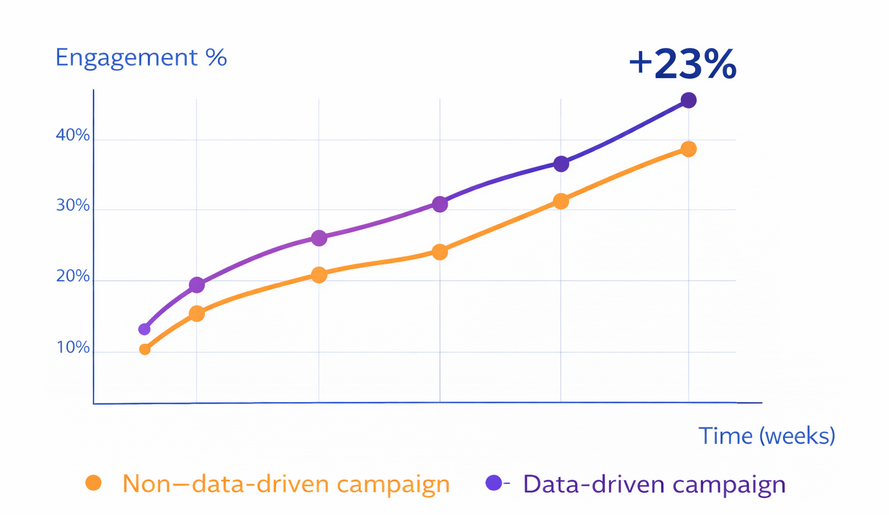
Engagement trends over time showing a 23% higher engagement rate for data-driven campaigns versus non-data-driven
-
Audience behavior patterns
-
Which audience segments consistently convert at a lower cost?
-
Which audience sizes show stable performance versus volatility?
-
-
Creative signals
-
Messaging angles that outperform others across multiple campaigns
-
Visual formats that consistently generate higher click-through rates
-
-
Funnel timing and sequencing
-
How long users typically take to convert
-
Which retargeting windows produce the highest return
-
A useful rule of thumb: if a pattern appears in at least two separate campaigns or time periods, it is worth documenting.
Turn Insights Into Reusable Assets
Insights lose value when they remain trapped in dashboards. To reuse learnings, they must be converted into assets or rules that can be deployed again.
Examples of Reusable Assets
-
Audience frameworks: documented ranges for effective audience sizes, similarity levels, or engagement depth
-
Creative briefs: repeatable structures for headlines, hooks, and calls to action that already proved effective
-
Testing templates: predefined testing matrices that reflect past wins and failures
Marketers who use structured templates instead of ad-hoc testing reduce redundant experiments and improve comparability between campaigns.
Apply Learnings at the Right Level
One common mistake is applying learnings too narrowly. Effective reuse happens at multiple levels.
Strategic Level
-
Use past conversion data to guide which campaign objectives to prioritize
-
Apply proven funnel structures instead of rebuilding journeys from scratch
Tactical Level
-
Launch new campaigns with previously validated creatives as controls
-
Start with audience segments that historically delivered stable results before expanding
Operational Level
-
Standardize naming conventions and reporting formats so learnings are easy to compare
-
Document failed tests as clearly as successful ones
According to internal marketing studies, nearly 40% of repeated ad tests fail because teams did not track prior negative results.
Avoid the “Copy-Paste” Trap
Reusing learnings does not mean cloning campaigns wholesale. Market conditions, competition, and creative fatigue change over time.
Instead:
-
Reuse the logic, not the execution
-
Treat past winners as baselines, not guarantees
-
Retest assumptions periodically with controlled experiments
This approach preserves efficiency while still allowing adaptation.
Measure Whether Reuse Is Working
To confirm that learnings are being applied effectively, track meta-level metrics—not just individual campaign performance.
Key indicators include:
-
Time to first stable results
-
Percentage of campaigns that reach target cost-per-result
-
Reduction in total tests required per launch
Teams that actively reuse learnings often see more predictable outcomes and smoother scaling curves.
Build a Continuous Learning Loop
The most successful advertisers treat every campaign as both a revenue driver and a learning system. Each launch feeds the next one.
A simple loop looks like this:
-
Launch with proven components
-
Test only what is new or uncertain
-
Document outcomes clearly
-
Feed insights into the next campaign
Over time, this compounding effect becomes a competitive advantage.
Further Reading
To deepen your understanding of systematic campaign optimization, consider exploring these related articles: