Many teams associate scaling with higher budgets, faster launches, and broader targeting. While this can generate short-term volume, it often introduces hidden risks:
-
Budget increases amplify existing inefficiencies
-
Larger audiences reduce relevance and conversion rates
-
Rapid changes make it harder to diagnose performance drops
According to industry benchmarks, nearly 65% of performance drops during scale phases are caused by scaling unvalidated tactics rather than external market factors.
Scale What Is Proven, Not What Is New
The safest way to grow is to expand strategies that already show consistent results.
Before increasing spend, ensure that:
-
Campaigns are profitable across multiple weeks
-
Results remain stable at different budget levels
-
Performance holds across more than one audience segment
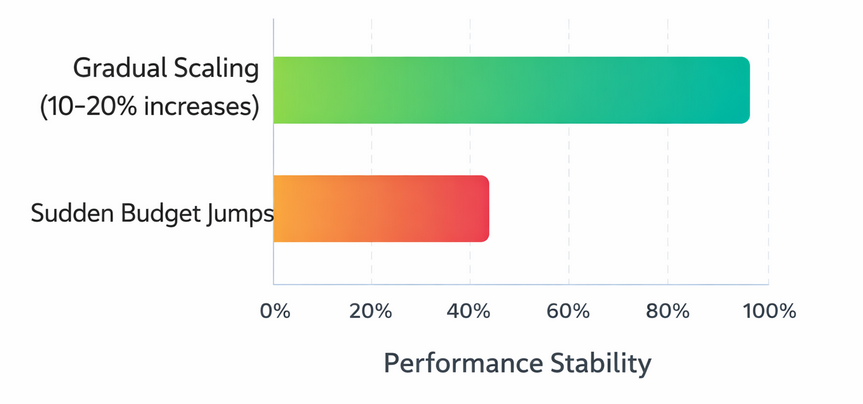
Performance Stability by Scaling Approach: Gradual increases lead to stronger and more reliable results than abrupt budget expansions
Data from large-scale advertising accounts shows that campaigns scaled gradually (10–20% budget increases) are up to 30% more likely to maintain efficiency compared to sudden budget jumps.
Use Controlled Budget Expansion
Instead of doubling budgets, apply incremental growth:
-
Increase budgets in small, predictable steps
-
Allow enough time for algorithms to stabilize
-
Monitor cost per result and frequency after every change
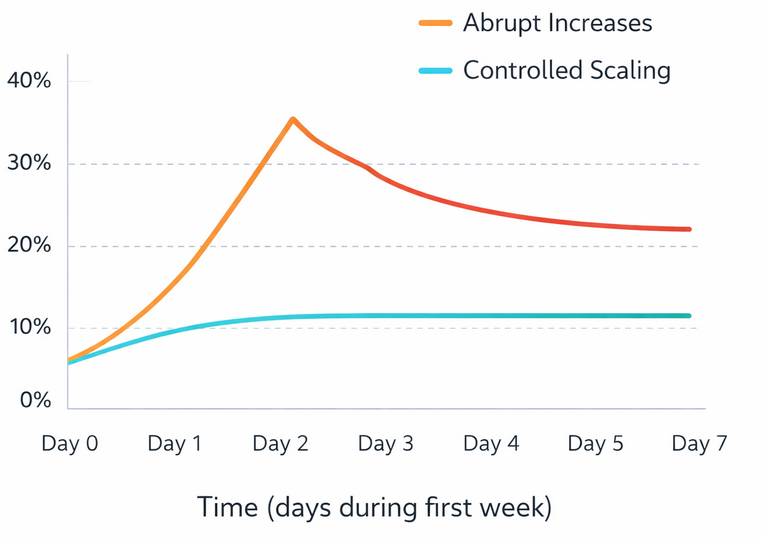
Cost per acquisition trends over the first week: controlled budget scaling keeps cost changes minimal, while abrupt increases cause larger spikes
Studies indicate that abrupt budget increases can raise cost per acquisition by 20–40% within the first week, while controlled scaling keeps cost fluctuations below 10%.
Diversify Before You Maximize
Scaling safely means spreading exposure, not concentrating it.
Risk increases when:
-
One campaign or audience drives most revenue
-
A single creative format dominates spend
-
One traffic source accounts for the majority of conversions
High-performing advertisers typically ensure that no single campaign exceeds 30–35% of total spend, reducing the impact of sudden performance shifts.
Let Data, Not Assumptions, Guide Decisions
Scaling introduces noise. Without clear benchmarks, teams often react too late or overcorrect.
Key metrics to track during scale:
-
Cost per result trends, not daily spikes
-
Conversion rate consistency
-
Frequency and audience saturation
Analysis of mature ad accounts shows that teams using predefined scale thresholds reduce failed scaling attempts by nearly 25%.
Automate Guardrails, Not Decisions
Automation should protect performance, not blindly push growth.
Effective guardrails include:
-
Spend caps based on efficiency ranges
-
Alerts for sudden cost increases
-
Automated pauses when thresholds are exceeded
Advertisers using automated safeguards report up to 40% fewer budget losses during aggressive growth phases.
Scaling Is a Process, Not a Moment
The most stable growth curves come from patience and repetition, not acceleration.
Successful scaling follows a loop:
-
Validate performance
-
Increase exposure gradually
-
Monitor impact
-
Reinforce what holds
-
Pull back what weakens
This approach allows growth while keeping downside risk controlled and measurable.
Recommended Reading
To deepen your understanding of safe and sustainable growth, explore these related articles:
Final Thoughts
Scaling without increasing risk is not about avoiding growth. It is about respecting data, protecting efficiency, and building systems that allow expansion without breaking what already works. When growth is treated as a structured process, scale becomes predictable rather than dangerous.