Instagram has over 2 billion monthly active users globally. More importantly for product launches, 90% of users follow at least one business account, and approximately 50% report visiting a website to purchase a product after seeing it in Stories. These behaviors make Instagram follower audiences one of the most commercially responsive segments available to marketers.
Follower audiences are powerful because they are:
-
Interest-qualified
-
Algorithmically engaged
-
Socially validated
-
Retargeting-compatible
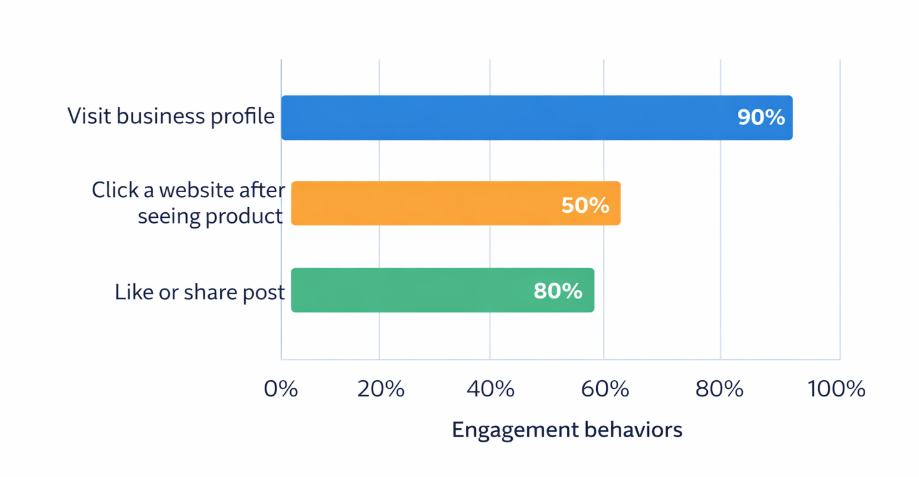
User engagement behaviors on Instagram: product discovery leads to action — illustrating why follower audiences are high-value segments
Unlike cold prospecting audiences, follower-based segments represent individuals who have already expressed topical or brand interest. During a launch window, this significantly increases conversion probability and shortens the path to purchase.
Types of Instagram Follower Audiences to Use
1. Your Own Followers
Your existing followers are your highest-priority launch audience. They have already opted into your content and brand positioning.
Key launch actions:
-
Teaser campaigns 2–3 weeks before launch
-
Countdown and reminder sequences
-
Exclusive early-access offers
-
Limited-time bonuses for followers
Brands that leverage warm audiences during launch phases typically see 2–5x higher conversion rates compared to cold audiences.
2. Competitor Follower Audiences
Targeting followers of competing brands allows you to intercept demand at the awareness or consideration stage. This is especially effective in saturated categories.
Industry research shows that 63% of consumers compare at least two brands before making a purchase decision. Competitor follower targeting positions your offer directly in that evaluation window.
Strategic considerations:
-
Identify competitors with similar pricing and positioning
-
Segment by niche-specific accounts
-
Exclude your own followers to avoid overlap
3. Influencer Follower Segments
Influencer audiences are valuable for new product launches because they combine trust and topical relevance.
Micro-influencers (10K–100K followers) often deliver engagement rates between 3% and 7%, significantly higher than macro accounts. When launching a new product, combining influencer collaborations with paid follower targeting creates both social proof and scalable reach.
Structuring a Launch Campaign Using Follower Audiences
Phase 1: Pre-Launch Warm-Up (Weeks -3 to -1)
Objectives:
-
Build anticipation
-
Collect emails or waitlist sign-ups
-
Test messaging
Recommended audience mix:
-
60% own followers
-
25% competitor followers
-
15% influencer followers
Focus on engagement metrics during this phase: video completion rate, saves, profile visits.
Phase 2: Launch Week Acceleration
Objectives:
-
Drive traffic and conversions
-
Create urgency
-
Amplify social proof
During launch week, retarget:
-
Profile visitors
-
Video viewers (50%+ watch time)
-
Website visitors
Instagram ads retargeting engaged audiences can reduce cost per acquisition by up to 30–50% compared to cold traffic.
Phase 3: Post-Launch Optimization
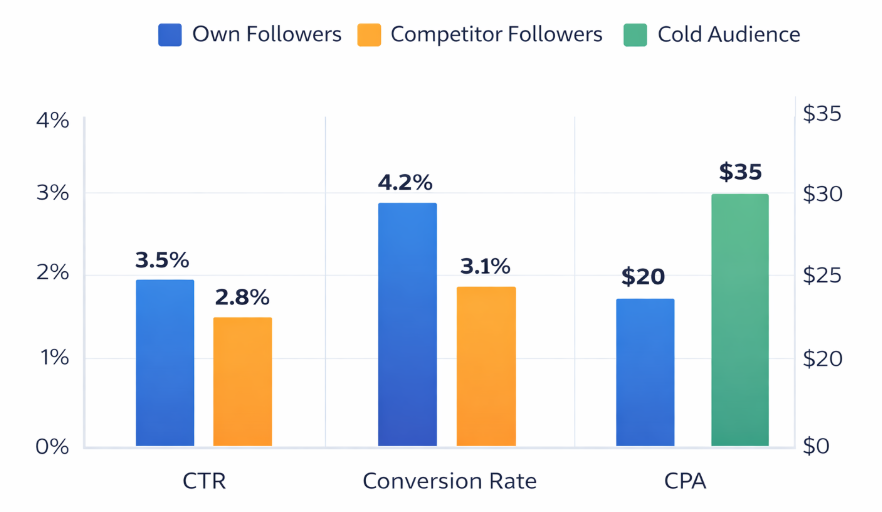
Performance comparison by audience type — showing how warm follower audiences outperform cold audiences in launch campaigns
Objectives:
-
Scale winners
-
Build lookalike audiences
-
Retain new customers
Export engaged segments and create expansion audiences based on:
-
Purchasers
-
Add-to-cart users
-
High-engagement followers
This ensures sustained growth beyond the initial launch spike.
Using Data to Refine Audience Quality
Follower audiences are not equally valuable. Advanced filtering significantly improves results.
Consider filtering by:
-
Geographic location
-
Industry relevance
-
Account activity level
-
Business vs. personal accounts
Inactive or bot-heavy audiences can dilute launch performance. Removing low-quality accounts increases CTR and reduces wasted spend.
On average, highly segmented Instagram audiences deliver:
-
20–40% higher click-through rates
-
15–25% lower cost per lead
-
Stronger ROAS during launch campaigns
Creative Strategy for Follower-Based Launches
Audience quality alone does not guarantee performance. Creative alignment is critical.
Effective launch creatives for follower audiences include:
-
Behind-the-scenes development content
-
Founder-led announcements
-
Problem-solution narratives
-
Testimonials and early access reviews
Instagram users spend an average of 29 minutes per day on the platform. High-retention video and short-form storytelling are particularly effective during product introductions.
Common Mistakes to Avoid
-
Launching to cold audiences only
-
Ignoring competitor follower targeting
-
Failing to retarget engaged viewers
-
Not cleaning follower data before campaign activation
-
Overlooking influencer follower segments
A launch without structured audience segmentation often results in inflated ad spend and inconsistent conversion rates.
Measuring Launch Success
Key metrics to monitor:
-
Cost per acquisition (CPA)
-
Conversion rate
-
Return on ad spend (ROAS)
-
Engagement rate
-
Click-through rate (CTR)
For most eCommerce launches, a healthy benchmark includes:
-
CTR above 1.5%
-
Conversion rate between 2% and 5%
-
ROAS above 2.5x during launch week
Performance should be evaluated separately for each follower segment to identify scaling opportunities.
Conclusion
Instagram follower audiences provide a high-intent, data-rich foundation for product launches. By combining owned followers, competitor audiences, and influencer segments, brands can reduce acquisition costs, accelerate traction, and create stronger early momentum.
When supported by segmentation, retargeting, and creative alignment, follower-based strategies consistently outperform broad targeting approaches in competitive markets.