In most marketing frameworks, warm traffic—users who have previously interacted with your brand—is expected to convert better than cold traffic. After all, familiarity reduces friction, builds trust, and shortens the decision-making cycle.
However, real-world campaign data often tells a different story. In some cases, warm audiences underperform compared to cold ones. This paradox can disrupt forecasting models, inflate acquisition costs, and mislead optimization strategies.
Understanding why this happens requires a closer look at audience psychology, campaign structure, and funnel alignment.
The Assumption: Warm Traffic Should Convert Better
Warm traffic typically includes:
-
Website visitors
-
Email subscribers
-
Social media followers
-
Retargeting audiences
According to multiple industry benchmarks, retargeting campaigns can increase conversion rates by 2–3x compared to cold campaigns. Some studies report conversion rate lifts of up to 150% when targeting users who have already engaged with a brand.
Yet despite these averages, performance is highly context-dependent—and often inconsistent.
Why Warm Traffic Can Underperform
1. Audience Saturation and Ad Fatigue
Warm audiences are repeatedly exposed to the same creatives. Over time, this leads to banner blindness and declining engagement.
Studies show that ad fatigue can reduce click-through rates by over 20–30% after repeated exposure. As frequency increases, incremental returns diminish rapidly.
2. Misaligned Messaging Across Funnel Stages
Not all warm users are equally ready to convert. A visitor who skimmed a blog post once is very different from someone who added a product to cart.
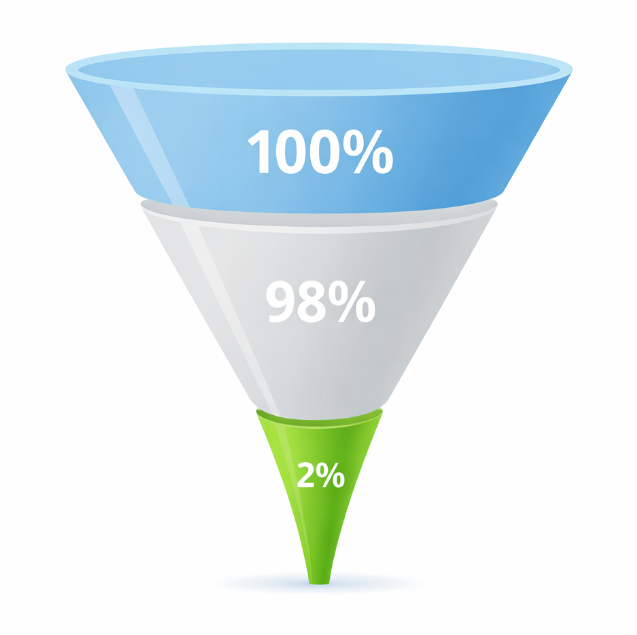
Most users become ‘warm’ by definition—but very few are actually ready to convert
When campaigns treat all warm traffic the same, messaging becomes too generic. This leads to:
-
Lower relevance
-
Reduced perceived value
-
Increased hesitation
Segmenting by intent is critical but often overlooked.
3. Overqualification of Audiences
Marketers sometimes over-filter warm audiences, narrowing targeting too aggressively. While this increases perceived relevance, it reduces scale and can exclude users who were closer to converting than expected.
In some cases, broader cold audiences provide better algorithmic optimization signals, especially in platforms like Meta Ads or Google Ads.
4. Higher Expectations and Skepticism
Warm users have already formed an impression of your brand. If their initial experience did not fully convince them, they may become more skeptical over time.
Unlike cold users—who may respond to novelty—warm users evaluate consistency. Any mismatch between expectations and messaging reduces trust.
5. Delayed Intent vs. Lost Intent
Not all non-converting users are still in the decision cycle. Many warm users have simply moved on.
Research indicates that up to 70–90% of website visitors who don’t convert on the first visit may never return with purchase intent. Retargeting these users can dilute performance metrics.
6. Algorithmic Learning Bias
Ad platforms optimize based on conversion signals. If warm audiences are too small or inconsistent, the algorithm may struggle to learn effectively.
In contrast, cold audiences often provide larger datasets, enabling better optimization and sometimes unexpectedly higher conversion efficiency.
When Cold Traffic Outperforms Warm
Cold traffic can outperform warm audiences in scenarios such as:
-
Strong, high-clarity offers
-
Highly optimized landing pages
-
Broad targeting with effective creative
-
Early-stage brand exposure with novelty appeal
For example, campaigns with clear value propositions and social proof can achieve conversion rates of 2–5% even with completely new users—sometimes surpassing poorly structured retargeting funnels.
How to Fix Underperforming Warm Traffic
1. Segment by Intent, Not Just Interaction
Differentiate between:
-
Page viewers
-
Product viewers
-
Cart abandoners
Tailor messaging accordingly.
2. Refresh Creative Frequently
Introduce new angles, visuals, and formats to combat fatigue. A/B testing different narratives can restore engagement.
3. Use Time-Based Windows
Separate recent visitors (e.g., last 7 days) from older ones (30–90 days). Conversion probability declines significantly over time.
4. Requalify Audiences with Value
Instead of pushing for immediate conversion, use:
-
Case studies
-
Testimonials
-
Educational content
This helps rebuild trust and re-engage users.
5. Expand and Compare Against Cold Campaigns
Continuously benchmark warm traffic performance against cold campaigns. In some cases, scaling cold traffic yields better ROI.
Key Takeaways
-
Warm traffic is not inherently high-converting
-
Audience quality degrades over time
-
Poor segmentation leads to irrelevant messaging
-
Cold traffic can outperform when offers and creatives are strong
Recommended Reading
Conclusion
The assumption that warm traffic always converts better is an oversimplification. Performance depends on timing, segmentation, creative strategy, and user intent.
Marketers who treat warm audiences as dynamic rather than static—and continuously test against cold traffic—are more likely to achieve consistent and scalable results.