

Marketing teams often believe that adding more targeting layers, channels, and automation rules will improve campaign performance. In reality, excessive complexity can slow decision‑making, obscure insights, and reduce overall ROI.
Modern marketing platforms allow teams to create highly detailed campaigns with multiple audiences, segmented messaging, automated triggers, and cross‑channel distribution. While these capabilities are powerful, they can also lead to unnecessary complexity.
Campaign complexity increases management overhead, slows optimization, and makes it harder to identify what actually drives performance. In some cases, simplifying a campaign structure leads to higher conversion rates and better resource allocation.
This article explores situations where reducing campaign complexity leads to stronger performance and provides practical guidance on when to streamline your strategy.
Signs Your Campaign Is Too Complex
1. Too Many Audience Segments
Segmented targeting is valuable, but excessive segmentation often leads to smaller audiences and insufficient data for reliable optimization.
According to marketing analytics studies, campaigns with extremely narrow audience segments can experience up to 30–40% lower statistical confidence in performance data because each segment generates fewer impressions and conversions.
If your campaign contains dozens of segments that differ only slightly, consolidating them can improve data clarity and accelerate optimization cycles.
2. Overlapping Messaging and Creative Variations
Many marketing teams run numerous ad variations simultaneously to test messaging. While experimentation is important, running too many variants can dilute results.
A marketing experiment by HubSpot found that campaigns with 3–5 creative variations often outperform campaigns running 10 or more variants simultaneously because the algorithm gathers meaningful performance signals faster.
Reducing the number of variations helps platforms allocate impressions more efficiently and identify winning messages sooner.
3. Excessive Automation Rules
Automation can streamline campaign management, but overly complex rule systems can create unintended interactions.
For example, when campaigns include multiple bid adjustments, scheduling rules, audience triggers, and budget reallocation logic, teams may struggle to understand why performance changes occur.
Simplifying automation rules improves transparency and allows teams to troubleshoot performance issues more quickly.
4. Too Many Channels in a Single Campaign Structure
Omnichannel strategies are effective, but combining too many channels into a single campaign can blur attribution and obscure channel performance.
Research from Gartner indicates that marketers who evaluate channels separately during testing phases gain clearer insights and improve campaign ROI by up to 15%.
Separating channels during early optimization phases often produces better insights than managing them inside one complex structure.
Situations Where Simplification Improves Results
Early Campaign Testing
During the initial launch phase, simple campaign structures provide faster learning.
Fewer variables make it easier to identify what drives performance, which audiences respond best, and which messages convert.
Once reliable insights emerge, campaigns can gradually introduce additional targeting layers.
Limited Data Volume
Campaigns with small audiences or low traffic often suffer when too many segments are introduced.
When data volume is limited, simpler structures allow platforms to collect statistically meaningful performance signals faster.
This leads to more reliable optimization decisions.
Resource‑Constrained Marketing Teams
Complex campaigns require continuous monitoring, reporting, and adjustment.
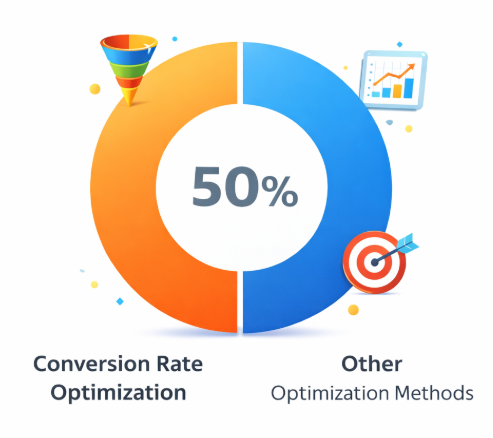
Conversion rate optimization is one of the most widely used strategies for improving campaign performance
For smaller teams, maintaining highly segmented campaign structures can consume valuable time that could be spent improving creative, messaging, or audience research.
Reducing complexity allows teams to focus on higher‑impact strategic work.
Practical Ways to Simplify Campaigns
Consolidate Similar Audience Segments
Review audience groups and merge segments with similar behavioral or demographic characteristics.
This increases sample sizes, improves optimization accuracy, and reduces reporting complexity.
Limit Active Creative Variants
Focus on a small number of clearly differentiated messaging concepts rather than testing many minor variations.
This approach improves test clarity and allows winning creatives to emerge faster.
Reduce Automation Layers
Evaluate automation rules and remove overlapping conditions.
Maintaining a smaller set of well‑defined automation triggers improves transparency and reduces unexpected campaign behavior.
Separate Testing From Scaling
Use simple structures during testing phases and introduce complexity only after performance patterns are clear.
This staged approach prevents campaigns from becoming unnecessarily complicated early in the process.
Conclusion
Campaign complexity is not inherently harmful, but excessive complexity often obscures insights and slows optimization. Marketing teams that regularly audit campaign structures and simplify where necessary gain clearer performance signals, faster learning cycles, and better overall results.
Knowing when to streamline a campaign is an essential skill for modern marketers seeking both efficiency and scalability.
Recommended Reading
