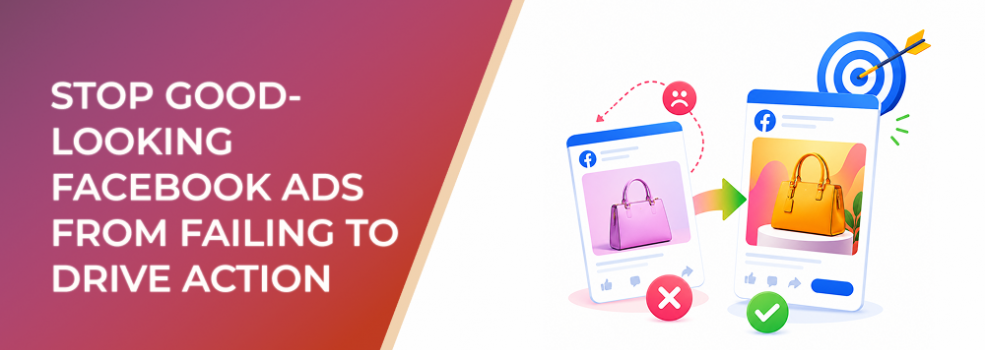
A good-looking Facebook ad is not always an action-driving Facebook ad.
Many campaigns look polished in preview but become passive in the feed. The visual is clean. The copy is acceptable. The brand feels credible. But users do not click, message, submit a form, book a call, start a trial, or purchase.
That gap matters for performance marketers, agencies, SMB owners, ecommerce teams, B2B lead-generation teams, startups, affiliate marketers, and freelancers. Paid social budget is not spent to create attractive assets. It is spent to create business movement.
If an ad looks good but does not move people toward a next step, the campaign has a performance problem.
The Problem
The problem is creative that is visually complete but behaviorally weak.
It may explain the brand. It may show the product. It may look consistent with the design system. But it does not give the user a strong enough reason to act now.
Action-driving creative needs more than a nice layout. It needs a clear action path.
That means the user should quickly understand what the ad is about, why it matters, why the next step is worth taking, and what will happen after they click or respond.
When that path is missing, the ad becomes passive. Users may notice it, understand it, and still do nothing.
Why This Problem Hurts Performance
Action failure damages the metrics that matter most.
If users do not click, CTR falls and CPC can become less efficient. If they click but do not complete the next step, CPA rises. If they submit low-intent forms or start vague conversations, lead quality declines. If they visit a product page without buying, ROAS weakens.
For agencies, action failure creates reporting problems. The ad looks good in creative review, but the client cares about pipeline, sales, bookings, and qualified leads.
For growth teams, action failure slows testing. It becomes unclear whether the offer, audience, CTA, landing page, or objective is the real issue.
For SMB owners, it wastes limited budget. A small campaign cannot afford to spend heavily on ads that only create passive visibility.
Common Scenarios Where This Happens
A coaching business runs a polished video ad, but the CTA is vague. Users understand the topic but do not know whether they should book a call, download a guide, or watch more content.
An ecommerce brand promotes a product with beautiful visuals, but the ad does not give shoppers a clear reason to click now. There is no urgency, comparison, bundle, proof, or problem-solution angle.
A B2B company uses a professional carousel to explain a service, but each card feels informational. The ad educates without moving the user toward a demo, audit, checklist, webinar, or consultation.
A local business promotes a clean service ad, but the next step feels too high-commitment for cold users. “Call Now” may be too direct if the user still needs pricing, examples, or trust signals.
An agency builds strong-looking creative but does not align the CTA with the campaign objective. The ad asks for engagement while the client expects leads.
Why the Problem Happens
This problem often happens because creative is built for presentation instead of decision-making.
The first cause is missing action intent. The team knows what the ad should say, but not what it should make the user do.
The second cause is weak offer framing. A user may understand the product but still lack a reason to act today. The ad needs to answer why this offer, why now, and why this next step.
The third cause is CTA-stage mismatch. Cold audiences usually need a lower-friction action. Warm audiences can often handle a stronger ask. Retargeting audiences may need reassurance or urgency.
The fourth cause is poor objective alignment. If the campaign objective optimizes for one behavior but the creative asks for another, results can become noisy.
The fifth cause is audience ambiguity. When advertisers are not clear about who is seeing the ad, they often write generic creative. Generic creative rarely drives decisive action.
The Solution
The solution is to design the ad around one intended action.
Start by naming the action before writing the ad. The action may be “click to compare plans,” “download the checklist,” “book a quote,” “send a message,” “start a trial,” “claim the offer,” “watch the demo,” or “shop the collection.”
Then define the user’s reason to take that action. The reason should be specific enough to create momentum. Instead of “learn more,” the ad might offer “see which plan fits your team,” “get the 10-point audit checklist,” or “compare before-and-after examples.”
Next, match the action to funnel stage. Cold audiences may respond better to education, examples, quizzes, guides, or low-friction product exploration. Warm audiences may be ready for a quote, demo, consultation, trial, or purchase. Existing engagers may need social proof, urgency, or a clear offer.
Then strengthen the CTA environment. The button matters, but so does the copy around it. The line before the CTA should reduce uncertainty and reinforce value.
Finally, make the destination obvious. If the ad asks users to book, the page should make booking easy. If the ad asks users to shop, the product path should be direct. If the ad asks users to message, the conversation prompt should help qualify interest.
How LeadEnforce Helps
LeadEnforce helps by making the audience-action match more intentional.
The right action depends on who is seeing the ad. A cold audience from a broad interest pool may need education before a sales ask. A niche Facebook group-based audience may already understand the problem and respond to a more specific offer. Instagram engagers may be ready for a visual product comparison or social-proof angle. LinkedIn-derived professional audiences may respond better to role-specific value and lower-friction B2B next steps.
LeadEnforce allows advertisers to build audiences from Facebook groups, Instagram profiles, Instagram followers, Instagram engagers, LinkedIn professional data, and custom social-profile data. This gives marketers clearer audience context before choosing the CTA and offer.
For example, a B2B lead-generation team can build a role-relevant audience and test a decision-stage action such as “request a consultation” or “see the workflow.” An ecommerce brand can build an audience around relevant Instagram profiles and test action prompts tied to product comparison, bundles, or seasonal demand. An agency can create separate audience-action hypotheses for different client segments.
LeadEnforce does not choose the campaign objective, write the CTA, fix the offer, or guarantee results. It helps reduce targeting guesswork so the action you ask for is more likely to fit the audience’s intent.
Risks and Considerations
The biggest risk is asking for too much too soon.
A strong CTA is not always a hard CTA. If the audience is cold, a direct purchase or demo request may create resistance. If the audience is warm, a vague “learn more” CTA may be too weak. Action strength should match intent.
Another risk is confusing engagement with action. Likes, comments, and shares can be useful, but they do not automatically indicate qualified demand. Evaluate the action that matters to the campaign.
Audience size also matters. Highly relevant audiences can perform well, but very small pools may fatigue quickly or limit learning.
Compliance is important when using audience-specific messaging. Speak to the problem and offer without implying sensitive personal knowledge or making the user feel individually identified.
Prerequisites and Dependencies
To make an ad drive action, you need a clear campaign objective, a defined ICP, and one primary next step.
You also need an offer that is worth acting on. Creative cannot manufacture urgency or relevance if the offer is weak.
The destination must support the action. A lead form should qualify without adding unnecessary friction. A booking page should be simple. A product page should reinforce the same promise from the ad. A message campaign should have a response process ready.
If LeadEnforce is part of the workflow, you need relevant source communities, profiles, professional signals, or custom social-profile data that match the action you plan to request.
Finally, success metrics should be defined before launch. For lead gen, track qualified lead rate, booked-call rate, sales acceptance, and pipeline. For ecommerce, track CTR, CPA, ROAS, AOV, and conversion rate. For local businesses, track quote quality, appointment rate, and actual revenue impact.
Practical Recommendations
Write the ad objective as a user action, not a platform metric.
Instead of “get traffic,” write “get qualified prospects to compare the service package.” Instead of “increase engagement,” write “get cold users to watch the short explanation and enter a retargeting pool.”
Make the CTA specific. “See Pricing,” “Get the Checklist,” “Book a Quote,” “Compare Options,” or “Start Free Trial” can often communicate more intent than a generic button.
Use creative proof before the ask. Show the user why the action is safe, useful, relevant, or timely.
Use LeadEnforce when the campaign needs better audience-action alignment. Build audience pools around real communities, profiles, engagers, or professional signals, then choose an action that fits what those users likely know and need.
Test one action path at a time. Do not change the audience, offer, CTA, and landing page all at once. If the campaign improves, you need to know why.
Final Takeaway
Good-looking Facebook ads fail when they do not create a clear path from attention to action.
The fix is to decide the intended action first, match it to audience intent, support it with a strong offer, and make the next step obvious. A polished ad gets noticed. A performance-focused ad gets people to move.
To build more relevant audience-action tests for your next campaign, join the free 7-day LeadEnforce trial period.
Related LeadEnforce Articles
- Use Facebook Page Ads as a Real Performance Test, Not Just a Quick Boost — Helps turn Page-created ads into structured tests instead of one-off promotions.
- Facebook Ads Goals: How to Connect Campaign Setup to Revenue and Pipeline — Explains how campaign goals should connect to real business outcomes.
- How to Stop Meta From Optimizing for the Wrong Result — Useful for advertisers whose campaigns generate activity but not the right actions.
- How to Build Your Target Audience from a Facebook Group — Shows how community-based audiences can improve relevance before creative testing.
- Facebook Ad Creative Testing Sprint: A 7-day Framework — Provides a structured approach to testing creative that drives action.