
Campaign dashboards often present a simplified view of success: number of leads generated, cost per lead, and conversion rate. While these metrics are valuable, they overlook a critical factor—lead quality.
Lead scoring helps organizations determine which prospects are most likely to become customers. Without it, marketing teams evaluate campaigns using incomplete information. A campaign generating 500 leads may appear more successful than one producing 200 leads, yet if only a handful of those 500 leads match the ideal customer profile, the campaign is far less effective.
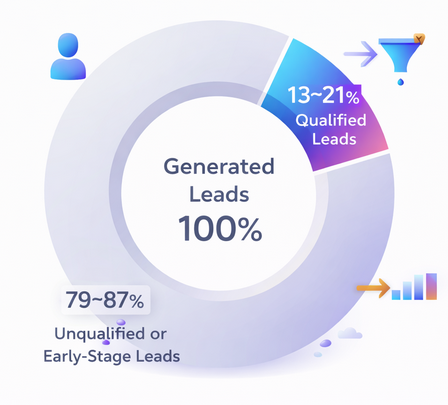
Most marketing leads are not sales-ready: only 13–21% qualify as marketing-qualified leads
According to research by MarketingSherpa, 61% of B2B marketers send all leads directly to sales without qualification, which significantly reduces conversion efficiency. When unqualified leads flood the pipeline, campaign performance metrics become distorted and optimization decisions suffer.
How Optimization Decisions Become Misleading
Ignoring lead scoring impacts multiple areas of marketing analysis and campaign optimization.
Misinterpreting Cost Per Lead
Cost per lead (CPL) is one of the most widely used campaign metrics. However, when lead quality is not considered, CPL becomes misleading.
A campaign generating inexpensive but poorly qualified leads may show a low CPL and appear highly efficient. In reality, those leads may rarely convert into opportunities or revenue.
Research from HubSpot shows that only 27% of leads passed to sales are considered qualified. This gap demonstrates how easily marketing teams can overestimate campaign performance when lead scoring is absent.
Incorrect Channel Prioritization
Without lead scoring, marketing teams often prioritize channels that produce the highest volume of leads rather than the highest-value prospects.
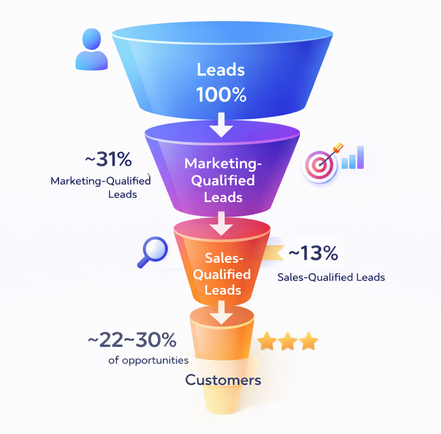
Typical B2B conversion funnel: only a small portion of leads progress through each qualification stage
For example, paid social campaigns may generate large numbers of leads quickly, while niche channels such as webinars or targeted outreach may produce fewer but significantly more qualified prospects. If campaigns are optimized purely for volume, high-performing channels can be incorrectly deprioritized.
Distorted Conversion Analysis
Conversion metrics become unreliable when lead quality varies significantly between campaigns.
Two campaigns may produce the same number of leads, yet one may generate highly relevant prospects while the other attracts users who are unlikely to purchase. Without lead scoring, both campaigns appear equally successful during early analysis.
This leads to optimization strategies based on incomplete or misleading data.
The Impact on Sales Alignment
Marketing and sales alignment often suffers when lead scoring is not implemented.
Sales teams depend on qualified leads to maintain productivity. When marketing campaigns send large volumes of unqualified prospects, sales representatives must spend time filtering irrelevant contacts. This slows response times and reduces the likelihood of successful conversions.
According to CSO Insights, companies with mature lead management processes generate 9.3% higher sales quota achievement than those without structured qualification systems.
Without lead scoring, marketing teams may believe campaigns are performing well, while sales teams experience declining lead quality.
How Lead Scoring Improves Campaign Optimization
Lead scoring introduces a structured method for evaluating prospect quality based on attributes such as firmographic data, behavioral signals, and engagement patterns.
Once lead scoring is integrated into campaign reporting, marketing teams gain deeper insights into performance.
Optimization Based on Revenue Potential
Instead of optimizing campaigns for raw lead volume, teams can focus on generating leads that match the ideal customer profile.
This shifts campaign optimization from quantity-driven to value-driven decision-making.
Accurate Channel Performance Analysis
Lead scoring reveals which marketing channels consistently deliver qualified prospects. Channels that previously appeared underperforming may prove to generate the highest-value leads.
Improved Marketing ROI
When campaigns are optimized using lead quality data, marketing investments become more efficient. Budgets can be allocated toward channels and strategies that drive real pipeline growth rather than superficial lead volume.
Research from Forrester indicates that organizations implementing advanced lead qualification frameworks see marketing-driven revenue increase by up to 20%.
Practical Steps to Integrate Lead Scoring into Campaign Analysis
To prevent skewed campaign optimization, marketing teams should incorporate lead scoring directly into reporting and analytics workflows.
Define clear qualification criteria based on company size, industry, job role, and behavioral engagement.
Align scoring models with sales feedback to ensure that marketing-qualified leads reflect real buying potential.
Include lead score distribution in campaign reports so that optimization decisions consider both volume and quality.
When lead scoring becomes part of the analytical process, campaign performance metrics become significantly more reliable.
Conclusion
Campaign optimization depends on accurate data interpretation. When lead quality is ignored, marketing teams risk prioritizing the wrong channels, misjudging campaign efficiency, and weakening alignment with sales.
Lead scoring provides the necessary context for understanding which campaigns truly contribute to revenue growth. By incorporating lead qualification into campaign analytics, marketers can make optimization decisions based on meaningful insights rather than incomplete metrics.