Instagram ads can look healthy while the audience quietly burns budget.
You may see decent CTR, acceptable CPC, and enough clicks to keep the campaign running. Then the back-end numbers tell a different story. Demo bookings are weak, purchases are thin, lead quality is poor, and ROAS does not move.
This often happens when advertisers test one audience too long. They keep adjusting the creative, landing page, budget, or offer before checking whether the audience segment has enough buying intent.
A narrow Instagram audience is not automatically a good audience. It only becomes useful when it can beat other segments on the metrics that matter after the click.
Why one Instagram audience can distort your performance data
A single audience gives you one version of the truth.
If you target one interest cluster, one follower group, or one demographic pocket, every performance signal comes from that same pool. Meta can only optimize within the people available inside that audience. If the segment is weak, the algorithm may still find cheap clicks, but it cannot manufacture stronger intent from poor inputs.
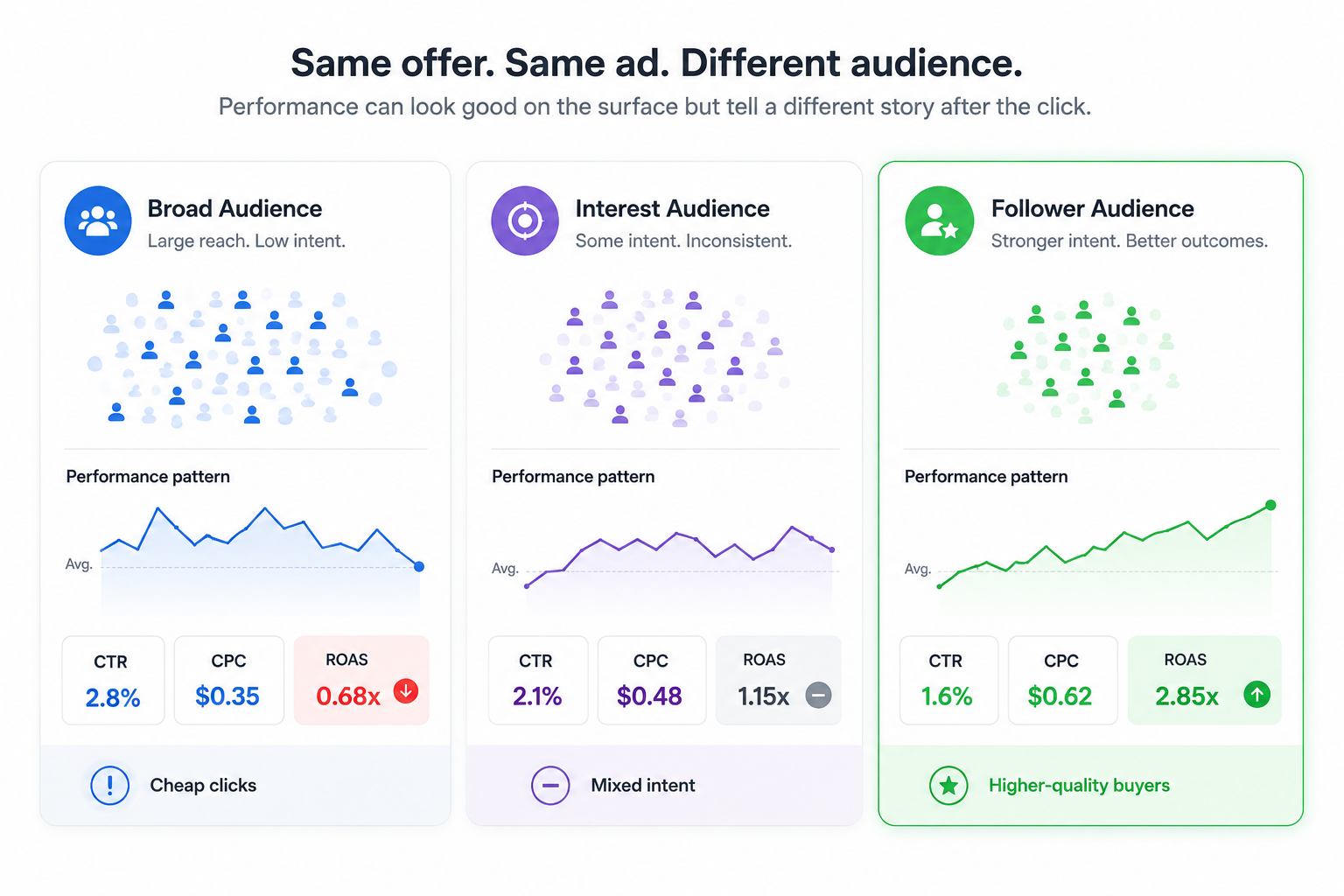
That is where many Instagram campaigns get misread. The ad may not be the main issue. The offer may not be broken either. The campaign may simply be reaching people who are interested enough to engage, but not qualified enough to convert.
This is common in service businesses, SaaS, coaching, local services, and B2B lead generation. A person may follow related content on Instagram without being ready to book a call, request pricing, or speak with sales.
The first mistake is treating engagement as proof of audience quality.
What the wrong audience segment does to CPC, CPA, and ROAS
Bad audience fit rarely shows up as one clean failure. It usually creates mixed signals.
An audience can produce cheap traffic because the creative is easy to click. It can also generate a high CTR because the topic is familiar. But if the users are too early-stage, too casual, or too far from the buying problem, the campaign starts leaking money after the click.
You may see patterns like:
- Low CPC with poor lead quality. The ad attracts users who are curious, but they do not match the buyer profile your sales team can close.
- Strong CTR with weak conversion rate. The creative earns attention, but the audience does not have enough urgency to continue through the funnel.
- Stable CPM with rising CPA. Delivery is not the issue. The problem is that the segment has stopped producing enough qualified actions.
- Good form volume with low sales acceptance. The campaign optimizes toward submissions, while the business needs serious buyers or qualified prospects.
This is why audience testing should happen before major creative rewrites. If every segment reacts poorly, the ad or offer may need work. If one segment clearly outperforms the rest, the original audience was the constraint.
For deeper diagnosis, advertisers should look at audience testing before changing creatives before rebuilding the whole campaign.
How Instagram advertisers get trapped in one narrow segment
The trap usually starts with a reasonable decision.
A marketer picks an audience that seems logical: followers of a niche, people interested in a category, a narrow age range, or a local audience. Early results look promising enough to keep spending. After a few days, performance slows, and the team starts making surface-level changes.
They test a new headline. Then a new creative. Then a different CTA. Then a budget increase.
But the audience never gets challenged.
This creates a false optimization loop. The campaign keeps improving around the same limited segment, while other audience types remain untested. The advertiser learns how one audience behaves, not which audience is most profitable.
That difference matters. Instagram users vary heavily by intent source. Someone who follows a competitor, engages with a niche creator, belongs to a problem-aware community, or watches broad lifestyle content may all look relevant. Their conversion behavior can be completely different.
Compare audience segments before scaling Instagram spend
The practical fix is not to test random audiences. It is to compare segments with a controlled setup.
Use the same offer, same creative angle, same landing page, and same conversion event across each audience. If too many variables change at once, the test cannot show whether performance came from the audience or the ad setup.
A clean audience test might compare:
- Broad Instagram audience. Useful as a baseline, especially when Meta has enough conversion data to find patterns.
- Interest-based audience. Helpful for category relevance, but often too loose when the product requires strong intent.
- Follower-based audience. Built around people connected to relevant Instagram accounts, creators, competitors, or niche communities.
- Warm engagement audience. Based on users who interacted with your own Instagram content, profile, Reels, or ads.
Each audience should get enough budget to produce directional data. You do not need perfect statistical certainty for every test. You need enough signal to avoid scaling the weakest segment.
The key is to judge audiences on business outcomes, not only platform engagement.
What to measure when testing Instagram audience segments
CTR and CPC are useful, but they sit too close to the ad impression. They tell you whether people react. They do not tell you whether the segment is worth scaling.
A better Instagram audience test should include both front-end and back-end checks:
- CTR and CPC. Use these to spot attention and traffic efficiency, but never treat them as final proof.
- Landing page conversion rate. This shows whether the audience understands the offer after leaving Instagram.
- CPA or cost per qualified lead. This is where weak segments usually reveal themselves.
- Sales feedback or revenue quality. For lead gen, check whether the leads book, respond, show up, and match the buying profile.
For example, an agency may test three Instagram audiences for a webinar funnel. The broad audience delivers the lowest CPC. The interest audience gets the most registrations. The follower-based audience produces fewer leads, but more booked sales calls.
In that case, the best audience is not the cheapest one. It is the segment that produces the strongest movement toward revenue.
How LeadEnforce helps build higher-intent Instagram audiences
Meta’s native targeting can be useful, but it often groups people too broadly. Interest categories do not always separate casual content consumers from people with stronger buying intent.
LeadEnforce helps advertisers build more precise audiences from sources like Instagram followers and engagers, Facebook groups, and social profile data. For Instagram campaigns, this means you can create an audience from people connected to relevant accounts or communities, then test it against broad, interest-based, and warm audiences.
That matters when the market is narrow.
A SaaS company might test followers of industry influencers against broad business interests. A local service provider might compare local Instagram follower audiences against general location targeting. A B2B advertiser might test people connected to niche professional communities instead of relying only on broad job-related interests.
This does not mean every LeadEnforce audience will beat every native audience. The value is in creating a stronger testable segment. You can then measure whether that segment lowers CPA, improves demo quality, or lifts ROAS compared with your other audience pools.
If your current campaigns depend too heavily on broad targeting, it can help to test ways to reach the right Instagram audience without broad targeting.
When a narrow audience is too narrow to scale
Precision has a tradeoff. A high-intent audience can still underperform if it is too small, overused, or too similar to your retargeting pool.
Watch for delivery signals inside Ads Manager. If frequency climbs quickly, CPM rises without better conversion quality, or spend becomes uneven across ad sets, the audience may not have enough depth. In that case, the issue is not relevance. It is scale capacity.
A useful narrow audience should do two things:
- Produce better conversion quality than a broader baseline.
- Contain enough users to keep delivery stable during testing.
If it cannot do both, use it differently. You might treat it as a seed audience, a retargeting layer, or one segment inside a broader testing structure. For Instagram-specific audience building, advertisers can also test how they target Instagram followers with LeadEnforce and compare those users against other sources.
How to stop wasting spend on the wrong segment
The cleanest way to reduce wasted Instagram spend is to stop asking one audience to prove everything.
Build a simple comparison test. Keep the creative and offer stable. Give each audience enough budget to show direction. Then judge the result by qualified actions, not only cheap clicks.
If one segment brings low CPC but weak buyers, cap it or cut it. If another segment costs more upfront but produces better sales conversations, give it more budget carefully. If all audiences fail at the same point, move your attention to the offer, landing page, or conversion path.
Audience testing does not remove uncertainty. It tells you where the uncertainty sits.