Multi-product B2B companies operate in inherently complex environments. Different products often target distinct buyer personas, solve separate pain points, and operate at varying price points. Without a structured campaign framework, marketing efforts become siloed, budgets get misallocated, and performance data becomes difficult to interpret.
According to Gartner, B2B buyers spend only 17% of their purchasing journey meeting with potential suppliers. The remaining time is spent researching independently or in internal consensus-building. Additionally, Forrester reports that the average B2B buying group involves 6–10 decision-makers. In a multi-product context, this complexity multiplies.
A disciplined campaign structure enables:
-
Clear segmentation by product and persona
-
Efficient budget allocation
-
Accurate attribution modeling
-
Coordinated messaging across the funnel
-
Reduced internal friction between product marketing teams
This guide presents a practical framework for structuring campaigns in multi-product B2B environments.
1. Establish a Portfolio-Level Campaign Architecture
Start with a top-down portfolio view before building individual product campaigns.
Tier 1: Corporate-Level Campaigns
These campaigns promote overarching brand positioning, thought leadership, and category authority. They target broad audiences and are optimized for reach and awareness.
Examples:
-
Industry trend reports
-
Educational webinars
-
Executive positioning content
Tier 2: Solution-Focused Campaigns
These align related products under a unified problem statement. Instead of promoting Product A and Product B separately, focus on the business challenge they collectively solve.
This structure prevents overlapping messaging and reduces internal competition for the same audience.
Tier 3: Product-Specific Campaigns
These are bottom-of-funnel initiatives targeting high-intent prospects. They should be tightly segmented and supported by:
-
Persona-specific messaging
-
Clear value propositions
-
Dedicated landing experiences
A three-tiered hierarchy ensures that awareness, consideration, and conversion efforts are strategically aligned rather than disconnected.
2. Segment by Buyer Persona, Not Just Product
In multi-product companies, the same organization may contain multiple target personas:
-
Technical evaluators
-
Economic buyers
-
Operational users
-
Strategic executives
Campaigns should be structured around persona pathways rather than product silos.
For example:
-
Persona A receives thought leadership content and high-level solution messaging.
-
Persona B receives technical documentation and ROI breakdowns.
Research from McKinsey shows that personalization can reduce acquisition costs by up to 50% and increase revenues by 5–15%. Persona-based campaign segmentation drives this effect.
3. Map Products to Distinct Buying Stages
Not all products enter the buying cycle at the same stage. Some offerings serve as entry-level solutions, while others are enterprise expansions.
Structure campaigns according to funnel positioning:
Top of Funnel (Awareness)
-
Educational content
-
Problem framing
-
Industry benchmarks
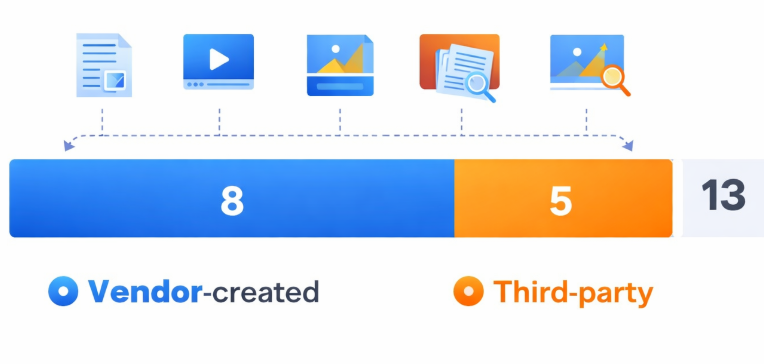
Average number of content interactions B2B buyers consume before engaging with a brand
Middle of Funnel (Consideration)
-
Case studies
-
Comparative guides
-
ROI models
Bottom of Funnel (Decision)
-
Product demos
-
Trials
-
Consultation offers
Each product should have clearly defined funnel entry points to avoid duplicated messaging and misaligned KPIs.
4. Align Budget Allocation With Revenue Potential
One of the most common structural errors is equal budget distribution across products. Instead, allocate resources based on:
-
Average contract value
-
Sales cycle length
-
Strategic growth priority
-
Historical conversion rates
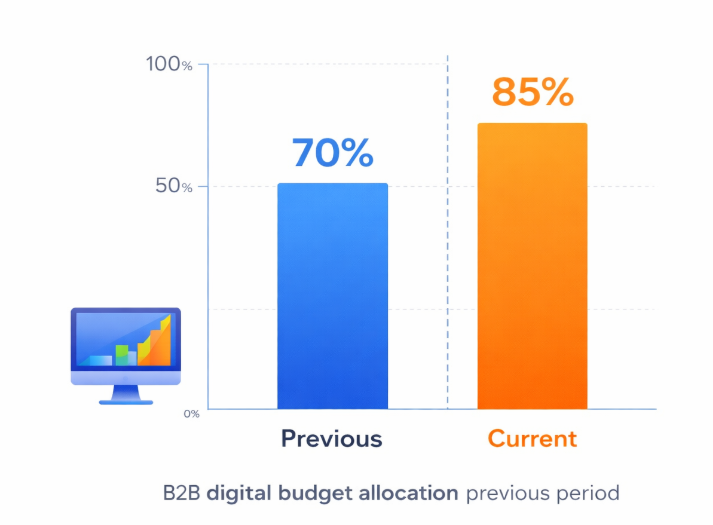
Trend in B2B digital budget allocation showing increased focus on digital channels
According to HubSpot, companies that align marketing budgets with revenue targets are 1.6x more likely to report above-average growth.
In practice:
-
High-ACV enterprise products justify longer, higher-investment campaigns.
-
Lower-ACV products may rely more heavily on automation and scaled digital acquisition.
This ensures ROI-driven campaign planning rather than politically driven distribution.
5. Implement Clear Attribution Models
Multi-product environments often suffer from attribution confusion. Shared content, overlapping audiences, and long sales cycles blur performance visibility.
Best practices include:
-
Multi-touch attribution modeling
-
Product-level tracking parameters
-
CRM integration for closed-loop reporting
-
Defined conversion events per product line
Without granular tracking, campaign optimization becomes speculative rather than data-driven.
6. Coordinate Messaging Across Product Lines
Even when campaigns are segmented, messaging must remain consistent at the brand level.
Establish:
-
Unified value propositions
-
Shared visual identity
-
Standardized terminology
-
Cross-product positioning guidelines
Disjointed messaging reduces trust and increases cognitive load for buyers evaluating multiple solutions within the same company.
7. Create Cross-Sell and Upsell Campaign Streams
Multi-product B2B companies hold a structural advantage: existing customer relationships.
Campaign architecture should include:
-
Customer lifecycle campaigns
-
Product adoption sequences
-
Upgrade pathways
-
Account-based expansion campaigns
Research from Bain & Company indicates that increasing customer retention by 5% can increase profits by 25–95%. Cross-sell campaign streams are essential to capturing this value.
8. Avoid Internal Product Competition
Without structured governance, product teams may target identical audiences with overlapping messaging. This results in:
-
Audience fatigue
-
Inflated acquisition costs
-
Internal budget conflict
Prevent this by implementing:
-
Shared audience definitions
-
Centralized campaign calendar
-
Unified reporting dashboards
-
Cross-functional campaign reviews
Campaign governance is as important as creative execution.
9. Measure Portfolio-Level Performance
In addition to product KPIs, evaluate overall portfolio health:
-
Customer acquisition cost by segment
-
Marketing-sourced revenue per product
-
Cross-sell rate
-
Customer lifetime value
-
Pipeline velocity by campaign type
Portfolio-level dashboards reveal structural inefficiencies that product-level reporting may obscure.
Conclusion
Structuring campaigns for multi-product B2B companies requires deliberate architecture rather than incremental execution. A hierarchical framework, persona-driven segmentation, funnel alignment, disciplined budget allocation, and unified attribution systems create operational clarity.
When campaign design reflects portfolio complexity, organizations reduce waste, improve measurement accuracy, and accelerate revenue growth across product lines.