Prospecting and retargeting serve different strategic roles in digital advertising. Prospecting introduces your brand to new audiences, while retargeting re-engages users who have already interacted with your website, ads, or content.
When these audiences become too similar, your campaigns may compete for the same users. Instead of expanding reach and acquiring new customers, prospecting campaigns may repeatedly target people who are already familiar with your brand.
This issue often leads to rising acquisition costs, lower incremental reach, and misleading performance metrics. Understanding how to diagnose audience overlap is essential for maintaining an effective funnel structure.
Why Prospecting and Retargeting Must Remain Distinct
Maintaining separation between these audiences ensures that each campaign stage performs its intended role.
-
Prospecting campaigns should focus on discovering new potential customers.
-
Retargeting campaigns should convert users who have already demonstrated interest.
According to industry benchmarks, retargeting audiences typically convert 2–3 times more frequently than cold audiences because they already have some level of brand familiarity. If prospecting campaigns start showing similar conversion behavior, it may indicate that they are unintentionally reaching warm users.
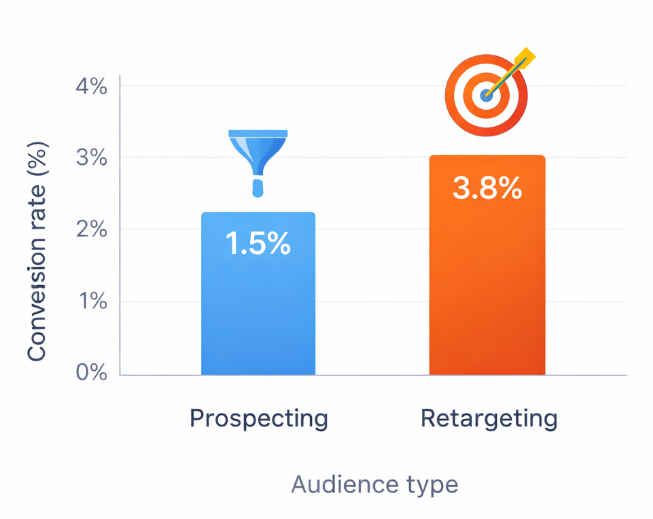
Retargeting audiences typically convert more than twice as often as cold prospecting audiences, highlighting the importance of maintaining clear audience separation in advertising funnels
Additionally, research from advertising platforms suggests that up to 40% of advertising spend can be wasted when audience overlap causes internal competition between campaigns.
Signs Your Prospecting Audience Is Too Similar to Retargeting
1. Prospecting Conversion Rates Are Unusually High
Prospecting campaigns normally produce lower conversion rates compared with retargeting campaigns. If both audiences show similar conversion performance, it may indicate that your prospecting audience includes users who have already interacted with your brand.
For example, if retargeting campaigns convert at 8% and prospecting campaigns are converting at 6–7%, the gap may be too small for a true cold audience.
2. Rapid Frequency Growth in Prospecting Campaigns
Frequency measures how often users see your ads. If prospecting campaigns quickly reach high frequency levels, it often means the platform is repeatedly showing ads to a limited audience pool.
A prospecting campaign that reaches a frequency of 4–5 within a short time frame may be cycling through users who already belong to your remarketing ecosystem.
3. Incremental Reach Is Stagnating
One of the main goals of prospecting is expanding reach. If reach growth slows down despite stable budgets, it may indicate that prospecting campaigns are repeatedly targeting the same users who already exist in retargeting segments.
4. Retargeting Audience Size Stops Growing
Prospecting campaigns should continuously feed new users into the retargeting pool. If retargeting audience growth plateaus while prospecting spend remains steady, it may mean prospecting campaigns are not bringing in new users.
5. High Audience Overlap Between Campaigns
Many advertising platforms provide audience overlap diagnostics. When prospecting and retargeting segments share a large percentage of users, the campaigns effectively compete against each other in auctions.
In some cases, overlap can exceed 30–50%, which significantly reduces the effectiveness of prospecting efforts.
Common Causes of Audience Similarity
Broad Lookalike Sources
If lookalike audiences are created from website visitors rather than converters, the resulting audience may contain many users who have already interacted with the brand.
Weak Exclusion Lists
Failing to exclude recent visitors, engaged users, or past customers from prospecting campaigns allows the platform to re-target warm users under the prospecting label.
Small Seed Audiences
When seed audiences are too small, algorithmic expansion can prioritize users already familiar with the brand because they have stronger engagement signals.
Platform Optimization Bias
Advertising algorithms naturally prioritize users who are more likely to convert. If warm users are not excluded, the platform may repeatedly target them even in prospecting campaigns.
How to Prevent Prospecting and Retargeting Overlap
Build Strong Exclusion Layers
Exclude the following segments from prospecting campaigns:
-
Recent website visitors
-
Existing customers
-
CRM contact lists
-
Users who engaged with ads
Clear exclusion rules ensure prospecting campaigns focus on entirely new users.
Use Conversion-Based Lookalikes
Lookalike audiences based on high-quality conversion events (such as purchases or qualified leads) typically generate more distinct prospecting audiences compared with audiences built from website traffic.
Expand Audience Signals
Combining multiple data sources — such as customer lists, high-value leads, and conversion events — improves the quality and diversity of prospecting audiences.
Monitor Overlap Regularly
Audience overlap analysis should be part of routine campaign monitoring. Regular audits can identify when prospecting segments gradually drift toward retargeting audiences.
Why This Issue Matters for Long-Term Growth
When prospecting audiences overlap with retargeting audiences, the marketing funnel becomes compressed. Instead of introducing new users to the brand, campaigns repeatedly compete for the same limited audience pool.
Over time, this dynamic can lead to:
-
Increasing cost per acquisition
-
Decreasing incremental conversions
-
Limited campaign scalability
Maintaining clear separation between prospecting and retargeting ensures that campaigns continue to generate new demand rather than recycling existing audiences.
Recommended Reading
To deepen your understanding of audience targeting and campaign structure, consider exploring the following articles: