
Not all warm traffic is the same. Many marketers treat every returning visitor or engaged prospect as a single category, but warm audiences actually contain several distinct segments with different levels of intent, awareness, and readiness to convert. Recognizing these differences allows marketers to personalize campaigns more effectively and significantly improve performance across advertising and email channels.
Studies show that warm audiences convert between 2–5 times more often than cold audiences. However, campaigns that segment warm traffic properly can increase conversion rates by an additional 30–50 percent compared with campaigns that treat warm users as a single group.
What Is Warm Traffic?
Warm traffic refers to users who have already interacted with your brand in some way. This interaction might include visiting your website, engaging with social content, opening an email, or downloading a resource.
Because these users already recognize your brand, they typically require less persuasion than completely new visitors. However, their prior interaction does not guarantee purchase intent. This is where segmentation becomes essential.
The Main Types of Warm Traffic Segments
1. Engaged Visitors
These users have visited your website or landing pages but have not taken deeper actions such as signing up or requesting a demo.
Typical behaviors include:
-
Viewing multiple pages
-
Spending significant time on site
-
Returning within a short period
According to Google analytics benchmarks, visitors who view more than three pages during a session are up to 3.5 times more likely to convert later compared with single‑page visitors.
Marketing approach:
-
Highlight key benefits and differentiators
-
Reinforce trust with testimonials and case studies
-
Provide clear next‑step calls to action
2. Content Engagers
This segment includes users who interact with educational materials such as blog posts, guides, webinars, or downloadable resources.
They are often earlier in the buying journey but actively researching solutions.
Statistics indicate that companies publishing consistent educational content generate 67 percent more monthly leads than those that do not.
Marketing approach:
-
Continue providing valuable educational material
-
Introduce problem‑solution messaging
-
Offer deeper resources such as advanced guides or comparisons
3. Email Subscribers
Email subscribers represent a significantly warmer segment because they have explicitly chosen to hear from your brand.
Email marketing consistently delivers strong results. Industry reports show average ROI exceeding $36 for every $1 spent.
Marketing approach:
-
Use segmented email campaigns
-
Deliver personalized offers and recommendations
-
Build nurturing sequences that gradually introduce your product
4. Product‑Interested Users
These users have shown strong intent signals such as:
-
Visiting pricing pages
-
Viewing product features
-
Starting signup or checkout processes
Research from multiple conversion optimization studies suggests that users who visit pricing pages are often 5–10 times more likely to convert than average site visitors.
Marketing approach:
-
Address objections clearly
-
Highlight ROI and use cases
-
Provide demonstrations, trials, or limited offers
Why Treating Warm Traffic as One Group Hurts Performance
When marketers combine all warm visitors into a single audience, messaging becomes too generic. A user who only read one article has very different expectations than someone who viewed your pricing page three times.
Without segmentation:
-
Messaging relevance drops
-
Engagement decreases
-
Conversion opportunities are missed
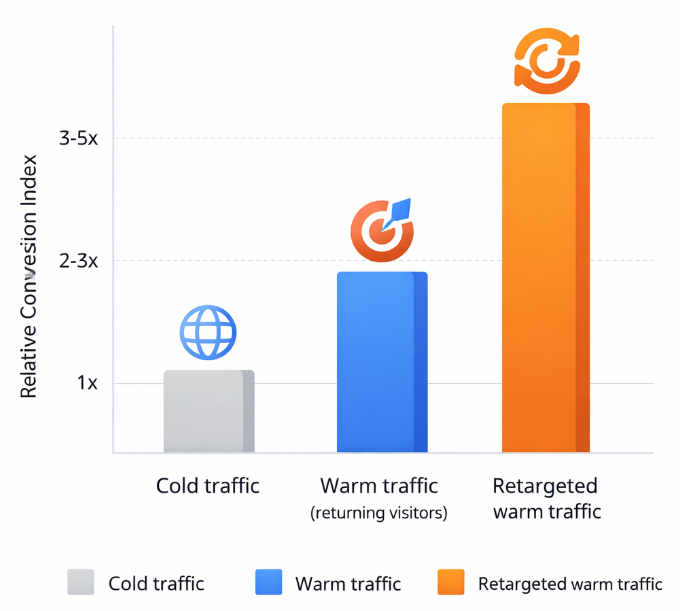
Returning visitors and retargeted users convert significantly better than first-time visitors, highlighting the value of warm audience segmentation
Segmented campaigns, on the other hand, can dramatically improve results. Research shows personalized marketing messages improve click‑through rates by up to 202 percent compared with non‑segmented campaigns.
How to Build Effective Warm Traffic Segments
Track Behavioral Signals
Segment audiences based on actions such as page visits, downloads, or time spent on site. Behavioral signals provide the clearest insight into intent.
Use Funnel‑Stage Messaging
Align your messaging with the user’s level of awareness. Early‑stage visitors need education, while high‑intent visitors need reassurance and proof.
Refresh Segments Regularly
Warm audiences cool down over time. Someone who interacted with your site six months ago may require re‑engagement before responding to conversion‑focused messaging.
Common Mistakes in Warm Traffic Targeting
Over‑retargeting
Showing the same ad repeatedly to all warm users often leads to ad fatigue and declining engagement.
Ignoring Content Interaction
Marketers frequently segment only by page visits while ignoring deeper engagement signals such as content downloads or webinar participation.
Skipping Personalization
Even simple personalization—such as referencing previously viewed topics—can significantly improve campaign performance.
Conclusion
Warm traffic represents one of the most valuable opportunities in digital marketing. These users already know your brand and are far more likely to convert than completely new audiences.
However, real performance improvements come from understanding that warm traffic is not a single category. By identifying distinct behavioral segments and tailoring messaging for each group, marketers can dramatically improve engagement, conversion rates, and long‑term customer acquisition efficiency.
Further Reading
