
Expanding into a new market does not have to mean committing a six-figure advertising budget. With the right validation framework, controlled experimentation, and data discipline, businesses can evaluate demand, pricing tolerance, and audience fit with minimal financial exposure.
Why Market Testing Matters
Market expansion failure rates remain high. According to CB Insights, 35% of startups fail due to lack of market need. Additionally, research by Harvard Business School indicates that over 75% of venture-backed startups do not return investors’ capital. These figures underscore a critical reality: demand validation must precede large-scale investment.
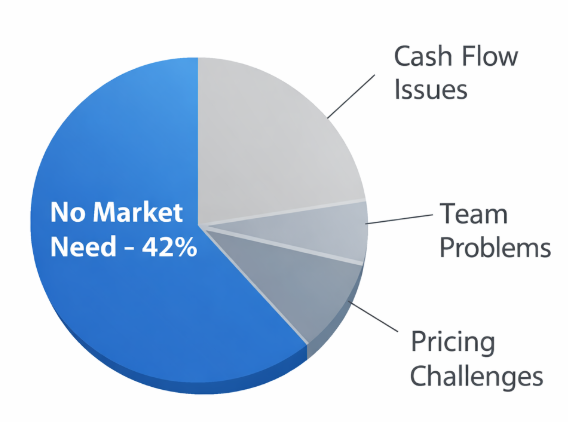
Breakdown of startup failure causes showing that lack of market need is the most common reason
Testing a new market with limited ad spend reduces downside risk while generating real behavioral data. Instead of relying on assumptions or anecdotal insights, businesses can validate:
-
Audience interest
n- Cost per acquisition (CPA) -
Messaging resonance
-
Pricing sensitivity
-
Competitive positioning
The objective is not immediate profitability. The objective is validated learning.
Step 1: Define a Narrow Test Hypothesis
Avoid broad goals such as “enter the German market” or “target fintech companies.” Instead, define a testable hypothesis:
Example:
"Mid-sized e-commerce brands in Germany will generate qualified demo requests at a CPA under $120 when presented with value proposition X."
A strong hypothesis includes:
-
Target segment (industry, geography, company size)
-
Core pain point
-
Value proposition
-
Quantifiable success metric
Clarity at this stage prevents wasted ad spend later.
Step 2: Use Micro-Budget Paid Campaigns Strategically
You do not need a large budget to gather statistically meaningful signals. In many B2B tests, $500–$2,000 is sufficient to evaluate early traction.
Focus on:
-
One platform at a time
-
One audience segment
-
One primary message
-
One conversion goal
According to WordStream benchmarks, average conversion rates in B2B Google Ads range between 2% and 5%. If your test produces sub-1% conversion rates, that is an early warning sign of poor market-message fit.
Key metrics to monitor:
-
Click-through rate (CTR)
-
Cost per click (CPC)
-
Conversion rate (CVR)
-
Cost per lead (CPL)
Avoid optimizing prematurely. First, gather enough data to identify patterns.
Step 3: Leverage Audience Pre-Qualification
Ad spend efficiency improves dramatically when audiences are pre-qualified.
Instead of targeting broad interest groups, narrow by:
-
Industry classification
-
Company size
-
Job title
-
Revenue band
-
Technology usage
The more precise the audience definition, the less budget is required to generate meaningful insights. Narrow targeting reduces irrelevant clicks and improves early-stage conversion quality.
Step 4: Validate Demand with Landing Page Experiments
Before investing in product localization or sales hiring, test demand using controlled landing pages.
Create:
-
A localized headline
-
Market-specific pain points
-
A clear call to action (demo, trial, consultation)
According to Unbounce’s benchmark reports, landing pages with a single focused CTA can improve conversions by over 30% compared to pages with multiple competing actions.
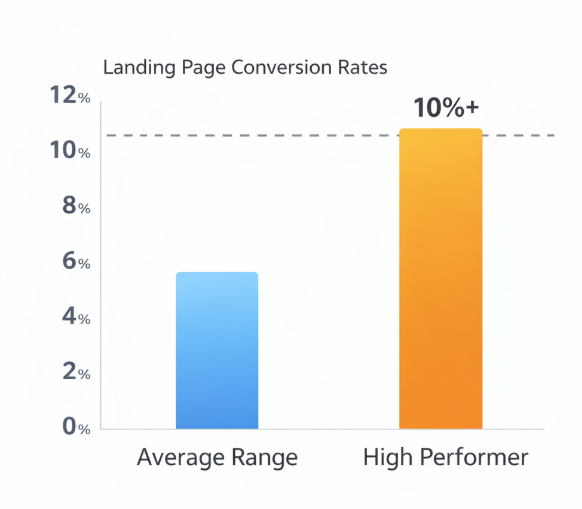
Landing page conversion rate benchmarks show the average range versus high-performing pages
Track:
-
Scroll depth
-
Time on page
-
Form completion rate
-
Bounce rate
Strong engagement but weak conversions may indicate pricing friction. Weak engagement suggests messaging misalignment.
Step 5: Measure Leading Indicators, Not Just Sales
Early-stage tests rarely produce immediate revenue. Instead, focus on leading indicators such as:
-
Qualified lead rate
-
Demo attendance rate
-
Follow-up engagement
-
Sales cycle length
For example, if 20% of leads book demos and 50% of those attend, the market may show promising intent even before closed deals occur.
Leading indicators help determine whether to iterate, scale, or abandon.
Step 6: Run Controlled A/B Messaging Tests
When budgets are limited, isolate variables.
Test one element at a time:
-
Value proposition framing
-
Industry-specific language
-
Pain-point emphasis
-
Offer structure
Even small improvements compound. Increasing conversion rate from 2% to 3% reduces acquisition costs by 33%.
Document findings systematically. Over time, this builds a proprietary dataset on market responsiveness.
Step 7: Combine Paid Testing with Organic Signals
Paid ads provide rapid feedback, but organic indicators strengthen validation.
Monitor:
-
Direct traffic growth from the new region
-
Branded search queries
-
Social engagement from target geography
-
Inbound inquiries mentioning local relevance
If both paid and organic signals trend positively, scaling becomes less speculative.
Step 8: Establish Clear Go / No-Go Criteria
Before launching the test, define success thresholds such as:
-
Maximum acceptable CPA
-
Minimum conversion rate
-
Minimum qualified lead ratio
-
Required sales pipeline value
Without predefined criteria, teams risk scaling prematurely or abandoning viable opportunities too early.
A structured framework may look like:
-
Phase 1: Traffic validation
-
Phase 2: Lead validation
-
Phase 3: Sales qualification validation
-
Phase 4: Revenue confirmation
Each phase requires progressively stronger evidence before increasing budget allocation.
Budget Allocation Framework Example
For a $2,000 validation test:
-
60% paid acquisition testing
-
20% landing page optimization
-
10% retargeting
-
10% analytics and tracking refinement
This ensures funds are distributed toward insight generation rather than pure exposure.
Common Mistakes to Avoid
-
Expanding targeting too quickly
-
Testing multiple variables simultaneously
-
Ignoring qualitative sales feedback
-
Overreacting to small sample sizes
-
Scaling before validating unit economics
Discipline in execution often matters more than budget size.
When to Scale
Consider scaling only when:
-
CPA stabilizes within acceptable range
-
Conversion rates remain consistent across 2–3 test cycles
-
Sales feedback confirms strong fit
-
Early customers demonstrate retention intent
At this stage, incremental budget increases (20–30% at a time) reduce volatility and preserve learning momentum.
Final Thoughts
Testing new markets with minimal ad spend is not about spending less; it is about spending precisely. By defining clear hypotheses, controlling variables, and focusing on measurable indicators, businesses can de-risk expansion and allocate capital intelligently.
Validated learning compounds. Each disciplined test strengthens strategic confidence and reduces uncertainty in future market entries.
Recommended Reading
A systematic approach to market validation transforms expansion from a gamble into a measured growth initiative.