Behavioral data is information based on what users actually do online rather than who they say they are. It includes actions such as clicking ads, visiting specific pages, watching videos, engaging with social content, or interacting with posts, profiles, and communities.
Unlike demographic or interest-based targeting, behavioral data reflects real intent. It captures signals that indicate what users care about right now, not what they cared about months or years ago.
Why Behavioral Targeting Outperforms Traditional Methods
Traditional targeting relies heavily on age, gender, location, and declared interests. While useful, these signals often fail to predict buying intent.
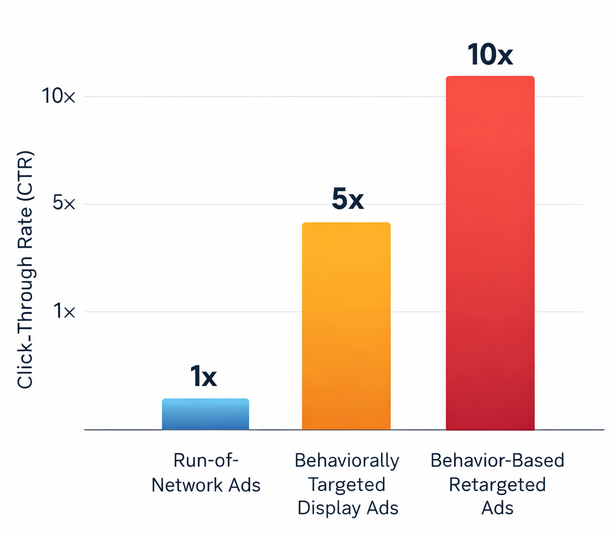
Comparison of click-through rate performance: standard ads vs. behaviorally targeted and retargeted campaigns demonstrating up to 10× higher engagement
Behavioral targeting focuses on actions, which are much stronger indicators of readiness and relevance. According to industry research, campaigns that use behavioral data can improve conversion rates by 2–3 times compared to demographic-only targeting. In addition, advertisers using behavior-based audiences report up to 30% lower cost per acquisition due to reduced ad waste.
Another key advantage is adaptability. Behavioral data updates continuously, allowing audiences to evolve as user interests and intent change.
Key Types of Behavioral Data to Use
Engagement Behavior
This includes likes, comments, shares, saves, and video views. Users who actively engage with content are far more likely to respond to related ads. Studies show that engaged users are up to 5 times more likely to convert than passive viewers.
Interaction With Specific Pages or Profiles
People who follow or interact with certain pages, accounts, or communities reveal clear topical interests. Targeting based on these interactions helps reach users already familiar with a niche or problem.
Content Consumption Patterns
Behavioral data also includes how long users watch videos, which posts they return to, and how frequently they engage with similar content. Longer and repeated interactions often signal stronger intent and higher lifetime value potential.
Recency and Frequency Signals
Recent actions matter more than older ones. Data shows that users who performed a relevant action within the last 7–14 days are significantly more likely to convert than those whose activity is over 30 days old. Frequency also matters: repeated engagement usually indicates deeper interest.
How to Apply Behavioral Data in Targeting
Build Action-Based Audiences
Start by grouping users based on specific actions, such as interacting with content in a niche, engaging with certain profiles, or being active in relevant communities. These audiences are naturally more qualified than broad interest groups.
Segment by Intent Level
Not all behaviors carry the same weight. Watching a full video or repeatedly engaging with similar content often signals higher intent than a single like. Segment audiences accordingly and tailor messaging to each intent level.
Combine Behavioral Signals
The strongest targeting strategies layer multiple behaviors together. For example, users who both engage with niche content and interact with specific profiles tend to convert at much higher rates than users who match only one behavior.
Refresh Audiences Regularly
Behavioral data loses value over time. Regularly updating audiences ensures that campaigns target users whose actions are still relevant. Marketers who refresh behavioral audiences monthly often see more stable performance and fewer sudden drops in conversion rates.
Common Mistakes to Avoid
One common mistake is over-broad behavioral definitions. Including weak signals can dilute audience quality. Another is ignoring recency, which can result in targeting users whose intent has already faded.
It is also important not to rely on a single behavioral signal. Strong performance usually comes from combining several meaningful actions rather than optimizing around one metric.
Measuring Success With Behavioral Targeting
To evaluate effectiveness, track metrics such as conversion rate, cost per acquisition, and engagement depth. Behavioral targeting should lead to higher-quality traffic, longer session times, and better post-click behavior.
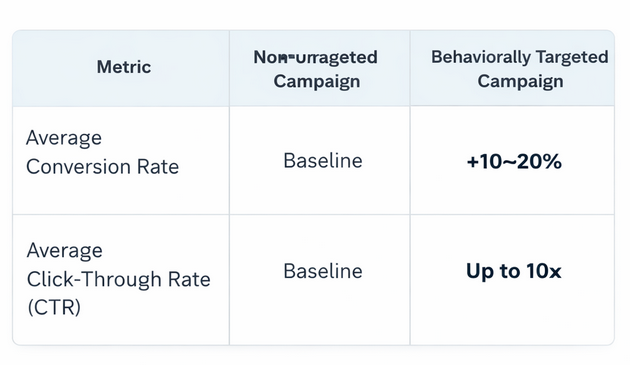
Performance comparison showing how behavioral targeting drives higher conversion rates and click-through rates compared with non-targeted campaigns
According to multiple performance studies, campaigns optimized around behavioral data see an average improvement of 20–40% in overall return on ad spend compared to static targeting models.
Final Thoughts
Behavioral data allows marketers to move beyond assumptions and target audiences based on real intent. By focusing on actions, recency, and engagement depth, campaigns become more relevant, more efficient, and more scalable.
As digital platforms continue to limit third-party data, behavioral signals generated within social ecosystems will play an even more critical role in effective targeting strategies.