Traditional prospecting relies heavily on static firmographic and demographic data. While useful, these data points fail to capture one critical element: timing. Buyer intent data fills this gap by revealing which prospects are actively researching topics, products, or services related to your offering.
Organizations that integrate intent data into their prospecting strategies see measurable improvements. According to recent industry reports, companies using intent data experience up to a 78% increase in conversion rates and a 47% higher average deal size compared to those relying solely on traditional targeting methods.
What Is Buyer Intent Data?
Buyer intent data refers to behavioral signals that indicate a potential customer’s interest in a specific product, service, or topic. These signals are typically collected from online activities such as:
-
Content consumption (articles, whitepapers, case studies)
-
Search behavior and keyword activity
-
Website visits and page engagement
-
Engagement with ads or email campaigns
Intent data is often categorized into two types:
First-Party Intent Data
Collected directly from your own digital properties, this includes website analytics, email engagement, and CRM interactions. It is highly accurate but limited in scope.
Third-Party Intent Data
Aggregated from external networks and publishers, this data provides a broader view of prospect behavior across the web. It helps identify prospects who have not yet engaged with your brand.
Why Buyer Intent Data Matters in Prospecting
The biggest challenge in prospecting is identifying who is ready to buy. Intent data addresses this by helping teams focus on prospects already in the research phase.
Studies show that 70% of the buyer’s journey is completed before a prospect ever contacts a vendor. Without intent data, sales teams are often reaching out too early or too late.
By incorporating intent signals, teams can:
-
Prioritize high-value, in-market prospects
-
Reduce time spent on unqualified leads
-
Improve alignment between marketing and sales
-
Increase response and engagement rates
Key Use Cases for Buyer Intent Data
1. Prioritizing Prospect Lists
Instead of working through static lists, sales teams can rank prospects based on intent signals. Accounts showing increased activity around relevant topics should be contacted first.
This approach can reduce prospecting time by up to 30% while improving pipeline quality.
2. Personalizing Outreach
Intent data enables highly relevant messaging. For example, if a prospect is researching a specific solution category, outreach can directly address that interest.
Personalized emails driven by intent data have been shown to increase response rates by up to 2–3 times compared to generic outreach.
3. Timing Outreach for Maximum Impact
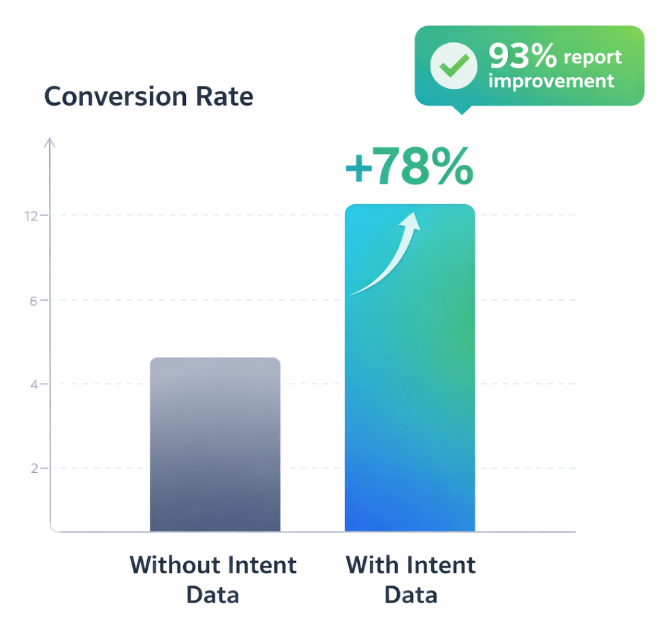
Intent-driven strategies significantly outperform traditional prospecting, with measurable gains in conversion rates and overall performance
Timing is critical. Contacting prospects during peak research activity increases the likelihood of engagement.
Organizations using real-time intent signals report a 35% increase in meeting booking rates.
4. Identifying New Market Opportunities
Intent data can uncover demand in segments or industries that were not previously targeted. This allows marketing teams to expand into high-potential areas with confidence.
How to Implement Buyer Intent Data in Your Workflow
Step 1: Define Relevant Intent Signals
Start by identifying keywords, topics, and behaviors that align with your offering. Focus on signals that indicate buying-stage activity rather than general interest.
Step 2: Segment and Score Prospects
Assign scores based on intensity and frequency of intent signals. Combine this with firmographic data to create a prioritized prospect list.
Step 3: Align Sales and Marketing Teams
Ensure both teams are using the same intent definitions and scoring models. Shared visibility into intent data improves coordination and reduces friction.
Step 4: Integrate Into Outreach Campaigns
Use intent insights to tailor messaging across email, ads, and sales outreach. Consistency across channels reinforces relevance.
Step 5: Continuously Optimize
Monitor performance and refine your targeting criteria. Over time, patterns will emerge that indicate which signals are most predictive of conversion.
Common Mistakes to Avoid
-
Relying solely on intent data without validating with firmographic fit
-
Ignoring signal recency and acting on outdated intent
-
Over-personalizing with assumptions rather than confirmed behavior
-
Failing to integrate intent data into CRM and workflows
Measuring Success
To evaluate the effectiveness of intent-driven prospecting, track the following metrics:
-
Conversion rates
-
Pipeline velocity
-
Cost per qualified lead
-
Engagement rates
Companies that adopt intent-based strategies often see a 20–40% improvement in pipeline efficiency within the first six months.
Conclusion
Buyer intent data transforms prospecting from a volume-based activity into a precision-driven strategy. By focusing on prospects who are actively researching solutions, teams can improve efficiency, increase conversions, and build stronger pipelines.
As competition for attention continues to grow, leveraging intent data is no longer optional—it is a critical component of modern prospecting.