Traditional retargeting often relies on simple signals such as page visits or cart abandonment. While useful, these signals only scratch the surface. Engagement data—how users interact, what they consume, and how deeply they engage—reveals intent, readiness, and interest levels that standard audience definitions miss.
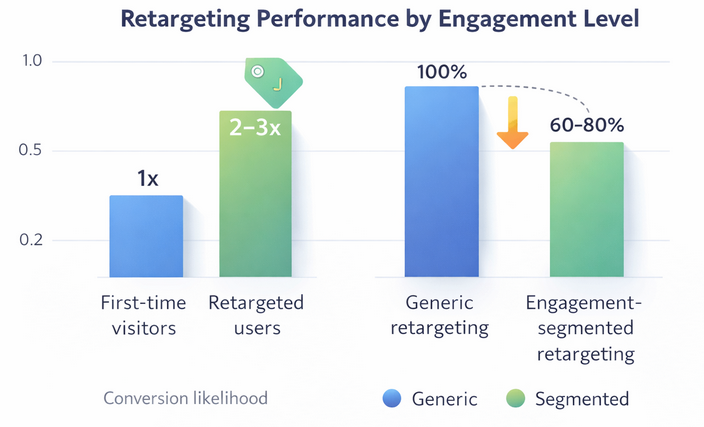
Bar chart comparing first-time visitor conversions with retargeted users, and CPA for generic versus engagement-segmented retargeting
According to industry benchmarks, retargeted users are 2–3× more likely to convert than first‑time visitors. Even more importantly, campaigns segmented by engagement depth consistently deliver 20–40% lower cost per acquisition (CPA) compared to generic retargeting pools.
Engagement data helps answer three critical questions:
-
Who is paying real attention?
-
What stage of the funnel are they in?
-
How aggressively should they be retargeted?
Types of Engagement Data That Matter Most
Not all engagement signals carry equal value. The most effective retargeting strategies prioritize quality over volume.
1. Content Interaction Depth
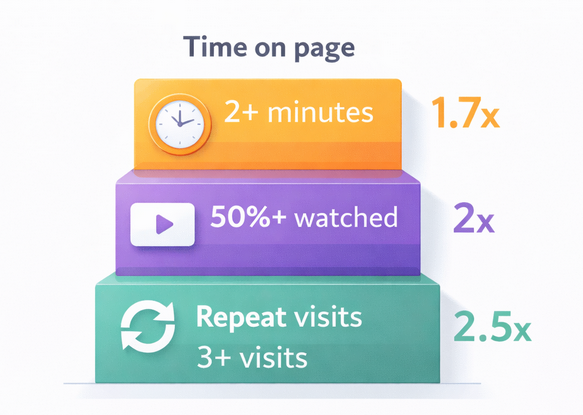
Infographic showing higher conversion signals for deep page engagement, video watch rate above 50%, and repeat site visits
Users who scroll, watch, or read extensively show significantly higher intent than those who bounce quickly.
-
Visitors who spend 2+ minutes on a page convert up to 70% more often than short‑session visitors.
-
Video viewers who watch over 50% of a video are typically 2× more likely to convert than viewers who drop off early.
2. Repeated Engagement
Frequency is a strong buying signal.
-
Users returning 3 or more times convert at nearly 2.5× the rate of single‑visit users.
-
Repeat engagement also correlates with shorter sales cycles and higher average order values.
3. High‑Intent Actions
Certain actions strongly predict conversion readiness:
-
Button clicks
-
Form starts (even without submission)
-
Pricing or feature page visits
These users often sit in the top 10–20% of engagement quality, yet they’re commonly mixed into broad retargeting audiences where their value is diluted.
How to Segment Retargeting Audiences Using Engagement Signals
Smarter retargeting comes from separating audiences by intent level instead of treating everyone the same.
Segment A: Light Engagement
Who they are:
-
Single visit
-
Short session duration
-
Minimal interaction
How to retarget:
-
Educational messaging
-
Low‑frequency ads
-
Content‑driven creatives
Segment B: Medium Engagement
Who they are:
-
Multiple page views
-
Long‑form content consumers
-
Repeat visitors
How to retarget:
-
Problem‑solution messaging
-
Social proof
-
Case studies and benefits
Segment C: High Engagement
Who they are:
-
Pricing or product page visitors
-
Repeat sessions
-
Click or form interactions
How to retarget:
-
Direct offers
-
Strong calls to action
-
Short conversion windows
Brands that apply engagement‑based segmentation typically see 30–50% higher conversion rates compared to flat retargeting strategies.
Optimizing Budget Allocation with Engagement Data
One of the most overlooked benefits of engagement‑based retargeting is budget efficiency.
Instead of evenly distributing spend:
-
Allocate 60–70% of retargeting budget to high‑engagement segments
-
Reserve 20–30% for medium engagement
-
Limit low‑engagement users to 10% or less
This structure reflects actual conversion probability rather than audience size. Advertisers who follow this model often report 25–35% lower CPA without increasing total ad spend.
Common Mistakes to Avoid
-
Over‑retargeting low‑intent users, which inflates costs
-
Using identical creatives across all engagement levels
-
Ignoring engagement recency—older engagement loses value quickly
Data shows that engagement older than 30 days can be 40% less effective for conversion‑focused retargeting compared to recent interactions.
Related Articles You May Find Useful
Final Thoughts
Engagement data turns retargeting from a blunt instrument into a precision tool. By identifying who is truly interested—and how interested they are—you can serve more relevant messages, control costs, and accelerate conversions.
Smarter retargeting isn’t about reaching more people. It’s about reaching the right people at the right moment, based on what they’ve already told you through their behavior.