
Every campaign generates valuable signals: impressions, clicks, conversions, costs, and audience responses. Over time, these signals form patterns that reveal what works, what doesn’t, and why. Analyzing historical data allows advertisers to:
-
Identify trends in performance across time periods
-
Understand seasonality and demand fluctuations
-
Reduce wasted spend by repeating proven strategies
-
Make forecasting and budgeting more accurate
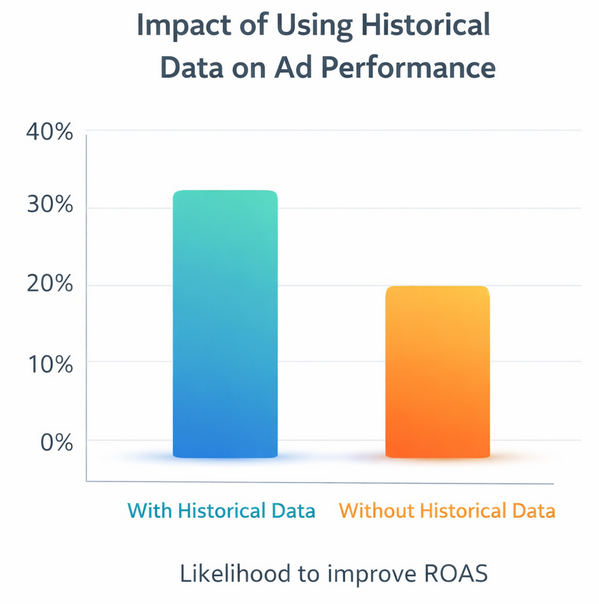
Comparison of ROAS improvement likelihood with and without historical data analysis
According to industry benchmarks, advertisers who consistently analyze historical performance data are up to 30–40% more likely to improve return on ad spend compared to teams relying primarily on real-time optimization alone.
What Types of Historical Data Are Most Valuable
Not all data has equal decision-making value. The most actionable insights usually come from:
1. Conversion and Revenue Data
Looking at conversion rates, cost per conversion, and revenue over time helps determine which campaigns and audiences truly drive business results. Studies show that optimizing based on historical conversion data can reduce acquisition costs by up to 25%.
2. Audience Performance Trends
Past audience behavior reveals which segments respond best to specific offers or creatives. For example, repeat exposure audiences often convert 2–3× higher than cold audiences when historical engagement is taken into account.
3. Creative and Messaging Performance
Analyzing historical creatives helps identify messaging patterns that consistently perform well. Data from large-scale ad accounts indicates that reusing top-performing creative concepts can increase click-through rates by 15–20% compared to constantly launching untested variations.
4. Time-Based and Seasonal Patterns
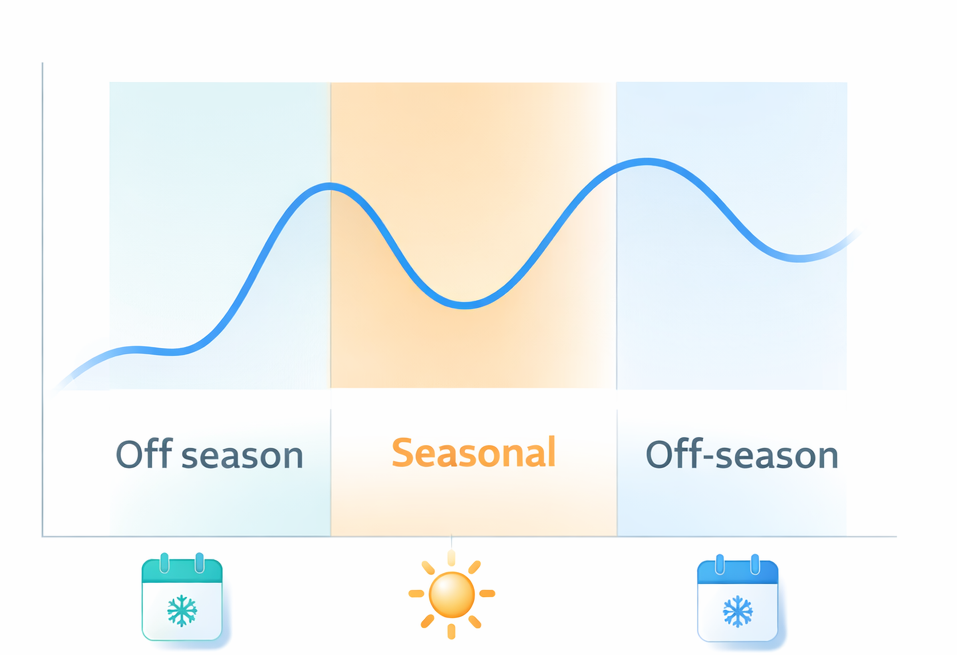
Line chart showing conversion rate changes through seasonal and off-season periods
Historical timelines reveal daily, weekly, and seasonal performance shifts. Many advertisers observe conversion rate fluctuations of 20–50% during peak seasonal periods compared to off-season months.
How to Turn Historical Data Into Better Decisions
Establish Clear Benchmarks
Use past performance to define realistic benchmarks for key metrics such as CPA, CTR, and ROAS. Benchmarks prevent overreacting to short-term fluctuations and help teams evaluate performance objectively.
Segment Data Before Analyzing
Aggregated data often hides important insights. Break historical data down by:
-
Audience type (cold, warm, retargeting)
-
Placement and device
-
Creative format
-
Funnel stage
This approach often uncovers performance gaps of 10–30% that are invisible at a high level.
Identify Repeatable Patterns
Look for strategies that performed well multiple times, not just once. Decisions based on repeatable outcomes are far more reliable than one-off wins. Advertisers using pattern-based optimization report more stable performance during platform or algorithm changes.
Apply Learnings to Testing Strategy
Historical insights should guide what to test next. Instead of guessing, prioritize experiments based on proven signals. Data-driven testing frameworks are shown to improve test success rates by up to 50%.
Common Mistakes When Using Historical Data
-
Relying on outdated data without considering platform changes
-
Ignoring context such as budget shifts or offer changes
-
Overfitting decisions to small sample sizes
-
Treating historical data as static instead of directional guidance
Avoiding these pitfalls ensures historical data supports smarter decisions rather than reinforcing bad assumptions.
Using Historical Data for Forecasting and Planning
Forecasting becomes significantly more accurate when grounded in historical trends. Advertisers who base budget planning on past performance typically see 20–35% less variance between forecasted and actual results, leading to better cash flow and scaling decisions.
Suggested Reading
To deepen your understanding of data-driven advertising, explore these related articles:
-
When to Consolidate Campaigns – Learn how historical performance data helps identify when simplification leads to better results.
-
How to Build Resilient Ad Strategies – Discover how past data can protect performance during market or platform changes.
-
Smarter Targeting, Bigger Impact – See how historical audience insights lead to more efficient targeting decisions.
Final Thoughts
Historical data turns advertising from reactive execution into strategic decision-making. By systematically analyzing past performance, advertisers gain clarity, confidence, and consistency—allowing every future decision to be backed by evidence rather than instinct.