
Accurately measuring the true impact of advertising has become increasingly difficult due to privacy restrictions, signal loss, and limitations of traditional attribution models. Media Mix Modeling (MMM) is emerging as a reliable methodology for evaluating marketing performance at a broader level.
Introduction
For years, advertisers relied heavily on deterministic attribution models and platform-reported metrics to evaluate campaign effectiveness. However, privacy changes, cookie limitations, and restricted tracking environments have significantly reduced the reliability of user-level attribution.
Media Mix Modeling provides an alternative analytical framework that evaluates the impact of marketing channels using aggregated historical data rather than individual user tracking. By analyzing correlations between marketing investments and business outcomes, MMM allows marketers to estimate the incremental contribution of advertising channels, including Meta Ads.
What Is Media Mix Modeling
Media Mix Modeling is a statistical analysis technique that evaluates how different marketing inputs influence business outcomes such as revenue, conversions, or leads.
Instead of relying on individual user journeys, MMM analyzes time-series data across multiple variables, including:
-
advertising spend by channel
-
seasonal demand patterns
-
pricing changes
-
promotions and discounts
-
macroeconomic conditions
-
competitor activity
By modeling the relationship between these variables and performance outcomes, marketers can estimate how much each marketing channel contributes to growth.
This approach has gained renewed popularity in recent years. According to a Nielsen study, media mix modeling can explain between 60% and 90% of the variation in sales performance across many industries.
Why Traditional Attribution Is Struggling
Several factors have made traditional attribution models less reliable:
-
Cookie restrictions and browser privacy policies
-
App tracking limitations
-
Growing use of ad blockers
-
Cross-device user behavior
Research indicates that up to 40% of conversions may be missing from pixel-based attribution systems due to signal loss and privacy limitations.
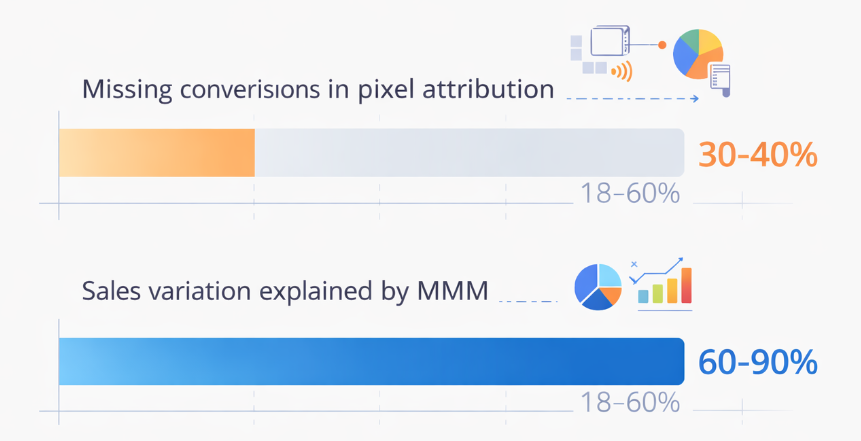
Comparison between signal loss in pixel-based attribution and explanatory power of media mix modeling
As a result, marketers increasingly rely on aggregated measurement approaches like MMM to complement or replace user-level attribution.
How Media Mix Modeling Evaluates Meta Ads
Media Mix Modeling evaluates Meta Ads by examining historical relationships between advertising spend and business outcomes over time.
The process typically involves several steps.
1. Data Collection
The first step is gathering historical data from multiple sources. A typical MMM dataset may include:
-
weekly or daily Meta Ads spend
-
impressions and reach
-
other channel investments such as search or display
-
conversions or revenue
-
marketing promotions
-
seasonality indicators
Many models require at least 12 to 24 months of data to produce stable results.
2. Data Transformation
Raw advertising data often requires transformation before modeling. Common transformations include:
-
adstock modeling to represent carryover effects of advertising
-
diminishing returns curves
-
normalization of variables
Adstock effects are particularly important for social media advertising. Studies suggest that between 30% and 50% of advertising impact may occur days or weeks after the initial exposure.
3. Statistical Modeling
Once the data is prepared, regression-based models or machine learning algorithms estimate the relationship between advertising inputs and performance outcomes.
These models calculate:
-
incremental contribution of Meta Ads
-
return on ad spend by channel
-
diminishing returns at different budget levels
For example, MMM might show that increasing Meta Ads investment by 10% produces only a 4% increase in conversions due to saturation effects.
4. Budget Optimization
After estimating channel contributions, marketers can simulate different budget allocations.
The model can answer questions such as:
-
How would conversions change if Meta Ads spend increased by 20%?
-
What is the optimal balance between paid social and search?
-
Which channels deliver the highest marginal returns?
Organizations using media mix modeling frequently report marketing efficiency improvements of 10–20% after reallocating budgets based on model insights.
Advantages of Media Mix Modeling
MMM offers several advantages when evaluating Meta Ads performance.
Privacy-Resilient Measurement
Because MMM relies on aggregated data rather than user-level tracking, it remains effective even when cookies and identifiers are unavailable.
Holistic Channel Evaluation
MMM evaluates marketing performance across all channels simultaneously, allowing marketers to understand the relative contribution of Meta Ads compared to other channels.
Long-Term Impact Analysis
The methodology captures long-term brand and awareness effects that are often invisible in short attribution windows.
Brand-driven campaigns can influence purchasing decisions weeks after exposure, which traditional attribution models often fail to capture.
Limitations to Consider
Despite its benefits, media mix modeling has several limitations.
First, MMM does not provide user-level insights or granular campaign analysis. It is best used for strategic budget decisions rather than tactical optimization.
Second, building reliable models requires substantial historical data and analytical expertise.
Finally, model accuracy depends heavily on data quality. Missing or inconsistent data can reduce the reliability of results.
Because of these limitations, many organizations combine MMM with other measurement methods such as incrementality testing and marketing experiments.
Best Practices for Applying MMM to Meta Ads
To get reliable insights from media mix modeling, marketers should follow several best practices.
Maintain Consistent Data Collection
Ensure that marketing spend, conversions, and external variables are tracked consistently over time.
Include External Drivers
Incorporate factors such as seasonality, pricing changes, and promotional campaigns to avoid overestimating advertising impact.
Run Periodic Model Updates
Marketing environments change quickly. Updating models quarterly or semi-annually helps maintain accuracy.
Combine MMM With Experiments
Controlled experiments such as geo-lift or incrementality tests can validate and improve MMM results.
Conclusion
As privacy regulations and signal loss continue to challenge traditional attribution systems, marketers need alternative ways to measure advertising effectiveness. Media Mix Modeling provides a privacy-resilient, data-driven approach for evaluating Meta Ads performance and optimizing marketing budgets.
By analyzing historical relationships between advertising investments and business outcomes, MMM helps organizations understand the true incremental impact of paid social advertising and make more informed strategic decisions.
Recommended Articles
You may also find these articles useful: