Meta invoices are usually treated as finance paperwork.
For performance marketers, they should also be treated as campaign evidence.
If you run paid social campaigns across multiple ad accounts, clients, regions, brands, or seasonal tests, billing records help you answer a practical question: where did the money actually go?
Meta’s help flow for this task is straightforward: go to Settings, select Billing & payments, then select Invoices. The indexed Meta source also notes that invoices can be filtered.
That sounds like an admin task. But when ad spend is moving quickly, invoice discipline directly affects budget efficiency, campaign analysis, and team accountability.
What the Invoice View Actually Solves
The invoice view helps advertisers find billing records tied to Meta ad activity.
That matters because campaign dashboards and finance records often answer different questions.
Ads Manager tells you how campaigns performed. Invoices tell you what was billed.
Those two views should be reconciled regularly, especially when you manage several campaigns, several client accounts, or several billing entities.
A practical invoice review should confirm 5 invoice fields before optimization decisions: ad account, billing period, invoice status, amount, and spend pattern.
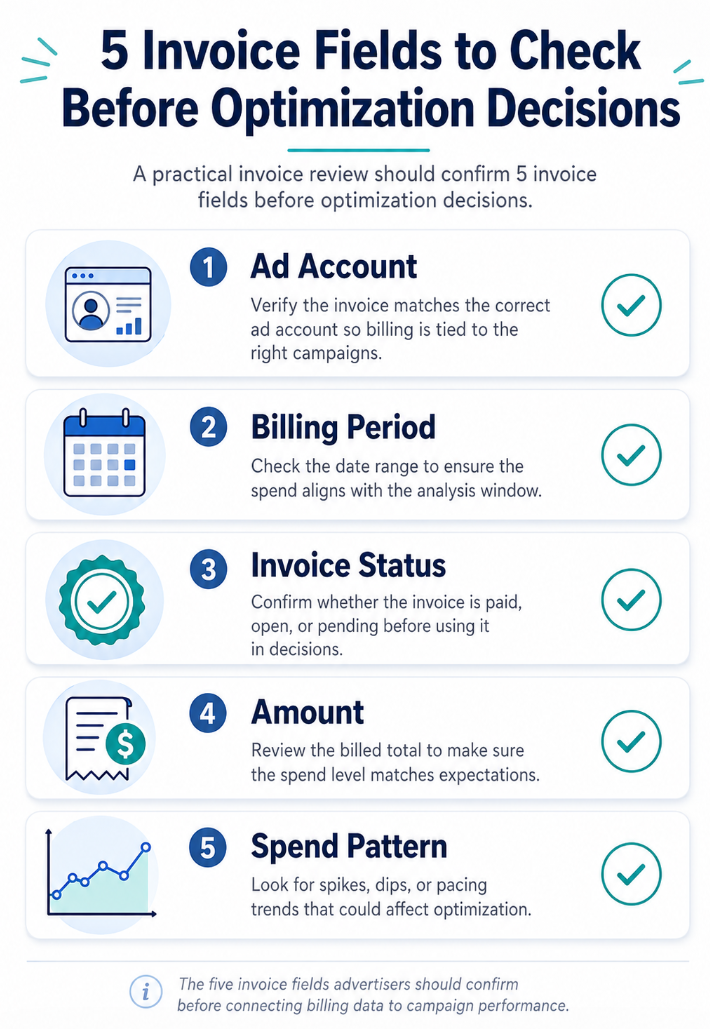
The five invoice fields advertisers should confirm before connecting billing data to campaign performance
Those fields help you connect finance data to marketing decisions.
Without that connection, teams can misread performance. A campaign may look inefficient because the wrong date range is being reviewed. A client may question spend because invoice timing does not match the campaign reporting window. An agency may optimize the wrong ad account because billing and campaign ownership were never clearly mapped.
Why This Matters for CPC, CPA, CAC, ROAS, and Wasted Spend
Invoices do not improve CPC or CPA by themselves.
They improve the decisions around those metrics.
When billing records are clean, marketers can see whether spend concentration matches strategy. That makes it easier to spot problems like:
- Budget being spent in the wrong ad account.
- Spend attached to campaigns that are no longer part of the active test plan.
- Client billing disputes slowing down optimization.
- Campaigns being judged on partial or mismatched billing periods.
- Spend increases happening before audience quality has been validated.
The real business impact is budget clarity.
If your finance team, media buyer, and client success team all work from different views of spend, campaign decisions slow down. That delay can increase CAC, reduce ROAS, and create unnecessary pressure to cut campaigns before the data is properly understood.
Typical Scenarios Where Invoice Reviews Matter
Invoice review is especially important in these situations.
Agencies managing multiple clients
Agencies need clean billing records to separate client spend, reconcile invoices, and avoid cross-account confusion.
SMBs increasing Meta budgets
As spend rises, small billing errors become more visible. Invoice review helps owners understand whether budget increases are tied to actual campaign priorities.
B2B lead-generation teams
Lead quality analysis depends on knowing which campaigns consumed budget. If invoices, campaign naming, and CRM reporting are not aligned, CAC analysis becomes unreliable.
Affiliate and performance teams
Affiliate campaigns often run fast tests with strict profitability thresholds. Invoice checks help prevent spend leakage across campaigns that should have been paused, capped, or isolated.
Startup marketing teams
Startups frequently move from founder-managed ads to structured paid acquisition. Invoice discipline helps prevent early scaling from turning into messy spend reporting.
Risks and Considerations
Invoice access is not the same as campaign insight.
A billing view can show what was charged, but it does not explain whether the audience, offer, creative, or funnel performed well.
That creates several risks.
First, teams may overreact to invoice totals without checking campaign-level outcomes.
Second, invoice timing may differ from internal reporting cycles.
Third, multiple ad accounts can make spend reconciliation harder if account ownership is unclear.
Fourth, billing access can become a bottleneck if only one person has the permissions needed to view or export invoices.
Finally, invoice data should be interpreted alongside campaign performance, audience structure, and conversion quality. A large invoice is not automatically a problem. A large invoice tied to low-quality traffic, weak leads, or unclear campaign ownership is the problem.
Prerequisites and Dependencies
Before invoice reviews become useful, advertisers need a clean operating setup.
You should know:
- Which Meta Business Portfolio owns the ad account.
- Which ad account belongs to each brand, market, client, or campaign line.
- Who has billing and finance access.
- Which campaigns were active during the billing period.
- Which audiences were tested during that period.
- Which campaign names, purchase orders, or internal labels finance will use to reconcile spend.
For every invoice review, ask 3 performance questions: which audience consumed spend, which campaigns converted, and which billing or account issues disrupted delivery.
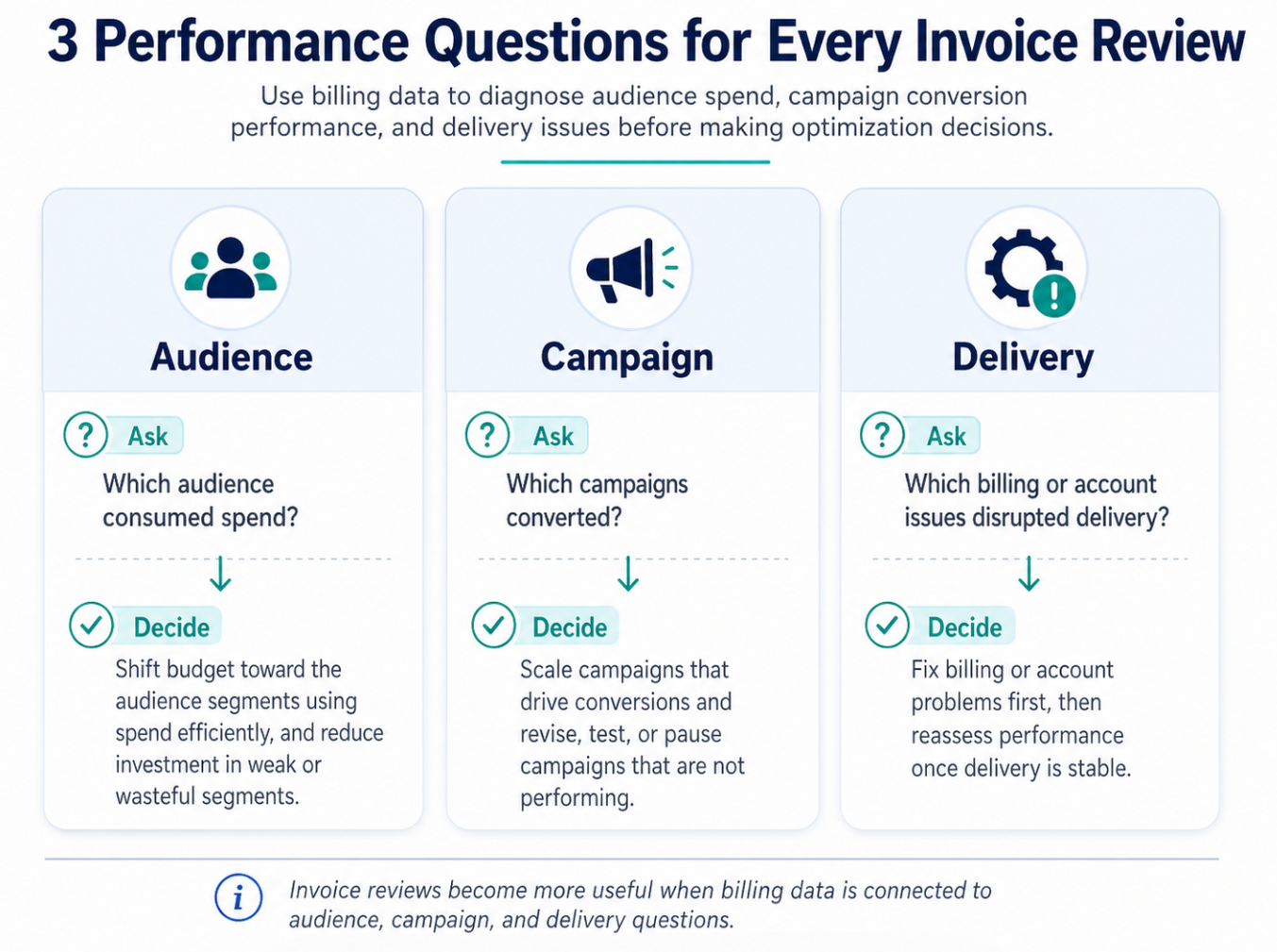
Invoice reviews become more useful when billing data is connected to audience, campaign, and delivery questions
That keeps billing from becoming a detached accounting exercise.
How LeadEnforce Helps
LeadEnforce does not replace Meta invoices or billing tools.
It helps with the performance side of the billing conversation.
Once you know where spend went, the next question is whether that spend reached the right people. LeadEnforce helps advertisers build more relevant audiences from Facebook groups, Instagram profiles, Instagram followers and engagers, LinkedIn professional data, and custom social-profile data.
That matters because invoice reviews often reveal wasted spend, but they do not solve the targeting problem behind it.
For example, an agency may see that a prospecting campaign consumed a meaningful portion of monthly budget but generated weak lead quality. LeadEnforce helps the team build a more intent-based audience for the next test instead of simply repeating broad targeting.
For B2B advertisers, LeadEnforce can help translate niche professional or community signals into practical audience inputs. For ecommerce and SMB teams, it can help test communities, competitor-adjacent audiences, or Instagram engagement pools before committing more spend.
The goal is not to make billing more complex.
The goal is to make every invoice easier to justify with better audience strategy.
Practical Recommendations
Review invoices on a fixed schedule, not only when there is a dispute.
Match invoice periods to campaign reporting periods before making performance judgments.
Keep ad account ownership and campaign naming clean enough that finance can understand what marketing is doing.
Document who is responsible for billing access, invoice review, and spend reconciliation.
Do not use invoice totals as your only performance signal. Compare spend with CPC, CPA, CAC, ROAS, conversion rate, and lead quality.
When invoices reveal waste, audit the audience strategy before assuming the entire campaign failed.
Use LeadEnforce to build sharper audience tests after identifying where broad targeting or weak audience relevance created inefficient spend.
Final Takeaway
Viewing Meta invoices is not just a finance task.
It is part of paid social operating discipline.
When invoices, campaign structure, and audience strategy are reviewed together, advertisers get a clearer view of where budget is going, why performance changed, and how to reduce wasted spend in the next test.
Related LeadEnforce Articles
- How Meta Business Suite Works — And Where Advertisers Misread It — Helps advertisers understand why Business Suite views can simplify the interface without explaining the full operating system behind campaigns.
- Meta Business Suite Homepage: How to Read The Signals — Useful for teams that need to interpret account alerts and operational signals before reacting to campaign data.
- Why Your Meta Business Portfolio Setup Affects Paid Social Performance — Explains how business structure can affect campaign execution, reporting, and performance diagnosis.
- Fix Disabled or Restricted Meta Ad Accounts Without Losing Campaign Performance — Relevant when billing, verification, or account issues interrupt delivery and distort invoice-to-performance analysis.
- What Is Facebook Ad Audience Targeting and Why It Matters — Connects billing discipline back to the core performance question: whether spend is reaching the right audience.