Marketers often use the terms “landing page” and “SEO page” interchangeably. In practice, they serve fundamentally different purposes. A landing page built for pay-per-click (PPC) campaigns is engineered for immediate conversion. An SEO page is designed to capture organic search traffic and satisfy search intent over time.
Understanding how these two page types differ in intent, architecture, messaging, and optimization metrics is essential for performance marketing efficiency.
According to industry benchmarks, the average Google Ads conversion rate across industries is approximately 4–6%, while top-performing landing pages can reach conversion rates above 10%. Meanwhile, organic search drives roughly 53% of all website traffic, making SEO pages foundational for long-term growth.
Both are critical assets. But they should never be built the same way.
Core Objective: Immediate Conversion vs. Search Visibility
PPC Landing Pages
PPC landing pages are designed with a single, focused conversion goal. This may include:
-
Lead form submission
-
Demo booking
-
Webinar registration
-
Product purchase
Traffic is paid for, meaning every click has a cost. The page must convert efficiently to justify ad spend. Clarity, relevance, and friction reduction are priorities.
SEO Pages
SEO pages aim to rank for specific keywords and capture organic traffic. Their primary goal is visibility in search engines, followed by user engagement and eventual conversion.
They often target informational, navigational, or commercial intent queries and must provide comprehensive value to rank competitively.
Traffic Intent: Controlled vs. Exploratory
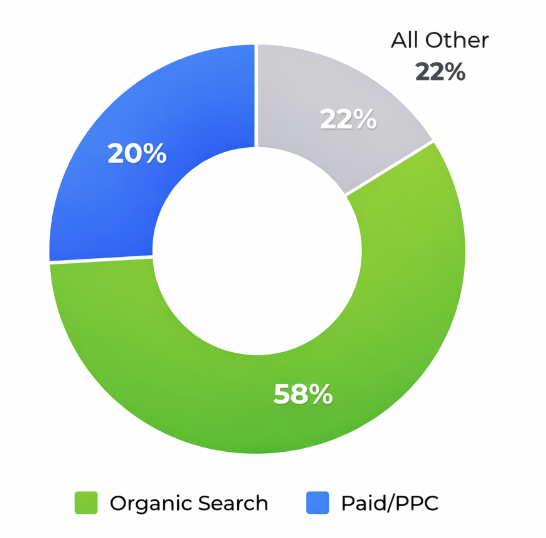
Proportion of web traffic from organic search compared to other sources including paid search
PPC traffic is highly controlled. You define:
-
Keywords
-
Audience targeting
-
Demographics
-
Behavioral signals
Visitors arrive with a defined commercial intent triggered by ad copy.
SEO traffic is broader. Users may be researching, comparing options, or seeking general information. The page must address multiple sub-questions and related search queries.
This difference significantly impacts page structure.
Page Structure and Content Depth
PPC Landing Page Structure
-
One primary headline aligned with ad copy
-
Focused subheading reinforcing value proposition
-
Minimal navigation or no navigation
-
Clear call-to-action above the fold
-
Social proof (testimonials, trust badges)
-
Conversion form or button
PPC pages are intentionally narrow in scope. Removing distractions improves performance. Studies show that reducing navigation options can increase conversion rates by up to 16%.
SEO Page Structure
-
Keyword-optimized H1 and semantic subheadings
-
Internal linking architecture
-
Comprehensive content (1,000–2,500+ words typical for competitive terms)
-
FAQ sections
-
Schema markup
-
Multimedia elements
Long-form SEO content tends to perform better in rankings. Research shows that pages ranking on the first page of search results often exceed 1,400 words on average.
SEO pages are built for crawlability, topical authority, and depth.
Messaging Strategy
PPC Messaging
-
Direct and benefit-focused
-
Aligned precisely with ad copy
-
Focused on a single offer
-
Urgency-driven
Message match is critical. If the ad promises “Free PPC Audit,” the landing page headline must reinforce that exact offer. A mismatch increases bounce rate and lowers Quality Score.
SEO Messaging
-
Informational and authoritative
-
Optimized for multiple keyword variations
-
Structured to answer related queries
-
Less urgency-driven
SEO messaging balances readability with keyword inclusion. It supports both users and search engine algorithms.
Conversion Optimization vs. Ranking Optimization
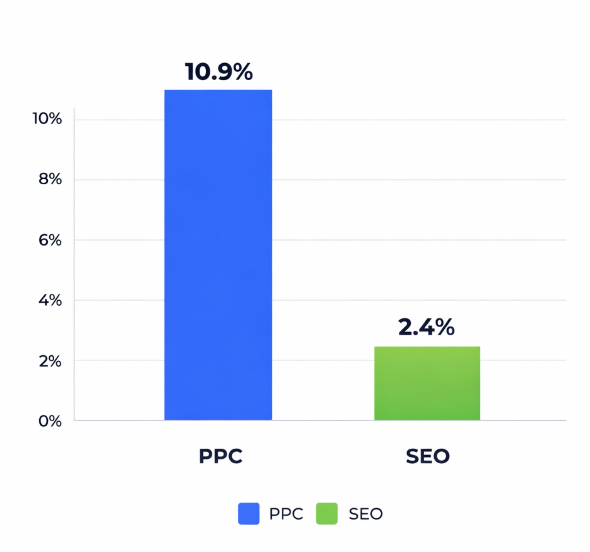
Average conversion rates: PPC landing pages (~10.9%) vs. SEO pages (~2.4%)
PPC pages are optimized for:
-
Conversion rate (CVR)
-
Cost per acquisition (CPA)
-
Return on ad spend (ROAS)
-
Quality Score
SEO pages are optimized for:
-
Organic rankings
-
Click-through rate from SERPs
-
Dwell time
-
Backlinks
-
Topical authority
The KPI frameworks differ significantly. For PPC, speed of testing is essential. A/B testing headlines, CTAs, and layouts is routine. Even small conversion rate increases can significantly lower acquisition costs.
SEO optimization, by contrast, is cumulative and long-term. Results may take months, but organic traffic compounds over time.
Design Philosophy
PPC pages prioritize:
-
Visual hierarchy
-
Conversion-focused layout
-
Fast load speed
-
Above-the-fold clarity
Every additional distraction increases the risk of abandonment. Even a one-second delay in load time can reduce conversions by approximately 7%.
SEO pages prioritize:
-
Structured content layout
-
Readability and scannability
-
Internal linking opportunities
-
Rich media to increase engagement time
Navigation is typically preserved because it supports crawl depth and site architecture.
Testing and Iteration
PPC landing pages are highly test-driven. Marketers regularly test:
-
Headlines
-
Button colors
-
Form length
-
Trust elements
Because traffic is immediate, statistically significant results can be obtained quickly.
SEO pages are tested differently. Iteration focuses on:
-
Updating content freshness
-
Expanding keyword coverage
-
Improving internal linking
-
Enhancing featured snippet eligibility
The timeline for measurable impact is longer.
When to Use Each Page Type
Use a PPC landing page when:
-
Running paid search or social campaigns
-
Promoting a specific offer
-
Targeting high-intent keywords
-
Needing measurable short-term ROI
Use an SEO page when:
-
Building long-term organic visibility
-
Targeting informational queries
-
Establishing topical authority
-
Supporting inbound traffic growth
In mature marketing strategies, both coexist. SEO builds sustained traffic. PPC captures high-intent demand immediately.
Common Mistakes
-
Sending paid traffic to a generic homepage.
-
Using SEO-style long-form content for PPC campaigns.
-
Removing navigation on SEO pages, harming crawlability.
-
Failing to maintain message match between ads and landing pages.
These structural mismatches often result in wasted ad spend or underperforming organic content.
Final Thoughts
PPC landing pages and SEO pages serve distinct strategic functions. One is engineered for immediate, controlled conversion. The other is built for discoverability, authority, and long-term growth.
Treating them as interchangeable assets undermines both paid and organic performance. Instead, align page architecture, messaging, and optimization tactics with traffic intent and campaign goals.
When executed correctly, the combination of conversion-focused PPC landing pages and authoritative SEO pages creates a balanced, scalable acquisition engine.