Sales teams often spend a disproportionate amount of time chasing leads that will never convert. According to industry research, up to 67% of lost sales result from improper lead qualification, while sales representatives spend only about 35% of their time actually selling. The rest is consumed by administrative work and unproductive outreach.
Effective lead filtering is the key to reclaiming that lost time. By identifying and prioritizing high-quality leads early in the funnel, businesses can streamline workflows, improve conversion rates, and increase overall revenue efficiency.
Why Lead Filtering Matters
Lead filtering ensures that sales teams engage only with prospects who are most likely to convert. Without it, teams risk:
-
Wasting time on unqualified or irrelevant leads
-
Lowering conversion rates due to poor targeting
-
Increasing customer acquisition costs
-
Creating friction between marketing and sales teams
Organizations that implement structured lead filtering processes report up to a 30% increase in sales productivity and a 20% reduction in sales cycle length.
Key Lead Filtering Techniques
1. Define an Ideal Customer Profile (ICP)
An Ideal Customer Profile serves as the foundation of any filtering strategy. It includes firmographic, demographic, and behavioral attributes that define high-value customers.
Key ICP criteria include:
-
Industry and company size
-
Revenue range
-
Geographic location
-
Technology stack
-
Pain points and use cases
Leads that closely match the ICP are significantly more likely to convert, making them top priority for sales outreach.
2. Use Lead Scoring Models
Lead scoring assigns values to leads based on their characteristics and behaviors. This helps prioritize outreach based on likelihood to convert.
Common scoring factors:
-
Website visits and engagement
-
Email interactions
-
Content downloads
-
Job title and decision-making authority
Companies that use lead scoring experience a 77% increase in lead generation ROI.
3. Leverage Data Enrichment
Incomplete or outdated data can lead to poor qualification decisions. Data enrichment enhances lead records with additional insights, such as company size, revenue, and contact details.
Benefits include:
-
More accurate segmentation
-
Better personalization
-
Improved targeting
High-quality enriched data enables faster and more confident decision-making.
4. Filter by Intent Signals
Intent data reveals which prospects are actively researching solutions. These signals indicate readiness to engage with sales.
Examples of intent signals:
-
Repeated visits to pricing pages
-
Searches for relevant keywords
-
Engagement with competitor content
Leads showing strong intent are up to 3x more likely to convert compared to cold prospects.
5. Automate Qualification Workflows
Automation tools can instantly filter leads based on predefined criteria, reducing manual effort and response time.
Automation can:
-
Route high-quality leads directly to sales
-
Nurture low-quality leads through marketing campaigns
-
Eliminate duplicates and invalid entries
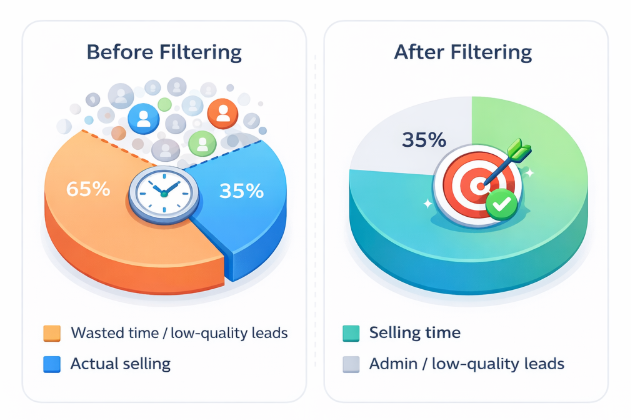
Effective lead filtering significantly increases the time sales teams spend on actual selling
Organizations that automate lead management see a 10% or greater increase in revenue within 6–9 months.
6. Exclude Low-Fit Leads Early
Just as important as identifying strong leads is eliminating poor-fit ones. Early exclusion prevents wasted outreach.
Common exclusion criteria:
-
Students or job seekers
-
Competitors
-
Companies outside target markets
-
Invalid or generic email addresses
Filtering out these leads ensures that sales teams focus only on viable opportunities.
7. Align Sales and Marketing Criteria
Misalignment between teams often results in low-quality leads being passed to sales. Establishing shared definitions of qualified leads is essential.
Best practices include:
-
Agreeing on MQL and SQL definitions
-
Regular feedback loops
-
Shared performance metrics
Aligned teams generate 208% more revenue from marketing efforts.
Measuring the Impact of Lead Filtering
To evaluate the effectiveness of lead filtering, track the following metrics:
-
Conversion rate from lead to opportunity
-
Sales cycle length
-
Cost per acquisition (CPA)
-
Lead response time
-
Win rate
Continuous monitoring and optimization ensure that filtering processes remain effective as market conditions evolve.
Conclusion
Lead filtering is not just a tactical step—it is a strategic advantage. By combining ICP definition, lead scoring, data enrichment, intent analysis, and automation, organizations can dramatically improve sales efficiency.
The result is a more focused sales team, higher conversion rates, and faster revenue growth.
Recommended Reading