
Marketing decisions today are driven almost entirely by data. Budget allocation, creative testing, audience targeting, and funnel optimization all depend on accurate measurement. Yet industry research consistently shows that between 20–30% of marketing data contains errors, and nearly 60% of marketers admit to making decisions based on incomplete or inconsistent data. These gaps don’t just reduce performance—they actively mislead teams.
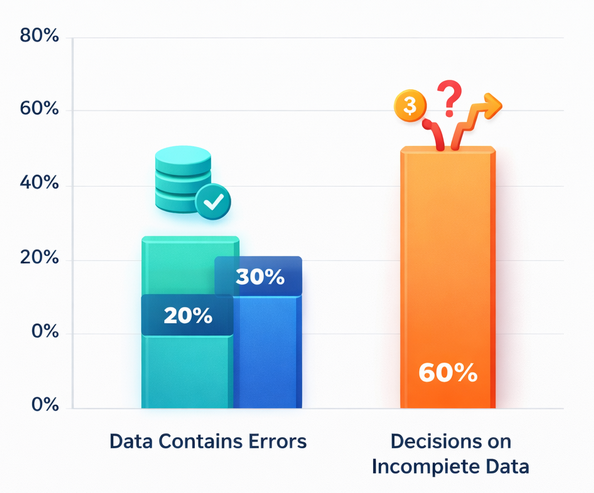
Proportion of marketing datasets with errors and marketers making decisions from incomplete or inconsistent data
Below are the most damaging data mistakes that skew results and how to avoid them.
1. Mixing Inconsistent Data Sources
One of the most frequent mistakes is blending data from platforms that use different attribution models, time zones, and conversion definitions. When ad platforms, analytics tools, and CRM systems are not aligned, reported performance can vary by 15–25% for the same campaign.
Why it skews results:
-
Conversions appear duplicated or missing
-
ROAS calculations become unreliable
-
Campaigns are scaled or paused based on false signals
Best practice:
Standardize attribution windows, naming conventions, and reporting time frames before combining datasets.
2. Ignoring Sample Size and Statistical Significance
Small datasets often lead marketers to draw conclusions too early. A/B tests with insufficient traffic can show apparent “wins” that disappear once more data is collected. Studies show that up to 70% of early A/B test winners fail to replicate when run to statistical significance.
Why it skews results:
-
Random variance is mistaken for real performance lift
-
Optimizations are made on noise rather than signal
Best practice:
Define minimum sample sizes in advance and wait until tests reach statistical confidence before acting.
3. Over-Relying on Last-Click Attribution
Last-click attribution remains widely used, despite its limitations. On average, it undervalues upper-funnel channels by 30–50%, especially in longer buying cycles.
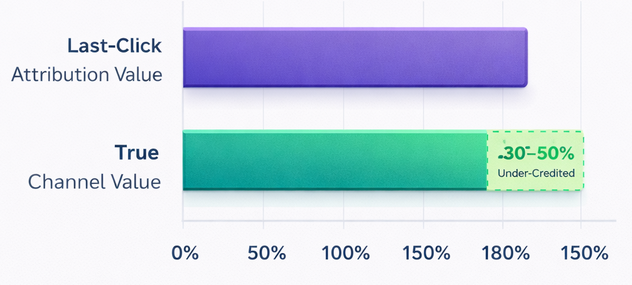
Comparison of channel value as reported by last-click attribution versus actual estimated contribution
Why it skews results:
-
Prospecting campaigns look unprofitable
-
Retargeting receives disproportionate credit
-
Budget shifts away from channels that drive demand
Best practice:
Use multi-touch or blended attribution models to understand the full customer journey.
4. Failing to Exclude Low-Quality or Irrelevant Data
Bot traffic, internal clicks, test purchases, and low-intent audiences can silently contaminate datasets. In some industries, up to 40% of traffic from poorly filtered campaigns shows no real user engagement.
Why it skews results:
-
Inflated impressions and click-through rates
-
Suppressed conversion rates
-
Misleading audience performance insights
Best practice:
Regularly audit traffic sources, exclude internal activity, and apply quality filters to datasets.
5. Treating Correlation as Causation
Marketing data often reveals patterns—but patterns alone do not prove cause and effect. Seasonal trends, promotions, or external events can coincide with performance changes. Analysts estimate that nearly half of reported performance “lifts” are influenced by external variables rather than the tested change.
Why it skews results:
-
Teams optimize the wrong variables
-
Structural issues remain unresolved
Best practice:
Control for external factors and validate insights across multiple tests and time periods.
6. Not Updating Data Models as Platforms Change
Ad platforms and analytics tools evolve constantly. Changes to tracking policies, privacy regulations, or conversion APIs can significantly alter reported results. After major platform updates, conversion reporting shifts of 10–20% are common.
Why it skews results:
-
Historical benchmarks lose relevance
-
Performance trends appear artificially positive or negative
Best practice:
Document platform changes and recalibrate benchmarks after major updates.
Turning Data Into Reliable Decisions
Accurate marketing insights are not about collecting more data—they’re about collecting the right data and interpreting it correctly. Eliminating these common mistakes improves forecasting, strengthens testing discipline, and protects budgets from being optimized in the wrong direction.
Teams that invest in data hygiene, consistency, and validation consistently outperform those chasing surface-level metrics.
Recommended Reading
If you found this article useful, you may also want to explore:
