Paid advertising has become a primary growth engine for B2B organizations. Global digital ad spend surpassed $600 billion in recent years, with B2B companies allocating a growing share of budget to paid search, paid social, and programmatic channels. Yet despite increasing investment, many marketing teams still evaluate performance using surface-level metrics: impressions, click-through rate (CTR), cost per click (CPC), and even cost per lead (CPL).
These metrics measure activity — not business impact.
True marketing effectiveness is determined by contribution to qualified pipeline and closed revenue. In B2B environments, where sales cycles often exceed 3–9 months and involve multiple stakeholders, measuring real pipeline impact from paid ads requires a more rigorous framework.
This article outlines how to move from vanity metrics to revenue accountability.
1. Define "Pipeline Impact" in Revenue Terms
Before measurement comes definition. True pipeline impact from paid ads should answer three questions:
-
How much qualified pipeline value did paid campaigns generate?
-
What percentage of that pipeline converts to revenue?
-
What is the return on ad spend (ROAS) based on closed-won revenue — not leads?
According to industry benchmarks:
-
Only 10–25% of marketing-generated leads become sales-qualified opportunities.
-
Of those opportunities, 15–30% typically convert to closed-won deals in B2B sectors.
-
Organizations that align marketing metrics with pipeline and revenue see up to 36% higher customer retention and 38% higher sales win rates.
If you measure only CPL, you ignore the 70–90% of leads that never generate revenue.
Pipeline impact must be calculated using:
Pipeline Value from Paid Ads = Sum of Opportunity Value where Original Source = Paid Channel
This requires CRM-level tracking and multi-touch attribution logic.
2. Move Beyond Cost per Lead to Cost per Opportunity
Cost per lead is attractive because it is immediate. However, it rarely reflects lead quality.
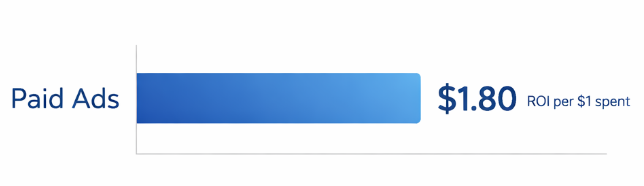
Average return on investment for paid advertising based on industry benchmarks
Consider this example:
-
Campaign A: $50 CPL, 5% lead-to-opportunity rate
-
Campaign B: $120 CPL, 20% lead-to-opportunity rate
If the average opportunity value is $50,000:
Campaign A generates:
-
100 leads → 5 opportunities → $250,000 pipeline
-
Effective cost per opportunity: $1,000
Campaign B generates:
-
100 leads → 20 opportunities → $1,000,000 pipeline
-
Effective cost per opportunity: $600
Despite higher CPL, Campaign B produces 4x more pipeline.
Tracking cost per sales-qualified opportunity (SQO) or cost per opportunity provides a more accurate performance signal.
3. Implement Multi-Touch Attribution Models
In B2B buying journeys, 6–10 decision-makers are typically involved, and prospects interact with multiple channels before converting. First-touch attribution often overvalues awareness campaigns, while last-touch models overweight retargeting and branded search.
To measure true pipeline impact, organizations should adopt:
-
Linear attribution (equal credit across touchpoints)
-
Time-decay attribution (greater weight to later interactions)
-
Position-based models (e.g., 40-20-40 distribution)
Research shows that companies using multi-touch attribution improve marketing ROI measurement accuracy by up to 30% compared to single-touch models.
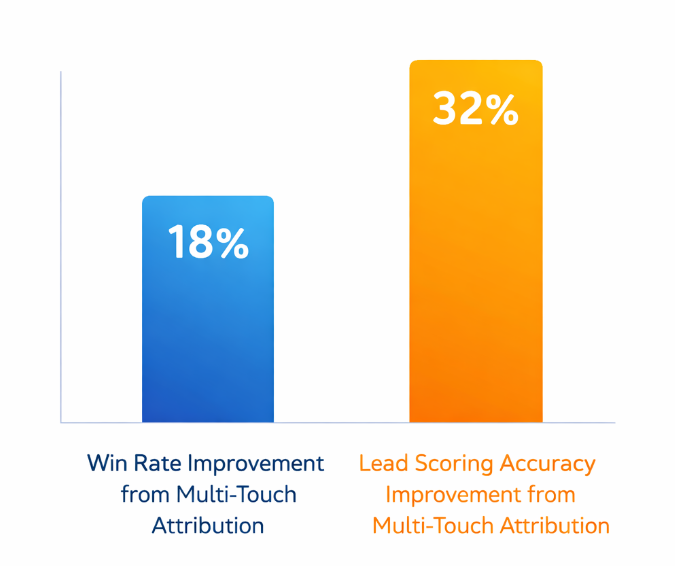
Impact of multi-touch attribution on opportunity win rates and lead scoring accuracy in B2B campaigns
Without attribution sophistication, paid ads may appear either overperforming or underperforming relative to their real influence.
4. Track Account-Level Engagement, Not Just Individual Leads
B2B deals are closed at the account level. A single ad click from one contact rarely represents full buying intent.
Measuring pipeline impact requires visibility into:
-
Number of engaged contacts per target account
-
Ad exposure frequency across stakeholders
-
Account-level opportunity creation rate
Organizations that use account-based measurement frameworks report 20–30% higher deal sizes and improved close rates compared to lead-centric measurement approaches.
Paid campaigns should be evaluated based on account penetration and opportunity acceleration, not just form submissions.
5. Connect Paid Ads to Sales Velocity
Pipeline impact is not only about volume — it is also about speed.
Key velocity metrics include:
-
Average days from first ad interaction to opportunity creation
-
Sales cycle length for paid-sourced opportunities
-
Stage-to-stage conversion rates
If paid campaigns accelerate deal progression by even 10–15%, the revenue impact compounds significantly across the fiscal year.
Revenue Velocity Formula:
Revenue Velocity = (Number of Opportunities × Average Deal Size × Win Rate) ÷ Sales Cycle Length
Paid ads that improve any of these variables create measurable business leverage.
6. Integrate Offline Conversions and CRM Feedback Loops
Many paid campaigns are optimized for online conversions (form fills, demo requests). However, in B2B sales, high-value deals frequently originate from:
-
Event follow-ups
-
Outbound sales touches
-
Direct outreach after ad exposure
Without syncing CRM opportunity data back into advertising platforms, optimization algorithms cannot learn which leads actually convert.
Closed-loop reporting improves targeting efficiency and can reduce cost per opportunity by 15–25% over time.
7. Measure Incrementality, Not Just Attribution
Attribution shows correlation. Incrementality measures causal impact.
To assess true pipeline contribution, consider:
-
Geographic holdout testing
-
Audience suppression experiments
-
Budget shift tests between channels
Organizations conducting incrementality testing often discover that 10–30% of attributed conversions would have occurred without paid media.
Adjusting spend based on incremental lift ensures budget allocation reflects genuine revenue contribution.
8. Align Marketing and Sales Around Shared Pipeline KPIs
The strongest indicator of true pipeline impact is cross-functional alignment.
Shared KPIs should include:
-
Marketing-sourced pipeline value
-
Marketing-influenced revenue
-
Cost per opportunity
-
Pipeline-to-revenue conversion rate
Companies with strong sales-marketing alignment achieve 19% faster revenue growth and 15% higher profitability compared to misaligned organizations.
When paid advertising is evaluated through revenue contribution rather than channel metrics, strategic clarity improves across teams.
Building a Revenue-Focused Measurement Framework
To measure true pipeline impact from paid ads:
-
Define pipeline and revenue as primary success metrics.
-
Track cost per opportunity instead of cost per lead.
-
Implement multi-touch attribution.
-
Measure account-level engagement.
-
Monitor revenue velocity and sales cycle impact.
-
Sync CRM outcomes into ad platforms.
-
Test incrementality to validate real contribution.
Paid ads should not be optimized for activity. They should be optimized for revenue outcomes.
Organizations that make this shift typically see improved budget allocation efficiency, stronger forecasting accuracy, and more predictable growth.
Conclusion
Clicks generate traffic. Leads generate database growth. But only qualified pipeline generates revenue.
Measuring true pipeline impact from paid ads requires integrating marketing data, CRM intelligence, attribution modeling, and sales outcomes into a unified performance framework. While this approach demands more analytical rigor, it transforms paid advertising from a cost center into a measurable revenue engine.
The companies that succeed in competitive B2B markets are not those that generate the most leads — they are those that generate the most qualified pipeline per dollar invested.
Recommended Reading
To deepen your understanding of revenue-focused marketing measurement, explore: