Seeing high impressions with low or zero clicks in Meta Ads is a clear signal that something in your campaign is misaligned. While impressions indicate that your ads are being delivered successfully, clicks measure engagement—and that’s where the real problem begins.
According to industry benchmarks, the average click-through rate (CTR) for Meta Ads across industries ranges between 0.9% and 1.6%, depending on the objective and audience targeting. If your CTR is significantly below this range, it’s not a distribution issue—it’s a relevance issue.
Let’s break down the most common reasons why this happens.
1. Weak Ad Creative That Doesn’t Stop the Scroll
Meta is a visually driven platform. If your creative fails to capture attention within the first 1–2 seconds, users will simply scroll past it.
Research shows that users spend less than 1.7 seconds on average deciding whether to engage with a piece of content in their feed. This means your creative must immediately communicate value.
Common issues:
-
Generic stock images
-
Lack of contrast or visual hierarchy
-
No clear focal point
-
Overcrowded design
What to do:
-
Use bold, high-contrast visuals
-
Include human faces or dynamic elements
-
Test video vs static formats (video ads can increase engagement rates by up to 20–30%)
2. Misaligned Targeting
Even strong creatives won’t perform if they’re shown to the wrong audience.
Meta’s algorithm is powerful, but it still depends on the inputs you provide. Poor audience selection leads to impressions without meaningful engagement.
Indicators of targeting issues:
-
High impressions, low CTR
-
Low relevance diagnostics (quality, engagement, conversion rankings)
What to do:
-
Refine audience segments based on behavior and intent
-
Use lookalike audiences derived from high-quality data sources
-
Exclude irrelevant or already-converted users
Campaigns that use well-optimized lookalike audiences can see CTR improvements of up to 35% compared to broad targeting.
3. Weak Value Proposition
If users don’t immediately understand what they gain by clicking, they won’t engage.
Your ad must answer the implicit question: “What’s in it for me?”
Common problems:
-
Vague messaging
-
No clear benefit
-
Overly technical or generic copy
What to do:
-
Highlight a specific outcome or benefit
-
Use numbers or results (e.g., “Increase conversions by 25%”)
-
Keep messaging concise and direct
Ads with clear, benefit-driven headlines typically achieve 2–3x higher CTR than generic messaging.
4. Poor Ad-to-Audience Message Match
Even if your targeting is technically correct, your message may not resonate with that segment.
For example, showing the same ad to both cold and warm audiences often leads to underperformance.
What to do:
-
Customize messaging for each funnel stage
-
Use different creatives for awareness vs consideration vs conversion
-
Align tone and offer with audience intent
Segmented campaigns can improve engagement rates by up to 50% compared to one-size-fits-all messaging.
5. Ad Fatigue
If your audience has seen the same ad multiple times, engagement will drop.
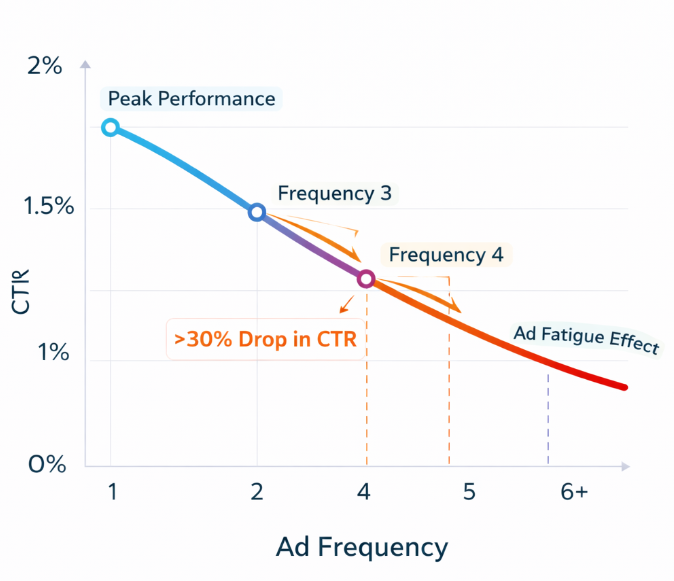
Ad performance declines as users see the same creative repeatedly
Meta data suggests that CTR can decline by over 30% after frequency exceeds 3–4 exposures per user.
Signs of ad fatigue:
-
Increasing frequency
-
Declining CTR over time
-
Rising cost per click (CPC)
What to do:
-
Rotate creatives regularly
-
Refresh visuals and copy every 2–4 weeks
-
Expand audience size if needed
6. Ineffective Call-to-Action (CTA)
A weak or unclear CTA can significantly reduce clicks, even if the rest of the ad performs well.
Common mistakes:
-
Generic CTAs like “Learn More” without context
-
No urgency
-
Misalignment with the offer
What to do:
-
Use action-oriented language
-
Add urgency or incentive (e.g., “Get Your Free Report Today”)
-
Ensure CTA matches the landing page experience
Strong CTAs can improve CTR by 15–25% depending on the campaign type.
7. Placement and Format Mismatch
Not all ad placements perform equally. An ad that works well in the feed may fail in Stories or Audience Network.
What to do:
-
Analyze performance by placement
-
Customize creatives for each format (e.g., vertical video for Stories)
-
Disable underperforming placements
Optimizing placements can increase overall campaign efficiency by up to 20%.
8. Low Trust Signals
Users are less likely to click ads that lack credibility.
Missing trust elements:
-
Social proof (reviews, testimonials)
-
Recognizable branding
-
Clear offer legitimacy
What to do:
-
Add testimonials or user-generated content
-
Use consistent branding
-
Highlight credibility indicators (e.g., client count, results)
Ads with strong social proof can see CTR increases of 10–30%.
Conclusion
High impressions with low clicks are not a delivery problem—they’re a signal of misalignment between your creative, targeting, and messaging.
To fix this, focus on:
-
Improving creative quality
-
Refining audience targeting
-
Strengthening your value proposition
-
Continuously testing and optimizing
Small, data-driven adjustments can significantly improve performance and turn passive impressions into active engagement.
Suggested Articles for Further Reading