Scaling Facebook prospecting campaigns often appears straightforward—identify a winning audience, increase budget, and expect proportional results. However, in practice, campaigns frequently hit a ceiling or even regress after initial success. Understanding the mechanisms behind this behavior is essential for maintaining sustainable growth.
1. Audience Saturation and Frequency Fatigue
One of the most common reasons prospecting campaigns stop scaling is audience saturation. As budgets increase, ads are shown more frequently to the same users.
-
The average click-through rate (CTR) can drop by 20–40% when frequency exceeds 3.
-
Conversion rates typically decline once users have seen the same creative multiple times.
This leads to higher costs per acquisition (CPA) and reduced efficiency.
2. Diminishing Returns in Auction Dynamics
Facebook operates on an auction system where advertisers compete for impressions. As you scale:
-
You enter more competitive auctions.
-
CPM (cost per 1,000 impressions) can increase by 15–35%.
-
Marginal cost per additional conversion rises.
This means that even if performance remains stable, profitability may decrease.
3. Learning Phase Disruptions
Frequent changes during scaling can reset the learning phase.
-
Budget increases above 20–30% within short periods often trigger relearning.
-
Ad set instability can lead to inconsistent delivery and performance fluctuations.
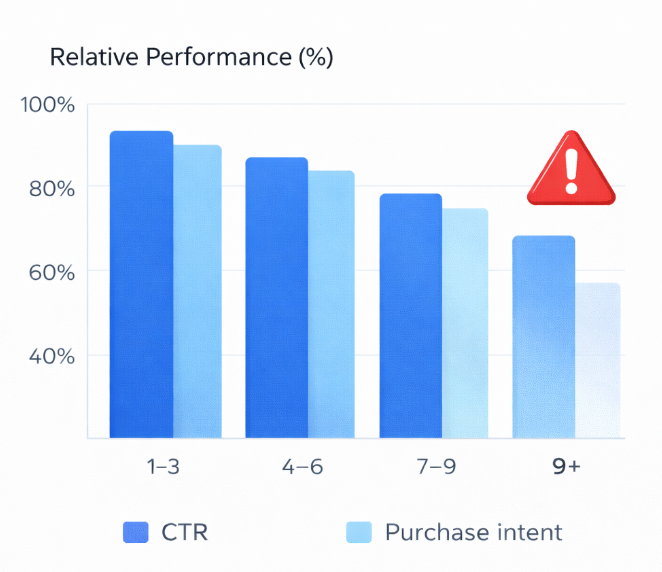
Higher ad frequency significantly reduces performance, with CTR dropping sharply after repeated exposure
As a result, campaigns may temporarily underperform or fail to stabilize.
4. Creative Fatigue
Creative performance degrades over time, especially in prospecting campaigns where users are unfamiliar with the brand.
-
Ad fatigue can reduce engagement rates by up to 50% within weeks.
-
High-performing creatives typically have a limited lifespan.
Without continuous creative refresh, scaling becomes increasingly difficult.
5. Narrow Targeting Constraints
Highly specific targeting can limit scalability.
-
Small audience sizes restrict delivery volume.
-
Over-segmentation reduces algorithmic flexibility.
Broad targeting often performs better at scale due to improved optimization capabilities.
6. Conversion Signal Limitations
Facebook’s algorithm relies on sufficient conversion data.
-
Campaigns receiving fewer than 50 conversions per week per ad set struggle to optimize effectively.
-
Weak or delayed signals reduce targeting accuracy.
This can prevent campaigns from scaling efficiently.
7. Budget Allocation Inefficiencies
Improper budget distribution across ad sets can hinder growth.
-
Overfunding underperforming ad sets wastes spend.
-
Underfunding high-performing segments limits scaling potential.
Dynamic allocation strategies are essential for sustained performance.
How to Restore and Sustain Scaling
1. Expand Audience Pools
-
Use broader targeting parameters.
-
Introduce new lookalike audiences.
-
Continuously test new segments.
2. Refresh Creatives Regularly
-
Rotate creatives every 2–4 weeks.
-
Test multiple formats (video, carousel, static).
-
Focus on diverse messaging angles.
3. Scale Gradually
-
Increase budgets incrementally (10–20% every few days).
-
Monitor performance closely during adjustments.
4. Optimize for Strong Signals
-
Prioritize high-intent conversion events.
-
Ensure proper tracking and attribution.
5. Use Automated Budget Strategies
-
Consolidate ad sets where possible.
-
Leverage campaign budget optimization (CBO).
Conclusion
Facebook prospecting campaigns stop scaling due to a combination of audience saturation, auction dynamics, creative fatigue, and algorithmic constraints. Sustainable growth requires continuous testing, gradual scaling, and strategic adjustments across targeting, creatives, and budget allocation.
Recommended Articles