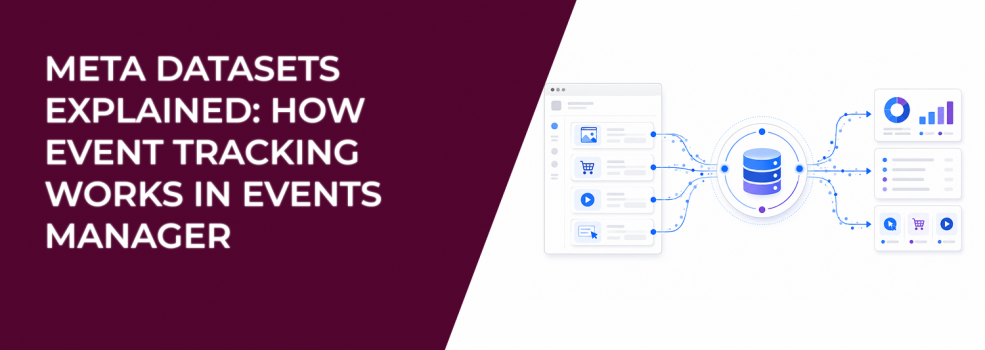
Meta is changing how event data appears inside Events Manager. Instead of separating website events, app events, offline conversions, and messaging activity into different systems, Meta is gradually merging them into one view called a dataset.
For advertisers, this changes how tracking is managed behind the scenes. Instead of handling multiple IDs and integrations separately, businesses can organize event data in one place.
That does not change campaign optimization directly, but it changes how advertisers manage tracking, attribution, and event quality.
What a Dataset Actually Does
A dataset groups event data from different customer touchpoints into one system. That can include:
- Website events from the Meta Pixel.
- Server-side events from Conversions API.
- App activity from the Facebook SDK.
- Offline conversions from physical stores or CRM systems.
- Messaging events from Messenger, Instagram, or WhatsApp.
Each event source still sends its own data, but the dataset helps manage everything under one dataset ID.
This matters because modern customer journeys rarely happen in one place anymore. A user may click an ad on Instagram, browse the website later, speak with sales through WhatsApp, and purchase in-store days afterward.
Datasets help Meta connect those signals more efficiently.
Why Meta Is Moving Toward Datasets
Older tracking setups often forced advertisers to manage separate integrations for websites, apps, offline conversions, and messaging events.
That created operational problems.
Reporting became harder to trust when different systems used different IDs or disconnected event sources. Marketing teams often compared CRM data, Ads Manager reports, and offline conversion uploads manually.
Datasets simplify this structure.
Instead of maintaining multiple APIs, advertisers can increasingly manage events through a single Conversions API integration connected to one dataset.
This usually reduces setup complexity for growing businesses with multiple sales channels.
How Dataset IDs Work
When you create a dataset, Meta assigns a dataset ID. In many cases, that dataset ID becomes the same as your existing Pixel ID.
This usually happens when:
- An existing Pixel gets converted into a dataset.
- A dataset is created from an existing Pixel connection.
- Website tracking already exists before dataset creation.
In other cases, Meta creates a completely new dataset ID. That often happens when datasets are built around apps, offline events, or new integrations without an existing Pixel attached.
For advertisers, the important part is operational clarity. Your integrations must point to the correct dataset ID, or event reporting can become fragmented.
Why Centralized Event Data Helps Campaign Performance
Datasets mainly improve organization, but better organization often improves optimization decisions.
Many advertisers struggle with reporting gaps between platforms. Website purchases appear in Shopify but not in Ads Manager. CRM-qualified leads do not match Meta lead totals. Offline conversions arrive late and distort ROAS reporting.
You can usually see the symptoms inside campaign performance:
- CPA fluctuates without obvious delivery changes.
- Retargeting audiences shrink unexpectedly.
- Purchase attribution looks inconsistent across systems.
- Lead quality drops after scaling despite stable CTR and CPC.
In many cases, the issue is not the campaign itself. The problem is fragmented event data.
A cleaner build a marketing data layer process helps advertisers reduce those inconsistencies before scaling budgets.
How Datasets Connect With Conversions API
Datasets work closely with Conversions API.
Meta now allows advertisers to use Conversions API for:
- Website events.
- App events.
- Offline events.
- Messaging events.
That means businesses can rely more heavily on one integration instead of maintaining separate APIs for different data sources.
This becomes important as Meta continues moving away from older systems like the Offline Conversions API.
For advertisers, fewer integrations usually mean fewer tracking failures and cleaner reporting structures.
Why Offline and Messaging Events Matter More Now
Many advertisers still optimize campaigns using only website purchases or lead forms. That leaves out large parts of the customer journey.
Datasets make it easier to include offline and messaging activity in optimization and reporting.
Examples include:
- Retail purchases happening in physical stores.
- Sales qualified through CRM pipelines.
- Purchases completed after WhatsApp conversations.
- Messenger conversations leading to offline bookings.
These signals often reveal higher-value customer behavior than website clicks alone.
Businesses with longer sales cycles usually benefit the most because Meta receives more complete feedback about what actually produces revenue.
If you need to connect backend sales data properly, this guide on align sales and marketing data explains the process in simpler terms.
What Advertisers Should Audit Inside Events Manager
Before scaling campaigns, advertisers should review how datasets are configured.
Check these areas regularly:
- Confirm all integrations connect to the correct dataset ID.
- Review event overlap between Pixel and Conversions API sources.
- Compare Meta conversion data against CRM or store data weekly.
- Monitor event match quality after adding new integrations.
Small setup mistakes can create major reporting problems later.
For example, duplicated purchase events may inflate ROAS artificially, while disconnected app events can weaken retargeting pools.
This article on marketing data mistakes that skew results explains several common tracking problems advertisers overlook.
Final Takeaway
Meta datasets are designed to simplify event tracking across websites, apps, offline systems, and messaging channels. Instead of managing disconnected integrations, advertisers can organize event data under one structure.
The biggest advantage is not convenience alone. Cleaner event organization usually leads to cleaner optimization signals, more reliable reporting, and better campaign decisions over time.
Advertisers who treat tracking infrastructure seriously often scale campaigns more efficiently because the algorithm receives more accurate business data.