Modern B2B buyers rarely respond to a single touchpoint. Research consistently shows that decision-makers require multiple interactions before engaging in meaningful sales conversations. According to industry studies:
-
It takes an average of 8–12 touchpoints to generate a qualified B2B sales meeting.
-
Campaigns using three or more channels achieve up to 287% higher purchase rates compared to single-channel campaigns.
-
Prospects exposed to coordinated multi-channel outreach demonstrate up to 24% higher engagement rates.
These numbers illustrate a clear reality: isolated outreach sequences underperform. Structured, automated, and synchronized workflows drive consistent pipeline growth.
What Is a Multi-Channel Prospecting Automation Workflow?
A multi-channel prospecting workflow is a structured automation sequence that coordinates outreach across multiple platforms while adapting to prospect behavior in real time.
Typical channels include:
-
Email sequences
-
LinkedIn connection and message steps
-
Website visitor identification and retargeting
-
Display ad exposure
-
CRM-triggered follow-ups
The objective is not volume. The objective is controlled frequency, contextual relevance, and behavioral responsiveness.
Core Components of an Effective Workflow
1. Unified Audience Segmentation
High-performing workflows begin with precise segmentation based on:
-
Industry and company size
-
Buying intent signals
-
Website visit behavior
-
Content consumption patterns
-
CRM lifecycle stage
Segmentation determines messaging tone, value proposition framing, and channel prioritization.
2. Trigger-Based Sequencing
Automation must respond to behavioral triggers rather than fixed time intervals alone. Key triggers include:
-
Email opens and link clicks
-
Website revisits
-
Pricing page views
-
Content downloads
-
LinkedIn engagement
Behavioral branching increases relevance and reduces fatigue.
3. Channel Synchronization Logic
Poorly coordinated outreach leads to message overlap and brand fatigue. Effective synchronization ensures:
-
Email messaging aligns with display ad creative
-
LinkedIn messaging references recent engagement
-
Retargeting ads reinforce current campaign themes
Consistency across channels strengthens recall and trust.
Example Multi-Channel Prospecting Workflow (30-Day Model)
Below is a simplified high-performance workflow structure:
Day 1: Introductory email with value-focused positioning
Day 3: LinkedIn connection request
Day 5: Retargeting ads activated for website visitors
Day 7: Follow-up email referencing initial value proposition
Day 10: LinkedIn message (non-sales, insight-driven)
Day 14: Case study email
Day 18: Display ad reinforcement campaign
Day 22: Direct response email with soft CTA
Day 30: Breakup email or nurture sequence entry
This layered structure ensures consistent brand presence without overwhelming the prospect.
Why Automation Outperforms Manual Prospecting
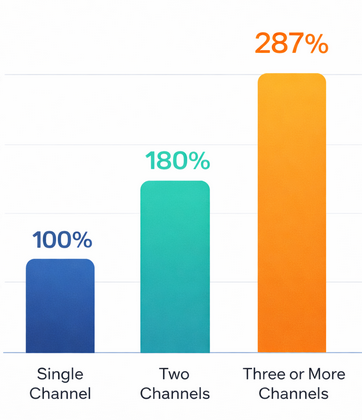
Comparison of engagement performance by number of outreach channels
Automation introduces structural advantages:
Scalability
Teams can manage thousands of synchronized touchpoints without increasing headcount.
Data-Driven Optimization
Performance data enables iterative refinement of:
-
Send timing
-
Channel prioritization
-
Creative variations
-
CTA positioning
Performance Uplift
Organizations implementing automated multi-channel strategies report:
-
30% increase in reply rates
-
25–40% improvement in meeting booking rates
-
18–22% reduction in sales cycle length
Consistency and orchestration drive measurable impact.
Common Mistakes to Avoid
-
Overlapping messaging across channels without coordination
-
Triggering retargeting too early without segmentation
-
Sending high-frequency emails without supporting brand exposure
-
Failing to suppress engaged prospects from cold outreach
-
Ignoring attribution across channels
Automation should enhance personalization, not eliminate it.
Attribution and Measurement Framework
Measuring multi-channel prospecting performance requires tracking:
-
First-touch attribution
-
Assisted conversions
-
Channel influence modeling
-
Engagement velocity
-
Pipeline contribution by channel
Dashboards should visualize cross-channel impact rather than isolating metrics by platform.
Advanced Optimization Strategies
Intent-Based Escalation
Increase channel intensity when prospects demonstrate buying signals.
Creative Rotation Models
Refresh display and LinkedIn ad creative every 14–21 days to prevent fatigue.
Frequency Capping
Control ad impressions to avoid overexposure while maintaining brand presence.
Sales and Marketing Alignment
Ensure automated workflows sync with SDR manual outreach to avoid duplication.
Strategic Benefits of Multi-Channel Automation
When executed properly, multi-channel automation delivers:
-
Stronger brand familiarity before first sales conversation
-
Higher trust due to consistent exposure
-
Reduced cold outreach resistance
-
Increased meeting acceptance rates
-
More predictable pipeline velocity
It transforms prospecting from random outreach into engineered demand generation.
Final Thoughts
Multi-channel prospecting automation workflows are no longer optional in competitive B2B markets. Buyers operate across platforms, devices, and environments. Revenue teams must mirror that behavior with coordinated, behavior-driven engagement models.
Organizations that treat automation as strategic infrastructure rather than a tactical tool consistently outperform competitors in engagement, pipeline growth, and revenue predictability.