The worst time to discover an access problem is right before a campaign launch.
A new agency is ready to start. A high-intent audience test is planned. Creative is approved. Budget is allocated. Then someone realizes the business does not have full control of the Meta Business Portfolio.
That is not a minor inconvenience. It can block partner access, asset assignment, user management, and campaign operations.
Meta’s help article states that if a person or organization wants full control of a Business Portfolio it claims ownership of, it can submit a request to Meta. The accessible source material also notes that, when ready for Meta to review the claim, the advertiser should go to Business Support Home.
For performance marketers, this is an operational risk that can directly slow down testing and budget deployment.
What Does “Full Control” Mean in Practice?
Full control is the permission level that allows a business user to manage the portfolio at a high level.
Without it, a marketer may be able to view or use certain assets but still be unable to manage the broader structure. That can create confusion because someone may think they “have access” when they do not have the authority required to add users, assign assets, remove old partners, or approve key changes.
This distinction matters for paid social teams.
- A user may be able to open Ads Manager but not add a new agency.
- A media buyer may be able to view campaigns but not assign assets.
- A business owner may control a Page but not the Business Portfolio that owns the campaign infrastructure.
- A founder may have access to Instagram but not to the ad account or dataset needed for conversion campaigns.
Access without control is often enough for daily work — until something changes.
Why Missing Full Control Affects Campaign Performance
Missing full control affects performance because it reduces your ability to act.
Paid social is a testing discipline. The faster your team can launch, measure, learn, and refine, the faster you can move toward efficient CPC, CPA, CAC, ROAS, and lead quality.
When full control is missing, basic execution can slow down.
- You may be unable to add an agency as a partner.
- You may be unable to assign an ad account to the right person.
- You may be unable to remove former employees or old contractors.
- You may be unable to connect or manage the assets needed for campaigns.
- You may be unable to approve changes during an urgent launch window.
This does not mean every campaign will stop immediately. But it means your operation has a weak point. When the weak point is triggered, it can stall testing and make performance problems harder to diagnose.
Business Impact for Advertisers
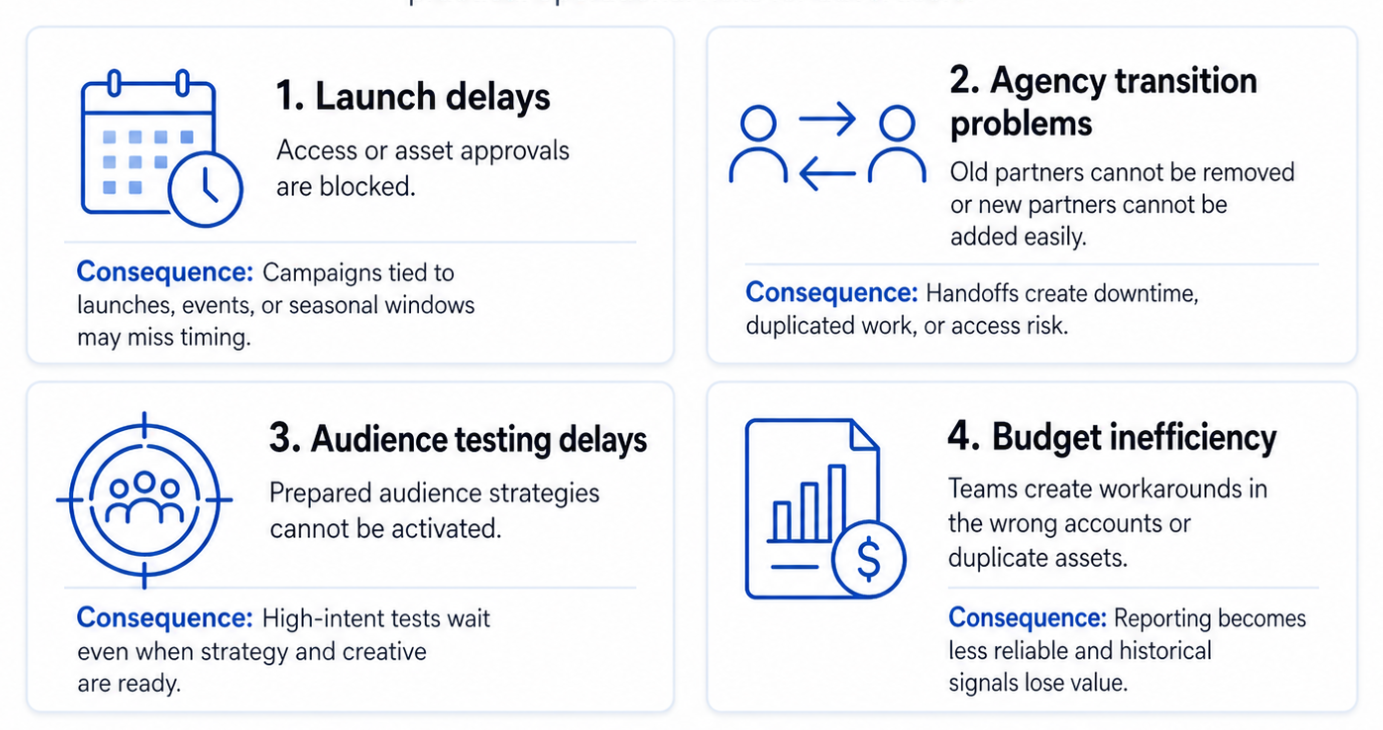
Missing full control can affect paid social performance in four practical ways: delayed launches, difficult agency transitions, slower audience testing, and inefficient budget deployment
The business impact usually appears in four areas.
Launch delays
If nobody can approve access or assign assets, new campaigns may be delayed. This is especially costly when campaigns are tied to seasonal offers, product launches, events, or limited-time promotions.
Agency transition problems
If a company changes agencies but lacks full control, removing the old partner or adding the new partner may become difficult. That can create downtime, duplicated work, or access risk.
Audience testing delays
High-intent audiences only help if the team can activate them. If your LeadEnforce audience strategy is ready but the correct ad account or partner access is blocked, the audience test waits.
Budget inefficiency
When access issues force teams to create workarounds, they may launch in the wrong account, duplicate campaigns, or rebuild assets unnecessarily. That can make performance reporting less reliable and reduce the usefulness of historical signals.
For a prevention-focused view, read Why Your Meta Business Portfolio Setup Affects Paid Social Performance. Once full control is restored, the next operational step is usually to give an agency partner access to Meta assets without losing campaign control.
Typical Scenarios Where This Applies
This problem appears in many common business situations.
- A former employee created the Business Portfolio and left the company. The current team can run some campaigns but cannot manage permissions.
- An agency created the portfolio during the original setup. Years later, the business wants to change agencies but realizes it does not fully control its own assets.
- A founder set up the business assets under a personal Facebook profile and never added backup full-control users.
- A startup hires its first serious paid social agency and discovers that the Page, ad account, Instagram account, and dataset are not controlled by the same business structure.
- An ecommerce brand wants to test catalog campaigns, but the catalog or ad account is controlled by a different portfolio.
- A B2B lead-generation team wants to test audiences built from LinkedIn professional data, niche Facebook communities, and Instagram profile engagement, but the media buyer cannot access or assign the correct ad assets.
In each case, the issue is not strategy. The issue is control.
Risks and Considerations
- Do not rush into random fixes.
- Creating a new ad account may seem easier, but it can separate the campaign team from useful history, existing assets, and previous performance context.
- Removing users without understanding their role can create new access problems.
- Transferring assets without documenting ownership can make future recovery harder.
- Assuming someone has full control because they can run campaigns can be misleading. Campaign access and portfolio control are not the same thing.
- There is also no guarantee that a request to Meta will be approved quickly or at all. Advertisers should be careful not to build launch timelines around access recovery unless they have already confirmed the path.
- Before acting, gather the facts. Identify the Business Portfolio, the assets involved, the current users, the current partners, and who appears to have the highest level of access.
- Also check whether account restrictions, security issues, disabled profiles, or unresolved business verification problems may be involved. These can complicate access workflows.
Prerequisites and Dependencies
Before a full-control recovery strategy works well, the business should clarify several items.
- Know which Business Portfolio is involved.
- Know which assets are affected.
- Know who currently has access.
- Know whether anyone inside the organization has full control.
- Know whether the business can support its claim of ownership.
- Know which campaigns, audiences, or partners are blocked by the issue.
- Keep a clear list of the business assets needed for campaign operations: Pages, Instagram accounts, ad accounts, datasets, catalogs, domains, and partner relationships.
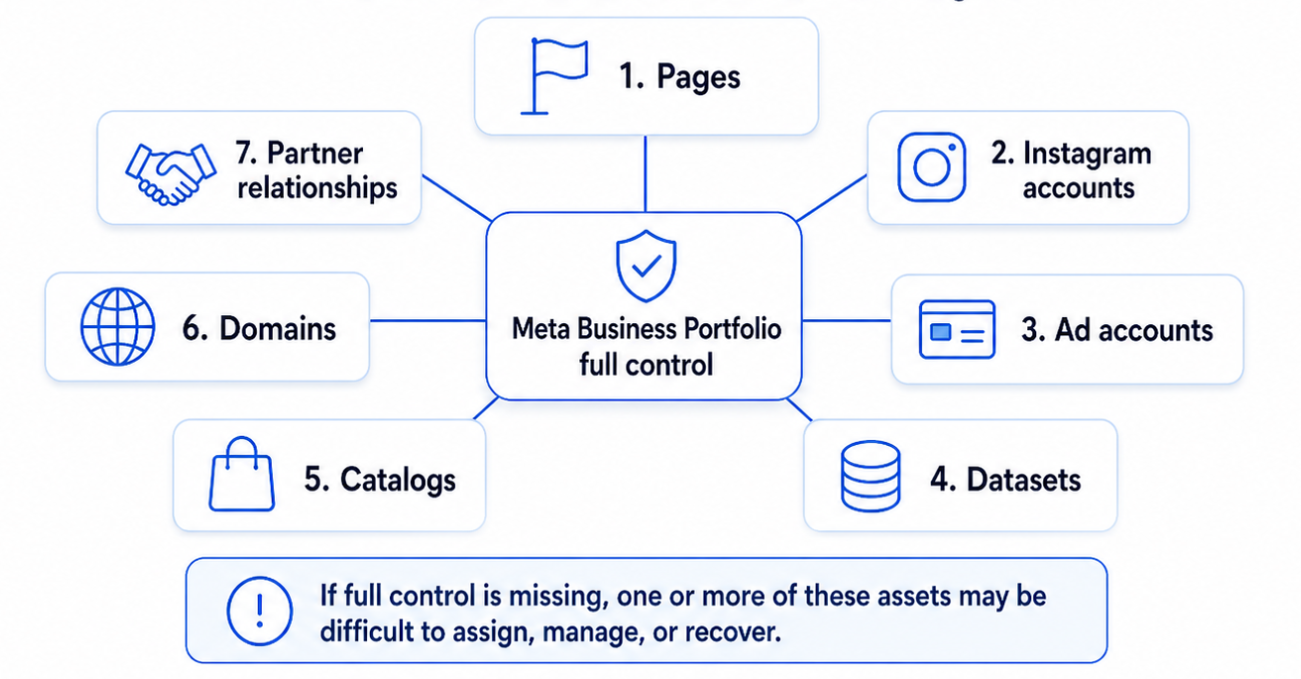
Before campaign operations depend on Meta access, advertisers should confirm control over seven core asset categories: Pages, Instagram accounts, ad accounts, datasets, catalogs, domains, and partner relationships
- You should also define what happens after control is restored. Add backup full-control users, clean up old partner access, document ownership, and create a repeatable process for assigning future campaign teams.
How LeadEnforce Helps
LeadEnforce does not recover Meta Business Portfolio access and does not replace Meta’s support or request process.
Its role is different.
LeadEnforce helps paid social teams prepare better audience strategies so that, once access is restored, the team can move quickly into higher-quality testing.
While the business is resolving full-control issues, marketers can use LeadEnforce to identify relevant Facebook groups, Instagram followers and engagers, competitor communities, LinkedIn-derived professional segments, and custom social-profile audiences.
That means the team does not have to wait passively. It can define audience hypotheses, prioritize segments, and prepare test plans before campaigns go live.
Once the Business Portfolio is under control and the right partners have access, those audiences can be used to reduce broad targeting guesswork and improve the relevance of prospecting or retargeting campaigns.
- This is especially useful for B2B advertisers, agencies onboarding new clients, startups preparing paid social tests, and ecommerce brands that want stronger audience inputs before scaling spend.
Practical Recommendations
- Audit full-control access before there is an emergency. Do not wait until an agency transition or campaign launch.
- Add more than one trusted full-control user where appropriate. A single-person dependency is fragile.
- Document your Business Portfolio ID, ad account IDs, Page ownership, Instagram connections, datasets, catalogs, and partner access.
- Review old users and partners regularly. Remove access that is no longer needed.
- Create a standard onboarding checklist for agencies and freelancers. Include which assets they need, what permissions they should receive, and who approves access.
- Avoid using asset ownership as a substitute for good campaign strategy. Once control is restored, the next performance gains usually come from better audience selection, stronger creative, clearer offers, and cleaner testing.
- Use LeadEnforce to build audience segments before the launch window. That way, when the access issue is resolved, your team can start testing audiences that are already aligned with your ICP.
Final Takeaway
Missing full control of a Meta Business Portfolio can quietly become a major campaign bottleneck.
It can delay launches, block partner access, slow audience testing, and create unnecessary operational risk. Advertisers should treat full control as part of their paid social infrastructure, not as an afterthought.
To prepare stronger audience tests once your access is fixed, join the free 7-day LeadEnforce trial period.