Meta’s advertising ecosystem—spanning Facebook, Instagram, Messenger, and Audience Network—remains one of the most powerful performance channels for enterprise organizations. As of 2024, Meta reports over 3 billion daily active users across its family of apps. With global ad revenues exceeding $130 billion annually, competition for attention is intense, particularly in high-value B2B and B2C enterprise segments.
For enterprise-level advertisers, success depends less on tactical tweaks and more on structural rigor, data integrity, and scalable experimentation. Budget allocations often reach six or seven figures per month, making marginal efficiency gains materially impactful. A 5% improvement in blended CPA at scale can translate into millions in incremental profit annually.
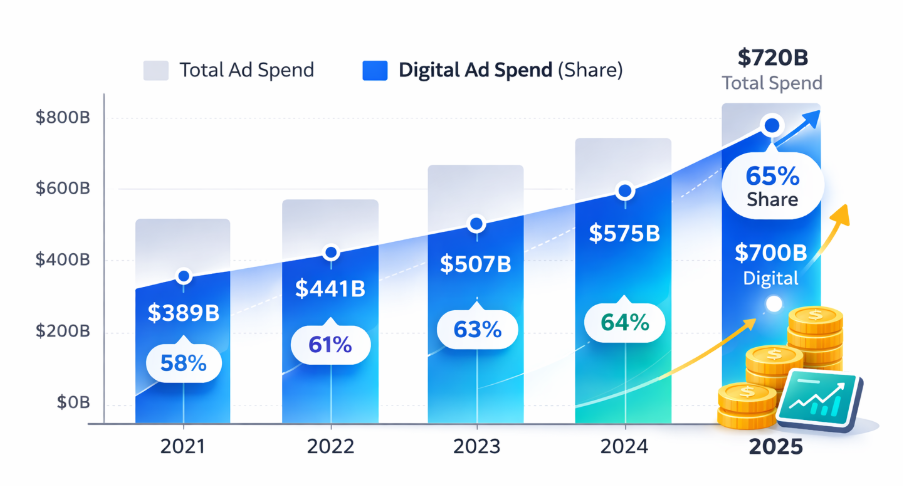
Global digital advertising expenditures projected to exceed $700 billion by 2025, with digital channels capturing more than 65% share
This guide explores the operational and strategic pillars required to optimize Meta Ads in enterprise environments.
1. Account Architecture and Governance
Enterprise ad accounts typically manage:
-
Multiple business units or product lines
-
Geographic segmentation across regions
-
Multi-language creative variations
-
Distinct customer lifecycle stages
Centralized vs. Decentralized Structures
Centralized structures provide better budget control, consistent naming conventions, and unified reporting. Decentralized structures allow regional flexibility but often introduce data fragmentation and inconsistent optimization standards.
Best practice for enterprise advertisers is a hybrid governance model:
-
Centralized measurement framework
-
Shared creative guidelines
-
Localized execution with performance thresholds
Standardized naming conventions and campaign taxonomies are critical. Without them, cross-market reporting becomes unreliable, limiting executive-level decision-making.
2. Measurement and Signal Integrity
At enterprise scale, measurement precision directly impacts optimization.
Conversion API and Server-Side Tracking
With privacy restrictions and signal loss from browser-based tracking, server-side implementation is no longer optional. Advertisers using Conversions API in combination with pixel tracking have reported measurable increases in attributed conversions due to improved signal matching.
Aggregated Event Measurement Prioritization
Enterprises must prioritize high-value events correctly:
-
Purchase or Closed Deal
-
Qualified Lead
-
Demo Booking
-
Add to Cart
-
View Content
Improper event prioritization can distort optimization, particularly under limited data scenarios.
Incrementality Testing
Large-scale advertisers increasingly use geo-lift and holdout experiments to measure true incremental impact. Industry studies suggest that up to 20–30% of reported platform-attributed conversions in performance channels may be non-incremental without structured testing.
For enterprise accounts, incrementality frameworks should be embedded quarterly, not treated as ad hoc experiments.
3. Budget Allocation and Bid Strategy
Meta’s machine learning performs best with statistical stability. Enterprise advertisers must balance control with automation.
Campaign Budget Optimization (CBO)
CBO generally improves allocation efficiency across ad sets, particularly when campaigns have:
-
Over 50 conversions per week per optimization event
-
Sufficient audience scale
-
Creative diversity
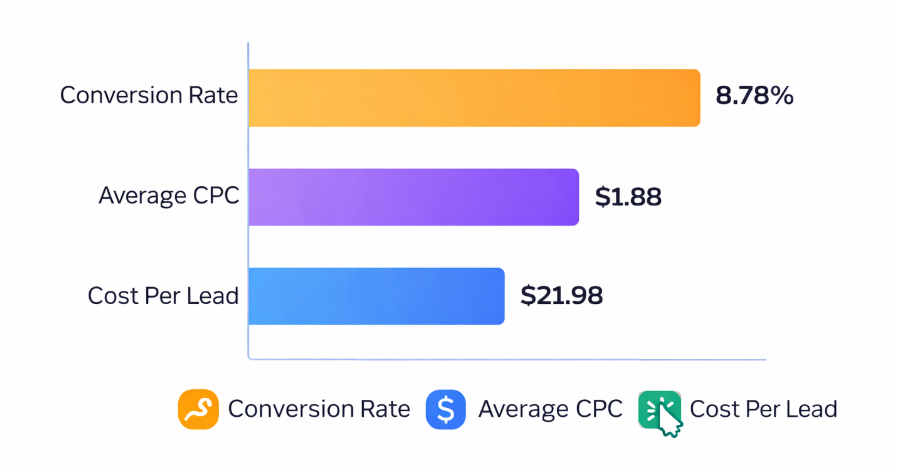
Performance benchmarks for typical Meta lead campaigns showing conversion rate, average CPC, and cost per lead
In high-volume accounts, Advantage+ campaign types can reduce manual fragmentation and improve CPA consistency.
Bid Strategies
Common enterprise approaches include:
-
Lowest Cost for scale expansion
-
Cost Cap for CPA stability
-
Bid Cap for strict efficiency control
Cost Cap strategies are often effective when historical CPA variance is under 15–20%. Excessively tight caps can restrict delivery and reduce learning efficiency.
4. Creative Strategy at Scale
Creative fatigue is one of the primary performance constraints in enterprise campaigns.
Meta data consistently shows that creative accounts for the majority of performance variance in auction environments. Enterprises running static creative sets for more than 6–8 weeks typically see declining CTR and rising CPAs.
Structured Creative Testing Framework
High-performing enterprise teams implement:
-
Ongoing concept testing (problem-solution, social proof, comparison, authority)
-
Format diversification (Reels, Stories, Feed, Carousel, Video)
-
Messaging personalization by funnel stage
For example:
-
Top-of-funnel: Problem awareness and category education
-
Mid-funnel: Case studies and differentiation
-
Bottom-funnel: Direct value propositions and urgency
Systematic testing cycles every 2–4 weeks reduce fatigue and stabilize blended CPA.
5. Audience Strategy for Large-Scale Accounts
Enterprise advertisers must move beyond micro-segmentation.
Broad Targeting with Strong Signals
Meta’s algorithm performs increasingly well with broad audiences when paired with:
-
High-quality first-party data
-
Optimized conversion events
-
Robust creative variety
In many enterprise tests, broad targeting combined with Cost Cap bidding has outperformed layered interest stacks by double-digit percentage improvements in CPA.
First-Party Data Activation
CRM-based custom audiences enable:
-
High-LTV customer expansion
-
Cross-sell and upsell segmentation
-
Exclusion of low-quality leads
Enterprises integrating CRM segmentation into campaign logic frequently observe improved ROAS consistency across quarters.
6. Automation and Operational Efficiency
Manual optimization does not scale in enterprise environments.
Automation layers should include:
-
Automated budget reallocation rules
-
CPA deviation alerts
-
Creative fatigue monitoring
-
Lead quality scoring integrations
Reducing human reaction time improves performance stability, particularly in accounts with daily spend fluctuations above $10,000.
7. Reporting and Executive Alignment
Enterprise reporting must translate media metrics into business outcomes.
Instead of reporting only:
-
CTR
-
CPM
-
CPC
Teams should align around:
-
Customer Acquisition Cost (CAC)
-
Marketing Qualified Leads (MQL)
-
Sales Qualified Leads (SQL)
-
Revenue per Lead
-
Incremental Lift
Executive dashboards should emphasize blended performance across markets rather than isolated campaign-level metrics.
8. Risk Management and Compliance
Enterprise advertisers often operate in regulated industries.
Governance processes should include:
-
Pre-approved creative libraries
-
Legal review workflows
-
Brand safety audits
-
Ad account redundancy planning
Operational resilience ensures continuity during policy updates or account disruptions.
Conclusion
Optimizing Meta Ads for enterprise-level campaigns requires structural discipline, rigorous measurement, scalable experimentation, and automation-driven operations. Marginal improvements compound significantly at high spend levels.
Organizations that treat Meta not as a tactical acquisition channel but as a performance infrastructure layer achieve greater long-term stability, improved incremental revenue, and stronger cross-market consistency.
Recommended Reading
By implementing a structured enterprise framework across architecture, creative, data, and governance, large organizations can unlock sustainable growth within Meta’s advertising ecosystem.