Businesses investing in Meta advertising are facing rising acquisition costs and declining signal quality due to privacy restrictions and tracking limitations. Quiz funnels offer a practical solution: they collect zero‑party data directly from users while creating highly personalized experiences that improve ad relevance and conversion rates.
Introduction
Over the past few years, advertisers have had to rethink how they collect and use customer data. With increasing privacy regulations, browser restrictions, and changes in platform tracking, the traditional reliance on third‑party data has become unreliable.
Zero‑party data — information that customers intentionally and proactively share with a brand — is rapidly becoming one of the most valuable marketing assets. According to industry research, 91% of consumers say they are more likely to engage with brands that recognize and remember their preferences.
Quiz funnels are one of the most efficient mechanisms for collecting this type of data while simultaneously improving the performance of Meta advertising campaigns.
What Is Zero‑Party Data?
Zero‑party data refers to information that users voluntarily provide to a brand. Unlike first‑party data, which is inferred from behavior (such as page views or purchases), zero‑party data is explicitly shared by the user.
Examples include:
-
Product preferences
-
Goals and challenges
-
Budget range
-
Demographic information
-
Use cases and intentions
Because the information is willingly provided, it tends to be both highly accurate and privacy compliant.
According to Forrester research, 59% of consumers are willing to share personal data with companies if it leads to more personalized experiences.
Why Meta Ads Need Better Data Signals
Meta’s advertising algorithm relies heavily on signal quality to optimize targeting and delivery. However, signal loss caused by tracking limitations has significantly reduced the amount of reliable behavioral data available to advertisers.
Several industry studies report that after major privacy updates, advertisers experienced performance volatility and reduced attribution accuracy. Many campaigns saw cost‑per‑acquisition increases of 20–40% as optimization signals weakened.
Quiz funnels help restore high‑quality signals by creating structured user inputs that can be used for segmentation, messaging personalization, and audience modeling.
How Quiz Funnels Work as a Data Engine
A quiz funnel is an interactive sequence of questions designed to guide users toward a personalized recommendation or outcome.
Instead of sending traffic directly to a product page, advertisers send users to a short quiz that captures intent signals.
The process typically includes:
-
Ad click from Meta
-
Interactive quiz experience
-
Data capture from answers
-
Personalized results page
-
Segmented follow‑up campaigns
This structure turns every quiz response into structured marketing data.
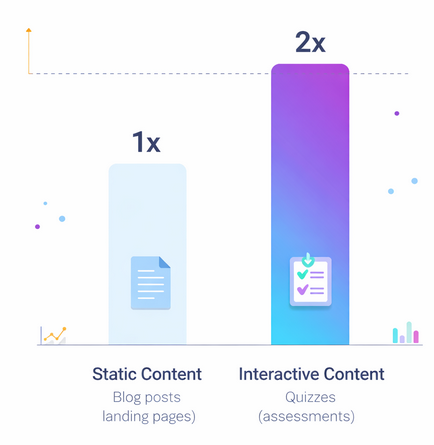
Interactive experiences such as quizzes generate roughly twice the engagement of static content formats
For example, a skincare brand might ask users about:
-
Skin type
-
Main concerns
-
Current routine
-
Budget preferences
Each answer becomes a segmentation variable that improves both immediate conversion and long‑term marketing performance.
Performance Benefits of Quiz Funnels
Quiz funnels often outperform traditional landing pages because they create engagement before the sales pitch.
Several studies show that interactive content generates significantly higher engagement rates than static content. According to demand generation research, interactive content can produce up to 2× higher engagement rates compared with passive experiences.
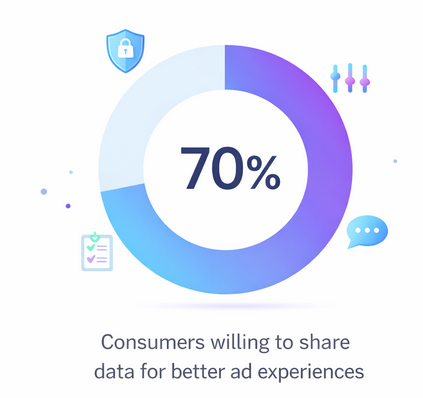
Most consumers are willing to share personal data when it improves advertising relevance and personalization
Additional performance advantages include:
Higher conversion rates
Quizzes create a sense of personalization and curiosity, encouraging users to complete the experience. Many brands report conversion rate improvements of 20–50% compared with standard product landing pages.
Better audience segmentation
Each response provides valuable intent signals that allow marketers to group users by needs and motivations.
Improved ad relevance
The collected data allows advertisers to create more precise audience segments and personalized creatives.
Stronger retargeting strategies
Quiz responses make it possible to build custom audiences based on specific user attributes rather than generic behavioral signals.
Building an Effective Quiz Funnel
Not all quizzes produce meaningful data. To function as a true zero‑party data engine, a quiz funnel must be strategically designed.
1. Ask questions that reveal buying intent
The most valuable questions uncover motivations, challenges, and product fit.
Examples include:
-
What is your primary goal?
-
What problem are you trying to solve?
-
Which features matter most to you?
These questions generate segmentation insights that can directly inform ad messaging.
2. Keep the quiz short and focused
Completion rates decline rapidly when quizzes become too long. In most cases, 5–8 questions is the optimal length.
This provides enough information for segmentation without creating friction.
3. Deliver personalized outcomes
The result page should provide clear value to the user, such as:
-
Product recommendations
-
Customized plans
-
Educational insights
Personalized outcomes increase trust and improve the likelihood of conversion.
4. Use responses for segmentation and creative testing
Quiz responses should not remain unused in a database. They should feed directly into campaign strategy.
For example, advertisers can:
-
Build custom audiences based on quiz answers
-
Test creatives tailored to specific user profiles
-
Personalize email sequences
-
Optimize retargeting campaigns
When used effectively, quiz data becomes a continuous optimization loop for advertising performance.
Quiz Funnels and the Future of Performance Marketing
As digital advertising becomes increasingly privacy‑centric, marketers must rely less on passive tracking and more on intentional data exchange.
Quiz funnels represent a scalable approach to gathering structured customer insights while delivering personalized experiences that users find valuable.
Brands that successfully implement zero‑party data strategies will have a significant advantage in campaign optimization, audience understanding, and long‑term customer relationships.
Further Reading
For deeper insights into improving advertising performance and data‑driven targeting strategies, explore these articles:
By integrating quiz funnels into advertising strategies, marketers can transform anonymous traffic into actionable customer intelligence while improving the effectiveness of Meta campaigns.