Surveys capture something most marketing signals cannot: explicit intent. Instead of inferring interests from browsing behavior alone, marketers receive direct answers about needs, preferences, purchase timelines, and pain points.
Recent research shows that:
-
74% of consumers are willing to share personal data if it leads to better experiences.
-
Personalized campaigns can increase conversion rates by up to 202%.
-
Audience segmentation based on declared preferences improves campaign ROI by more than 30%.

Consumer willingness to share personal data in exchange for better brand experiences
Survey responses therefore represent a form of high‑quality first‑party data. When structured correctly, they can become a reliable foundation for highly targeted marketing campaigns.
Identifying High‑Intent Signals in Survey Responses
Not all survey answers indicate the same level of intent. To create effective custom audiences, marketers should focus on responses that suggest strong buying signals.
Examples of high‑intent indicators include:
-
Planned purchase timelines ("within 30 days", "this quarter")
-
Budget ranges
-
Product category preferences
-
Current solution dissatisfaction
-
Feature priorities
These responses reveal not only who is interested, but how close they are to making a decision.
Structuring Survey Data for Audience Creation
Raw survey results rarely translate directly into effective audiences. They must first be structured and categorized.
A practical workflow includes:
-
Segmenting by intent level
Separate respondents into high, medium, and low intent groups. -
Creating interest clusters
Group respondents based on the problems they want to solve or product categories they selected. -
Identifying urgency signals
Detect answers that indicate near‑term purchasing plans. -
Combining demographic insights
Enrich responses with location, industry, company size, or role information.
This structured approach allows marketers to create audiences that reflect real‑world demand rather than generic demographic assumptions.
Transforming Survey Segments Into Custom Audiences
Once survey responses are organized, they can be translated into actionable advertising audiences.
Common strategies include:
1. Intent‑Driven Retargeting
Respondents who expressed active purchase interest can be grouped into high‑intent segments. Campaigns targeting these audiences often show significantly higher conversion rates because messaging directly addresses previously stated needs.
2. Problem‑Focused Messaging
Survey responses frequently reveal the exact challenges potential customers are facing. These insights allow marketers to build audience segments around specific pain points and tailor messaging accordingly.
3. Feature‑Based Segmentation
When respondents prioritize particular product features, they can be grouped into audiences that respond to messaging highlighting those exact capabilities.
This approach aligns advertising content with user priorities, which increases relevance and engagement.
Using Survey Data to Improve Lookalike Modeling
Survey responses can also strengthen lookalike audience creation. By starting with a seed audience composed of high‑intent respondents, marketers provide advertising platforms with clearer signals about the characteristics of valuable prospects.
This improves the quality of lookalike modeling and often results in:
-
Lower acquisition costs
-
Higher conversion rates
-
More qualified traffic
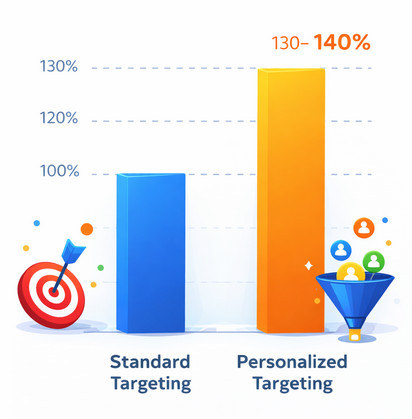
Personalized targeting strategies can increase conversion rates by 30–40% compared with generic campaigns
Because the source audience reflects declared intent, the resulting lookalikes tend to resemble users who are genuinely interested rather than casual browsers.
Maintaining Data Quality and Privacy
Survey‑based audience building requires responsible data handling. To maintain effectiveness and compliance, marketers should follow several best practices:
-
Collect only necessary information
-
Clearly communicate how data will be used
-
Regularly clean and update datasets
-
Remove outdated responses
High‑quality, permission‑based data not only protects user trust but also ensures that targeting remains accurate over time.
Measuring the Impact of Survey‑Based Audiences
The effectiveness of these audiences should be evaluated using performance metrics such as:
-
Conversion rate
-
Cost per acquisition
-
Click‑through rate
-
Return on ad spend
Many organizations observe meaningful improvements when campaigns are built around declared intent signals. In some cases, conversion rates increase by 30–50% compared with campaigns based solely on behavioral targeting.
Suggested Articles to Continue Reading
Conclusion
Survey responses offer a rare opportunity to understand customer intent directly from the source. By identifying high‑intent signals, structuring responses into meaningful segments, and translating those segments into targeted advertising audiences, marketers can significantly improve campaign efficiency.
When used strategically, survey data becomes far more than feedback—it becomes a powerful engine for high‑intent audience creation and smarter marketing decisions.