Free trials are a cornerstone of SaaS growth strategies, yet conversion rates remain a persistent challenge. Industry benchmarks show that only 15%–25% of free trial users convert into paying customers. Even more concerning, up to 60% of users never meaningfully engage with the product during the trial period.
Retargeting offers a powerful mechanism to bring these users back, reinforce value, and guide them toward conversion. By leveraging behavioral data and personalized messaging, SaaS companies can significantly improve trial-to-paid performance.
Why Free Trial Users Drop Off
Understanding why users disengage is critical before designing retargeting strategies. Common reasons include:
-
Lack of immediate value realization
-
Poor onboarding experience
-
Feature overwhelm
-
Misalignment between expectations and product capabilities
-
Distractions and competing priorities
According to research, 80% of users who churn during a trial do so within the first three days, highlighting the importance of early intervention.
Key Retargeting Channels
Email Retargeting
Email remains one of the most effective channels for re-engagement. SaaS companies using lifecycle-based email campaigns report up to 30% higher conversion rates compared to one-size-fits-all messaging.
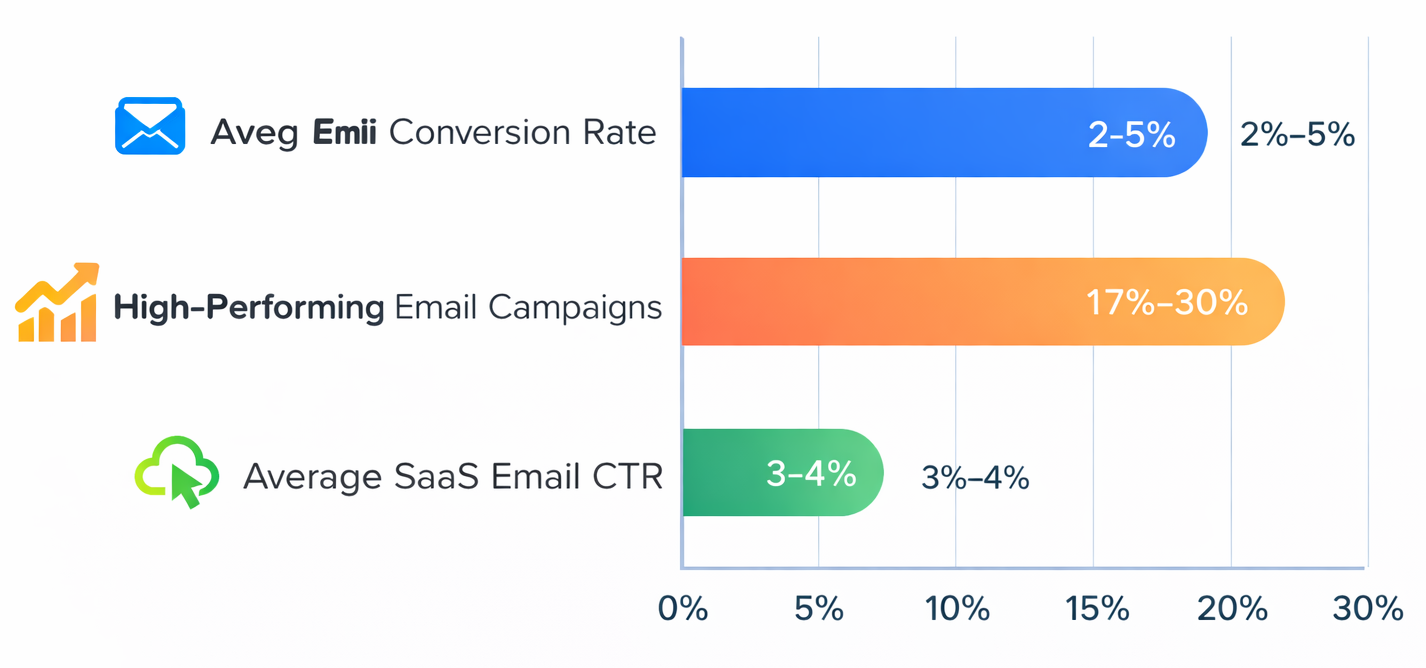
Email retargeting performance benchmarks across SaaS and marketing campaigns
Best practices include:
-
Trigger-based emails based on user behavior
-
Personalized content reflecting feature usage
-
Clear calls to action tied to product value
Display and Programmatic Advertising
Retargeting ads help keep the product top-of-mind. Studies show that retargeted users are 70% more likely to convert compared to non-retargeted users.
Effective tactics include:
-
Segmenting audiences based on activity level
-
Highlighting specific features not yet explored
-
Reinforcing social proof and use cases
In-App Messaging
For users who return but remain inactive, in-app messages can guide them toward meaningful actions. Contextual nudges can increase feature adoption by up to 20%.
Examples include:
-
Tooltips and walkthroughs
-
Milestone-based prompts
-
Usage reminders
Behavioral Segmentation for Precision Retargeting
Not all trial users are the same. Segmenting users based on behavior allows for more relevant messaging.
Common segments include:
-
Activated users who haven’t converted
-
Users who signed up but never logged in again
-
Users who explored limited features
-
High-intent users who abandoned during key actions
Companies that implement behavioral segmentation see up to 2x improvement in conversion rates.
Personalization at Scale
Generic retargeting campaigns are increasingly ineffective. Personalized experiences are essential:
-
Dynamic email content based on usage data
-
Custom ad creatives aligned with user intent
-
Tailored onboarding sequences
According to recent data, 72% of users engage only with personalized messaging, and personalized retargeting campaigns can improve ROI by up to 5x.
Timing and Frequency Optimization
Timing is critical in retargeting. Over-communication can lead to fatigue, while under-communication results in missed opportunities.
Recommended approach:
-
First 24 hours: onboarding reinforcement
-
Days 2–5: feature education and value demonstration
-
Days 6–10: social proof and case studies
-
Final days: urgency and conversion incentives
Leveraging Intent Data
Intent signals provide valuable insights into user readiness to convert. These include:
-
Frequency of logins
-
Depth of feature usage
-
Interaction with key features
Users exhibiting high intent are up to 3x more likely to convert, making them ideal candidates for focused retargeting efforts.
Multi-Channel Orchestration
The most effective retargeting strategies combine multiple channels into a cohesive experience. Companies using multi-channel campaigns achieve up to 287% higher purchase rates compared to single-channel approaches.
Key considerations:
-
Consistent messaging across channels
-
Sequential storytelling
-
Unified data tracking
Measuring Retargeting Success
To optimize performance, track the following metrics:
-
Trial-to-paid conversion rate
-
Activation rate
-
Email open and click-through rates
-
Cost per acquisition
-
Return on ad spend
Continuous testing and optimization are essential for long-term success.
Additional Reading
Conclusion
Retargeting is a critical lever for improving SaaS free trial conversions. By combining behavioral insights, personalized messaging, and multi-channel execution, companies can significantly increase engagement and drive revenue growth. The key lies in delivering the right message to the right user at the right time.