Retargeting remains one of the most effective strategies in digital marketing, with studies showing that retargeted users are up to 70% more likely to convert compared to first-time visitors. However, aggressive or poorly managed retargeting can quickly lead to overexposure, diminishing returns, and even negative brand perception.
Striking the right balance is essential. This article outlines how to execute retargeting campaigns that stay effective without overwhelming your audience.
The Problem of Overexposure
Overexposure occurs when users see the same or similar ads too frequently. According to industry data, ad fatigue can set in after as few as 5–7 impressions, leading to declining click-through rates and increased ad blindness.
Key consequences include:
-
Reduced engagement rates
-
Increased cost per acquisition (CPA)
-
Negative brand sentiment
-
Higher opt-out or ad-blocking behavior
Segment Your Audience Precisely
Not all users should be retargeted the same way. Segmenting audiences based on behavior allows for more relevant and less intrusive messaging.
Effective segmentation strategies include:
-
Page-specific visitors (pricing page vs. blog readers)
-
Time since last interaction
-
Depth of engagement
-
Purchase intent signals
Highly segmented campaigns can improve conversion rates by up to 50% while reducing unnecessary impressions.
Control Frequency Caps
Frequency capping is one of the most effective tools to prevent overexposure. Limiting the number of times a user sees your ad ensures that your message remains impactful.
Best practices include:
-
Setting daily and weekly impression limits
-
Adjusting caps based on funnel stage
-
Monitoring frequency vs. performance metrics
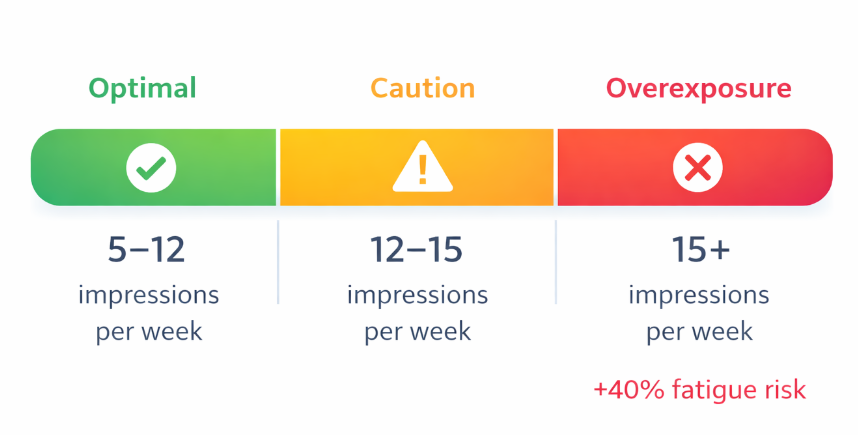
Maintaining impressions within the optimal range prevents fatigue and preserves campaign performance
Data suggests that optimal frequency typically falls between 3–5 impressions per user per week, depending on the campaign objective.
Refresh Creative Regularly
Even well-targeted ads lose effectiveness over time if the creative remains static. Rotating creatives helps maintain user interest and prevents fatigue.
Recommendations:
-
Update visuals and messaging every 2–4 weeks
-
Test multiple variations simultaneously
-
Align creatives with user journey stages
Dynamic creative optimization can increase engagement rates by up to 30%.
Use Sequential Messaging
Rather than repeating the same message, guide users through a narrative. Sequential messaging allows you to present different value propositions over time.
For example:
-
Awareness: Introduce your solution
-
Consideration: Highlight benefits and differentiators
-
Decision: Offer testimonials or incentives
This approach not only reduces fatigue but also increases relevance and conversion potential.
Leverage Burn Pixels and Exclusion Lists
Continuing to retarget users who have already converted is a common mistake. Implement burn pixels and exclusion lists to remove these users from campaigns.
Benefits include:
-
Reduced wasted ad spend
-
Improved user experience
-
More accurate performance data
Optimize Timing Windows
Timing plays a crucial role in retargeting effectiveness. Showing ads too soon or too late can reduce impact.
Consider:
-
Short windows (1–3 days) for high-intent users
-
Longer windows (7–30 days) for lower-intent audiences
Proper timing alignment can improve conversion rates by up to 20%.
Monitor Engagement Signals
Pay close attention to user behavior signals such as declining CTR, increased bounce rates, or rising CPA. These indicators often signal overexposure.
Regular optimization based on these metrics ensures campaigns remain efficient and user-friendly.
Conclusion
Retargeting is powerful, but only when executed with precision. Avoiding overexposure requires a combination of smart segmentation, controlled frequency, creative variation, and data-driven optimization.
By focusing on relevance rather than repetition, marketers can maintain strong performance while building a positive and sustainable user experience.
Suggested Articles for Further Reading