
We are excited to share a practical guide on scaling digital advertising campaigns using automated rules. As performance marketing becomes increasingly data-driven and complex, automation is no longer optional—it is foundational.
Scaling paid acquisition campaigns is not simply about increasing budgets. It is about maintaining efficiency while expanding reach, volume, and complexity. The more campaigns you run, the more variables you introduce: bids, budgets, placements, audiences, creatives, timing, frequency, and performance fluctuations.
According to industry benchmarks, advertisers managing more than 50 active campaigns manually experience up to 30% slower optimization cycles compared to teams leveraging automation. Additionally, research shows that marketing teams spend nearly 40% of their time on repetitive optimization tasks—budget shifts, bid adjustments, pausing underperforming ads, and reallocating spend.
Automation through rule-based systems eliminates operational bottlenecks and allows teams to scale without proportional increases in headcount.
What Are Automated Rules?
Automated rules are predefined conditions that trigger specific actions when performance thresholds are met. Instead of manually reviewing dashboards multiple times per day, the system executes actions automatically.
Examples include:
-
Increasing budget when ROAS exceeds target by 20%
-
Pausing ads when CPA exceeds threshold for 3 consecutive days
-
Raising bids when impression share drops below 60%
-
Shifting budget toward top-performing audience segments
Automated rules act as guardrails and accelerators simultaneously. They protect performance and unlock growth opportunities at scale.
The Scaling Framework: 4 Layers of Automation
Effective scaling requires a structured automation hierarchy.
1. Protection Rules (Loss Prevention)
These rules prevent waste.
Common triggers:
-
CPA above target for defined period
-
CTR below minimum benchmark
-
Conversion rate drops beyond statistical tolerance
Statistically, advertisers who implement structured stop-loss rules reduce wasted spend by 18–25% within the first 60 days.
2. Stability Rules (Performance Maintenance)
These maintain equilibrium as budgets grow.
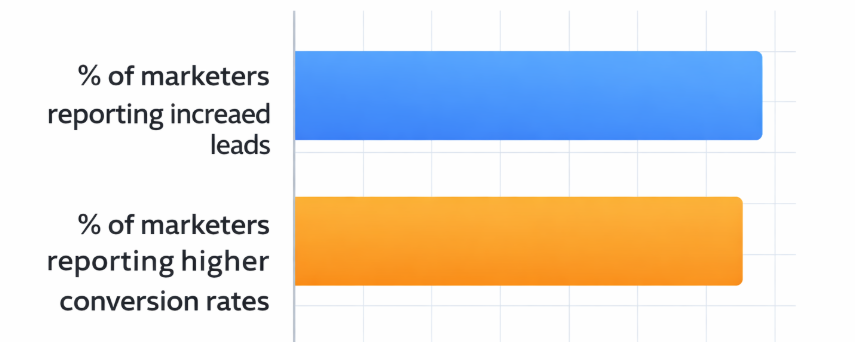
Most marketers using automation report measurable gains in lead generation and conversion rates
Examples:
-
Gradual budget increases (5–15% per day)
-
Bid caps tied to real-time CPA
-
Frequency monitoring adjustments
Aggressive scaling without stability rules often causes algorithmic resets, leading to 10–35% temporary performance volatility.
3. Acceleration Rules (Growth Triggers)
These rules amplify winning segments.
Triggers include:
-
ROAS 30% above target
-
Conversion volume exceeds learning threshold
-
High-performing creatives exceeding baseline CTR by 40%
Structured acceleration systems allow advertisers to scale budgets 2–3x faster while maintaining efficiency.
4. Reallocation Rules (Capital Efficiency)
Capital should constantly migrate toward stronger assets.
Examples:
-
Shift 20% of budget from bottom quartile campaigns to top quartile
-
Duplicate and expand top-performing audiences
-
Reinvest savings from paused ads into growth campaigns
Campaign portfolios using automated reallocation improve blended ROAS by an average of 12–18%.
Data Requirements for Safe Automation
Automation without statistical safeguards creates instability.
Before activating rules, ensure:
-
Minimum 30–50 conversions per campaign (to avoid noise)
-
Defined attribution window consistency
-
Baseline performance benchmarks
-
Clear profitability thresholds (true CPA, not platform-reported only)
Automated rules must rely on statistically significant data, not short-term volatility.
Budget Scaling: Controlled vs. Aggressive Approaches
There are two primary scaling models.
Controlled Scaling
-
5–15% daily budget increases
-
Bid adjustments in small increments
-
Rule activation after 3–5 days of stable performance
Best for maintaining consistent CPA and protecting margin.
Aggressive Scaling
-
20–50% budget jumps
-
Rapid duplication of winning ad sets
-
Faster acceleration triggers
Higher risk but enables rapid market capture.
Industry data suggests campaigns scaled gradually maintain 22% more consistent ROAS over 90-day periods compared to aggressively scaled campaigns without safeguards.
Common Mistakes in Automated Scaling
-
Overlapping rules causing conflicting actions
-
Scaling based on insufficient conversion volume
-
Ignoring external variables (seasonality, promotions, inventory)
-
Automating without margin awareness
-
Failing to monitor rule performance weekly
Automation is not “set and forget.” It is “design, monitor, refine.”
Advanced Optimization: Rule Stacking
Sophisticated scaling systems layer multiple conditions.
Example:
-
IF ROAS > 150% of target
-
AND Conversions > 20 in 7 days
-
AND Frequency < 2.5
-
THEN Increase budget by 12%
This reduces false positives and ensures only statistically valid winners receive additional capital.
Advertisers using multi-condition rule stacks report 15–28% higher scaling efficiency compared to single-metric automation.
Monitoring and Governance
Automation requires governance frameworks.
Best practices:
-
Weekly audit of triggered rules
-
Monthly recalibration of thresholds
-
Quarterly restructuring of scaling logic
-
Performance dashboards segmented by rule category
Governance ensures automation evolves with market conditions.
The Strategic Outcome
When implemented correctly, automated rules:
-
Reduce manual workload by up to 40%
-
Shorten optimization cycles by 25–35%
-
Improve capital allocation efficiency
-
Enable portfolio-level scaling without operational overload
Scaling campaigns is no longer a manual craft. It is a systems-engineering discipline.
Recommended Reading
To deepen your understanding of performance optimization and scaling systems, explore these related arti
Conclusion
Sustainable growth is built on structured automation, not reactive adjustments. Automated rules provide the operational backbone required to scale campaigns confidently while preserving profitability.
Organizations that treat automation as infrastructure—not convenience—gain durable competitive advantage in increasingly complex advertising ecosystems.