Enterprise sales has evolved from single-threaded relationship selling to multi-stakeholder consensus building. In large organizations, purchasing decisions—particularly those involving software, infrastructure, or strategic services—are made by buying committees rather than individual executives.
Understanding how buying committees function is essential for improving win rates, accelerating deal cycles, and increasing average contract value. Organizations that map stakeholders accurately and engage them with relevant messaging significantly outperform those that rely on one champion.
What Is a Buying Committee?
A buying committee is a cross-functional group of stakeholders involved in evaluating, approving, and implementing a purchase decision. The structure and size of the committee depend on company size, deal value, and perceived business risk.
Research consistently shows that B2B purchase decisions involve multiple stakeholders. According to widely cited industry data, the average B2B buying group now includes 6 to 10 decision-makers. In enterprise environments, that number can exceed 12 participants across departments.
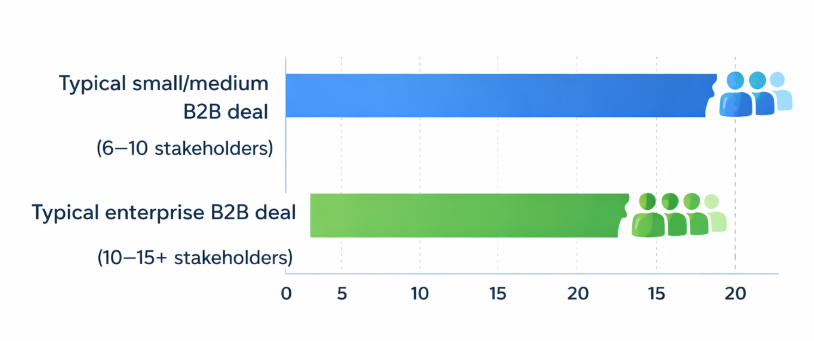
Average number of stakeholders typically involved in B2B and enterprise buying decisions
These stakeholders typically represent different business functions, technical roles, and levels of authority. Each member evaluates the purchase from a distinct perspective, including financial impact, operational feasibility, security, integration, and long-term scalability.
Why Buying Committees Have Expanded
Several structural factors explain the growth of buying committees in enterprise sales:
-
Increased financial scrutiny: Larger investments require executive oversight and budget alignment.
-
Risk mitigation: Organizations distribute accountability across departments to reduce implementation risk.
-
Digital transformation complexity: Modern solutions impact multiple workflows, systems, and teams.
-
Compliance and governance requirements: Security, legal, and procurement functions play a formal role in approval.
Additionally, enterprise buyers conduct extensive independent research before engaging vendors. Studies indicate that buyers may be 60–70% through their decision process before speaking with sales. This shift makes early stakeholder identification even more critical.
Core Roles Within a Buying Committee
Although titles vary, buying committee members usually fall into defined role categories:
1. Economic Buyer
The executive who controls the budget and signs off on the investment. Their priority is measurable business outcomes—ROI, cost reduction, revenue growth, or strategic advantage.
2. Technical Buyer
Often part of IT or engineering. This stakeholder evaluates architecture, integration capability, data security, and implementation feasibility.
3. User Buyer
Operational leaders or end users who assess usability, workflow alignment, and adoption impact.
4. Champion
An internal advocate who promotes the solution and drives consensus internally. Champions influence discussions but may not have final authority.
5. Procurement and Legal
Responsible for contract structure, pricing negotiations, and compliance.
High-performing sales teams identify these roles early and tailor communication to each stakeholder’s priorities.
Common Challenges in Engaging Buying Committees
Misaligned Messaging
One-size-fits-all messaging fails in committee environments. Finance stakeholders expect quantified ROI. Technical evaluators require documentation. End users seek operational clarity.
Single-Threaded Outreach
Relying on one contact increases risk. If a champion leaves or loses influence, the deal can stall.
Internal Disagreement
Committees frequently experience conflicting priorities. For example, IT may prioritize system stability while operations push for innovation speed.
Decision Paralysis
As committee size increases, consensus becomes more difficult. Research shows that larger buying groups correlate with longer sales cycles.
Strategies for Successfully Navigating Buying Committees
Map Stakeholders Early
Create a stakeholder matrix identifying influence level, decision authority, business objectives, and potential objections.
Develop Multi-Layered Value Propositions
Craft differentiated messaging aligned with each role:
-
Executives: financial impact and strategic alignment
-
Technical teams: architecture, security, integration
-
End users: productivity and workflow efficiency
Quantify Business Impact
Enterprise buyers expect measurable value. Use data models, scenario analysis, and industry benchmarks to support claims.
Enable Internal Selling
Provide champions with executive-ready materials, business cases, and objection-handling frameworks they can use internally.
Maintain Multi-Threaded Communication
Engage several stakeholders simultaneously to reduce dependency risk and accelerate consensus.
The Role of Data in Identifying Buying Committees
Accurate account intelligence is foundational to engaging buying committees effectively. Sales teams need visibility into:
-
Organizational hierarchies
-
Departmental structures
-
Decision-making authority
-
Technology ownership
Without reliable data, teams risk missing critical stakeholders or targeting individuals without influence.
Metrics That Improve with Effective Committee Engagement
Organizations that systematically engage buying committees often report:
-
Higher win rates
-
Larger average deal sizes
-
Shorter sales cycles due to proactive objection management
-
Improved forecast accuracy
Given that enterprise buying decisions increasingly require cross-functional alignment, the ability to orchestrate multi-stakeholder engagement is becoming a core revenue competency.
Conclusion
Enterprise sales success depends on more than persuasive conversations. It requires structured stakeholder mapping, role-based messaging, and data-driven engagement strategies. Buying committees are not obstacles—they are structured decision systems designed to manage risk and ensure organizational alignment.
Revenue teams that understand these systems and adapt their strategy accordingly gain a significant competitive advantage.