International B2B expansion presents a paradox: growth opportunities increase with each new market, yet complexity scales even faster. Differences in language, regulatory environments, buyer behavior, data availability, and channel effectiveness make standardized global campaigns inefficient and often ineffective.
Localized targeting resolves this tension. By aligning segmentation, messaging, and outreach infrastructure with regional realities, organizations can scale internationally without sacrificing performance metrics such as engagement rates, qualified lead volume, and pipeline contribution.
According to industry research, over 70% of B2B buyers expect personalized experiences, and campaigns localized by geography and industry can improve conversion rates by 20–30% compared to generic global messaging. In high-value B2B sales cycles, such performance lifts significantly impact revenue outcomes.
The Strategic Imperative of Localization in B2B
1. Buyer Behavior Differs Across Regions
Decision-making hierarchies, procurement cycles, and communication preferences vary significantly between North America, EMEA, and APAC markets. For example:
-
In North America, direct outreach and shorter sales cycles are more common.
-
In parts of Europe, regulatory compliance and data privacy transparency heavily influence vendor selection.
-
In APAC markets, relationship-building and multi-level stakeholder engagement often play a greater role.
Ignoring these differences reduces engagement rates and increases acquisition costs.
2. Regulatory Environments Shape Outreach
Data protection frameworks such as GDPR in Europe and other regional privacy laws directly affect how prospecting and outbound campaigns must be structured. Non-compliance not only risks fines but also damages brand credibility in competitive enterprise markets.
Localized targeting ensures:
-
Data sourcing aligns with regional legal standards.
-
Messaging includes necessary disclosures.
-
Contact strategies match permitted outreach frameworks.
3. Market Maturity Affects Positioning
A product positioned as "innovative" in one region may need to be positioned as "proven and reliable" in another. Mature markets may require differentiation, while emerging markets may require education-first campaigns.
Localized segmentation allows messaging to match the awareness and adoption stage of each target geography.
Core Components of Scalable Localized Targeting
Granular Geographic Segmentation
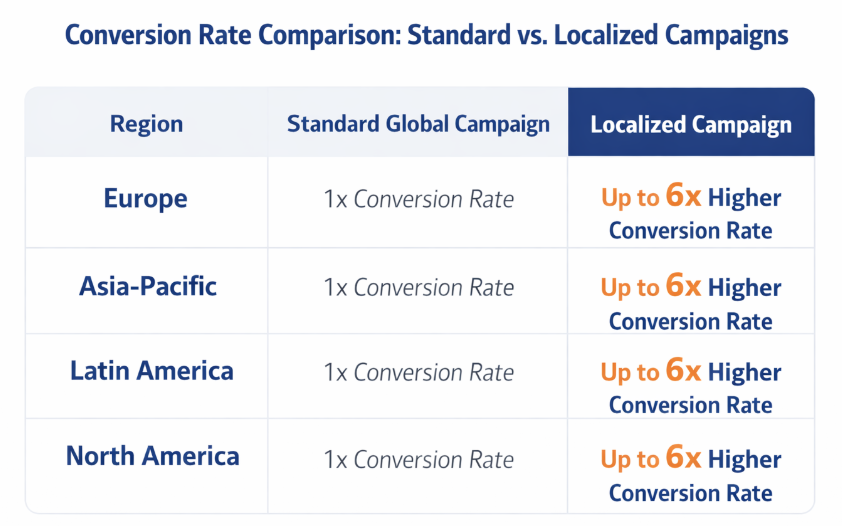
Localized B2B campaigns can drive significantly higher conversion rates compared to standard global approaches
Effective international scaling begins with precise geographic filtering at multiple levels:
-
Country
-
Region or state
-
Metropolitan area
-
Industry clusters within specific territories
This approach supports targeted account selection and improves outbound performance. Campaigns using refined geographic segmentation have demonstrated up to 25% higher reply rates compared to broad international targeting.
Industry-Specific Localization
Industry maturity and regulatory frameworks vary by region. For example, fintech adoption rates differ significantly between Western Europe and Southeast Asia. Segmenting not only by geography but also by vertical ensures messaging aligns with local industry conditions.
Role and Seniority Mapping by Region
Job titles and responsibilities are not globally standardized. A "Head of Growth" in one market may hold responsibilities equivalent to a "VP Marketing" elsewhere. Building localized title mapping frameworks prevents targeting gaps.
Multilingual Personalization
While English remains dominant in global business, localized-language outreach increases open and response rates. Studies show that emails written in a prospect’s native language can improve engagement by over 25%.
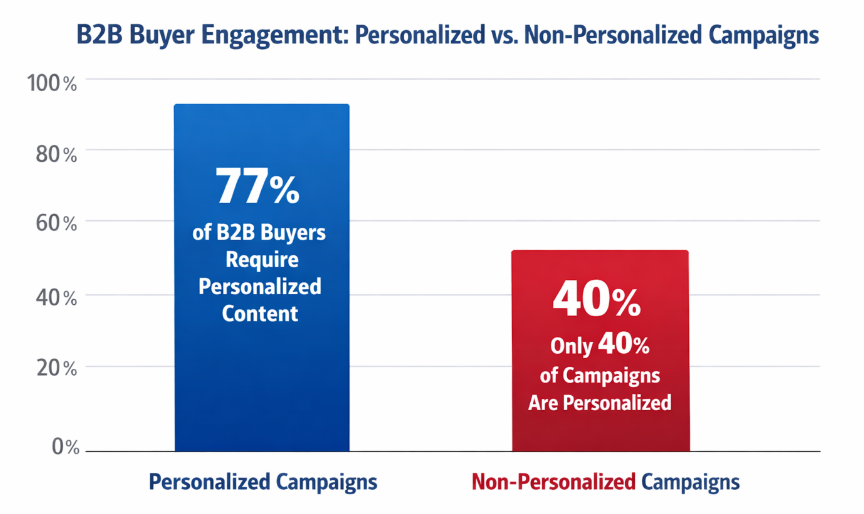
Comparison of B2B buyer engagement levels in personalized vs. non-personalized campaign experiences
Localization does not mean full operational duplication; it means selectively adapting high-impact elements such as:
-
Subject lines
-
Value propositions
-
Case study references
-
Compliance language
Infrastructure Requirements for Global Scaling
Centralized Data Governance with Local Flexibility
A scalable international strategy requires a unified data infrastructure with regional segmentation layers. Central oversight ensures data consistency, while local filters enable campaign-level precision.
Regional Performance Analytics
Scaling globally demands performance benchmarking by region. Metrics should include:
-
Delivery rates
-
Open rates
-
Reply rates
-
Qualified meeting rates
-
Pipeline contribution
Comparative analysis reveals which markets justify increased investment and which require strategy refinement.
Account-Based Targeting Across Borders
For enterprise B2B organizations, account-based strategies must adapt to multinational corporate structures. Targeting should identify:
-
Regional headquarters
-
Local subsidiaries
-
Country-level decision-makers
This prevents fragmented outreach and ensures coordinated engagement across global accounts.
Common Pitfalls in International B2B Expansion
-
Over-standardizing messaging across markets.
-
Applying identical ICP definitions globally without regional validation.
-
Ignoring legal nuances in data usage.
-
Underestimating cultural differences in communication tone.
Organizations that address these issues early reduce wasted spend and accelerate time-to-revenue in new markets.
A Framework for Scaling International Campaigns
To operationalize localized targeting at scale, follow a structured framework:
-
Define global ICP criteria.
-
Refine ICP by region using market-specific filters.
-
Map regional role equivalents.
-
Adapt messaging hierarchy for each geography.
-
Launch pilot campaigns in priority markets.
-
Benchmark and optimize before full-scale rollout.
Companies that pilot regionally before global expansion report up to 40% higher long-term campaign efficiency compared to immediate multi-market launches.
Measuring ROI of Localized B2B Campaigns
Localization investments should be evaluated using measurable indicators:
-
Cost per qualified lead by region
-
Revenue per account by geography
-
Sales cycle length comparison
-
Market penetration rate
When executed correctly, localized targeting reduces acquisition costs while improving lead quality, resulting in stronger pipeline velocity across international markets.
Conclusion
Scaling international B2B campaigns requires more than translation or expanded contact lists. It demands structured geographic segmentation, regional compliance alignment, and culturally aware messaging strategies.
Localized targeting enables organizations to expand confidently into global markets while maintaining precision, efficiency, and measurable growth outcomes.
Recommended Reading
To deepen your understanding of scalable B2B targeting and international outreach strategies, explore: