Most campaigns don’t fail because of bad creative or weak offers — they fail during scaling. A campaign that performs profitably at $50/day can collapse at $500/day if budget increases outpace learning, audience saturation, and signal stability.
Industry data shows that more than 60% of paid social performance drops occur within the first 7 days of aggressive scaling, largely due to disrupted delivery and audience fatigue. Scaling without structure turns optimization into guesswork.
Protective scaling focuses on expanding volume while preserving the signals that made the campaign work in the first place.
Rule 1: Scale Budgets Gradually, Not Emotionally
The most common mistake is reacting to early success with sudden budget spikes. While tempting, large jumps reset learning phases and distort delivery.
Best practice:
-
Increase budgets by 10–25% every 48–72 hours
-
Allow platforms time to recalibrate delivery
-
Monitor conversion quality, not just volume
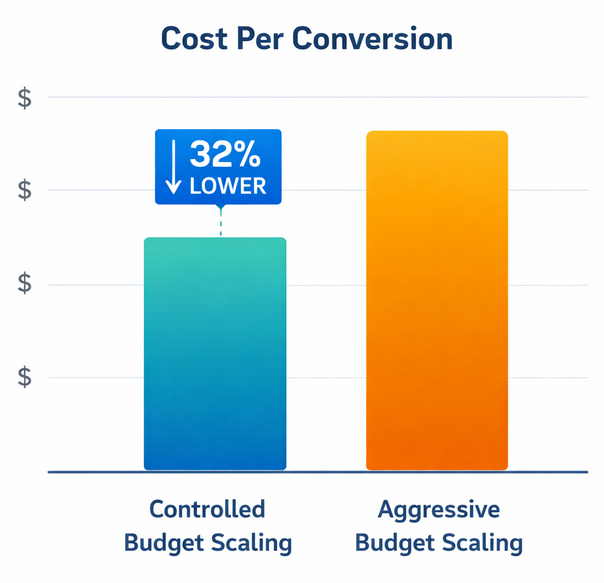
According to aggregated ad platform benchmarks, campaigns that increase budgets in controlled increments maintain up to 32% lower cost per conversion compared to campaigns that double budgets overnight.
Rule 2: Separate Scaling From Testing
Testing and scaling serve different goals. Mixing them inside the same campaign creates noise and unstable performance.
Protective structure:
-
Testing campaigns: validate creatives, audiences, and offers
-
Scaling campaigns: allocate budget only to proven combinations
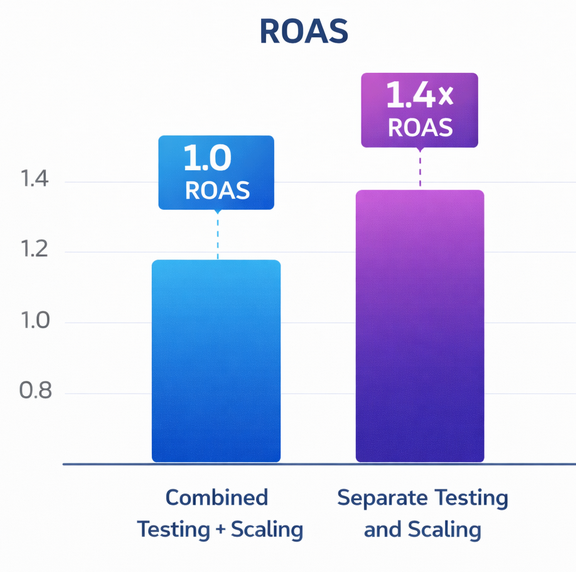
Data from performance marketers shows that accounts using isolated scaling campaigns achieve 1.4× higher ROAS compared to accounts where testing and scaling are combined.
Rule 3: Expand Audiences Before Expanding Spend
When spend increases faster than audience size, ads hit the same users repeatedly. This leads to fatigue, rising CPMs, and declining conversion rates.
Before increasing budget:
-
Broaden audience parameters
-
Add additional high-quality data sources
-
Stack complementary audience segments
Research across social ad platforms indicates that audience saturation can increase CPA by 40–70% once frequency crosses sustainable thresholds.
Rule 4: Protect High-Intent Segments
Not all traffic scales equally. Retargeting and high-intent segments often deliver the highest efficiency but break fastest when overfunded.
Scaling rule:
-
Cap frequency on warm audiences
-
Allocate incremental budget primarily to expansion layers
On average, retargeting campaigns convert 2–3× higher than cold traffic, but over-scaling them leads to diminishing returns within days.
Rule 5: Watch Leading Indicators, Not Just CPA
Cost per acquisition often lags behind performance problems. By the time CPA spikes, damage is already done.
Protective metrics to monitor:
-
Frequency growth
-
CTR decay
-
Conversion rate stability
-
Cost per click trends
Accounts that monitor leading indicators catch performance degradation 3–5 days earlier than CPA-only tracking.
Rule 6: Scale Horizontally Before Vertically
Vertical scaling (increasing budget) should come after horizontal scaling (duplicating proven structures).
Horizontal options include:
-
New audience clusters
-
Creative variations
-
Geographic expansion
Performance studies show that horizontal scaling maintains up to 25% more stable CPAs compared to purely vertical budget increases.
Rule 7: Lock in What Works Before Pushing Further
Before scaling further, document and protect:
-
Winning creatives
-
Stable audience segments
-
Consistent conversion paths
Scaling without documentation leads to repeated mistakes and lost performance history. Teams that standardize scaling rules reduce performance volatility by nearly 30% over time.
Common Scaling Mistakes to Avoid
-
Increasing budgets after one good day
-
Ignoring frequency and audience overlap
-
Scaling creatives that haven’t stabilized
-
Chasing volume instead of efficiency
Sustainable growth favors patience over pressure.
Related Articles You May Find Useful
Final Thoughts
Scaling is not a test of courage — it’s a test of control. The fastest-growing accounts are not the ones that spend the most, but the ones that scale with discipline, protect their signals, and expand only when the data supports it.
Apply these rules consistently, and scaling becomes a predictable system rather than a performance gamble.