Over the past few years, digital advertising has undergone a major shift. Privacy updates such as iOS App Tracking Transparency and browser-level cookie restrictions have significantly reduced the amount of data available for ad platforms.
According to industry benchmarks, advertisers have experienced up to a 30–50% drop in observable conversion data after iOS 14.5. At the same time, studies show that campaigns with higher-quality event tracking can achieve up to 20% lower cost per acquisition compared to poorly tracked campaigns.
Meta’s optimization algorithms rely heavily on conversion signals. When those signals are incomplete or delayed, delivery becomes less efficient, leading to higher costs and unstable performance.
What Server-Side Tracking Actually Is
Server-side tracking shifts data collection from the browser to a secure server environment. Instead of relying solely on client-side pixels, events are sent directly from the server to Meta using APIs.
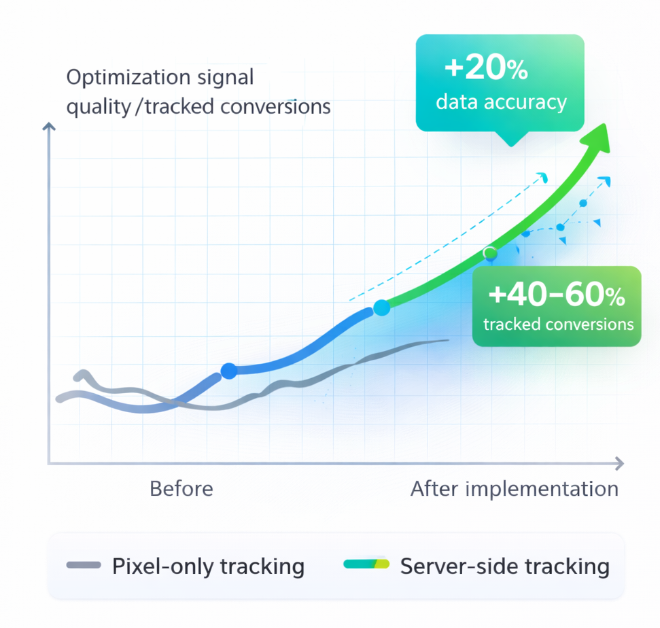
Improved tracking accuracy and signal volume directly enhance Meta’s ability to optimize campaigns
The most common implementation is the Conversion API (CAPI), which works alongside the Meta Pixel. This hybrid setup ensures more reliable event delivery and better resilience against browser restrictions.
What Server-Side Tracking Improves (In Practice)
1. Event Match Quality
Server-side tracking allows you to send enriched user data (such as email, phone number, and external IDs) in a privacy-compliant, hashed format. This significantly improves match rates.
Higher match quality means Meta can better associate conversions with users, improving attribution and audience modeling.
In practice, advertisers often see a 10–25% increase in match quality scores after implementing server-side tracking.
2. Signal Stability
Browser-based tracking is prone to disruptions from ad blockers, network issues, and script failures. Server-side tracking provides a more stable data pipeline.
This consistency leads to more predictable learning phases and fewer performance fluctuations.
3. Conversion Recovery
A portion of conversions is typically lost due to tracking limitations. Server-side tracking helps recover some of these lost events.
Industry estimates suggest that up to 15–30% of conversions can go untracked in browser-only setups. Server-side implementations can recover a meaningful share of that data.
4. Faster Learning Phase Exit
Meta requires approximately 50 optimization events per ad set per week to stabilize delivery. By increasing the number of tracked events, server-side tracking helps campaigns exit the learning phase faster.
What Server-Side Tracking Does NOT Fix
It is important to separate expectations from reality. Server-side tracking is not a magic solution.
1. Poor Funnel Conversion Rates
If your landing page or offer is underperforming, better tracking will not fix conversion issues. It will only report them more accurately.
2. Weak Creative or Targeting
Meta’s algorithm still depends on strong creatives and relevant audiences. Server-side tracking enhances signal quality but does not replace strategic inputs.
3. Limited Budget Constraints
Campaigns with insufficient budgets will still struggle to generate enough optimization events, regardless of tracking setup.
Best Practices for Effective Implementation
Use Hybrid Tracking
Always combine browser and server-side tracking. This ensures redundancy and maximizes data capture.
Prioritize Key Events
Focus on high-value events such as purchases, leads, and qualified conversions. Avoid sending excessive low-quality events that can dilute optimization.
Deduplicate Events Properly
Ensure that events sent from both browser and server are deduplicated using event IDs. Without this, data inflation can distort performance.
Maintain Data Consistency
Event parameters (value, currency, content IDs) must match across sources. Inconsistent data reduces reliability.
Monitor Event Quality Metrics
Regularly review match quality, event coverage, and latency. These indicators reveal whether your setup is actually improving optimization.
Strategic Takeaways
Server-side tracking improves optimization primarily by increasing the quantity and quality of conversion signals. Its impact is most visible in:
-
Better attribution accuracy
-
More stable campaign performance
-
Faster algorithm learning
-
Improved audience modeling
However, its effectiveness depends on proper implementation and strong overall campaign fundamentals.
Recommended Reading
To deepen your understanding of tracking and optimization, consider exploring these additional resources:
Final Thoughts
Server-side tracking is not about collecting more data—it is about collecting better data. When implemented correctly, it strengthens Meta’s ability to optimize campaigns, but it works best as part of a broader performance strategy.
Advertisers who combine high-quality tracking with strong creatives, clear offers, and structured funnels will see the most meaningful improvements.