Cost cap bidding strategies aim to keep the average cost per result within a specified threshold while still maximizing delivery. Platforms use machine learning models to predict conversion likelihood and adjust bids accordingly.
According to industry benchmarks, campaigns using cost cap bidding can reduce cost per acquisition (CPA) by up to 20–30% compared to manual bidding when properly optimized. However, this efficiency comes with sensitivity to constraints.
When the system cannot find enough opportunities that meet both the cost cap and performance criteria, delivery may slow down or stop entirely.
Common Reasons Campaigns Stop Spending
1. Cost Cap Set Too Low
One of the most frequent causes is an overly aggressive cost cap. If the cap is significantly below the market rate, the algorithm will struggle to find auctions that meet the requirement.
Studies show that setting a cost cap more than 25% below historical CPA often leads to a sharp drop in delivery volume.
2. Audience Saturation
As campaigns run over time, audiences may become saturated. Frequency increases while engagement decreases, making it harder for the algorithm to achieve conversions within the cost cap.
Data suggests that once frequency exceeds 3–4 impressions per user, conversion rates can drop by up to 40% in some verticals.
3. Limited Conversion Signals
Machine learning models rely on sufficient conversion data. Campaigns generating fewer than 50 conversions per week often struggle to maintain stable delivery.
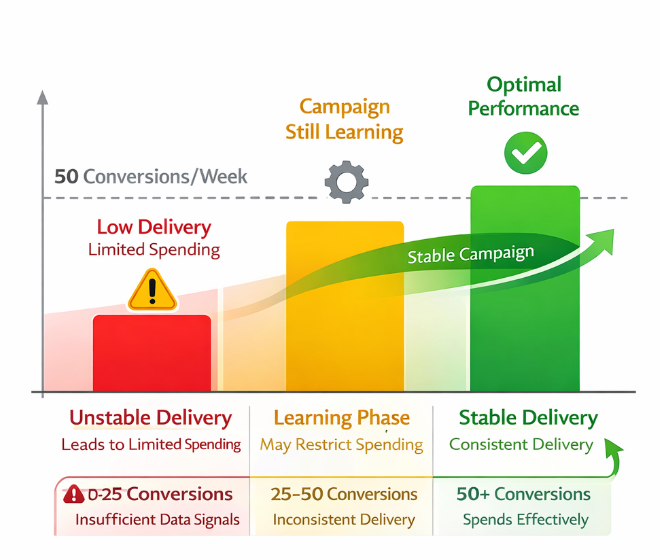
Campaigns need sufficient conversion volume to maintain stable delivery under cost cap bidding
Without enough signals, the system cannot confidently predict outcomes, leading to reduced spend.
4. Increased Competition
Auction dynamics change constantly. Seasonal demand, competitor activity, and budget shifts can all increase average costs.
For example, during peak periods, CPMs can rise by 20–50%, making previously viable cost caps unrealistic.
5. Learning Phase Reset
Significant changes—such as budget adjustments, audience edits, or creative swaps—can reset the learning phase. During this period, delivery may become unstable or pause.
6. Budget Constraints
Even with a cost cap in place, insufficient daily budget can limit the system’s ability to explore and optimize. A general guideline is to set a daily budget at least 5–10 times the target CPA.
How to Fix Spending Issues
Adjust the Cost Cap Gradually
Increase the cost cap incrementally (e.g., 10–20%) to allow the algorithm to re-enter auctions and gather data.
Expand Audience Size
Broaden targeting criteria or introduce new segments to reduce saturation and increase available opportunities.
Improve Conversion Volume
Optimize landing pages, simplify funnels, and ensure tracking is accurate to boost the number of recorded conversions.
Avoid Frequent Changes
Limit major edits to campaigns. Allow at least 3–5 days for stabilization after adjustments.
Monitor Market Conditions
Track CPM and CPA trends regularly. Be prepared to adjust cost caps during high-demand periods.
Preventing Future Delivery Drops
Proactive management is key to maintaining consistent spend. Maintain a balance between efficiency and scalability by periodically reviewing performance data and adjusting constraints accordingly.
Advertisers who regularly recalibrate their cost caps based on real-time performance see up to 35% more stable delivery compared to those who keep static targets.
Suggested Articles
Conclusion
Cost cap campaigns are powerful but sensitive to multiple variables. When campaigns stop spending, it is usually a signal that the system cannot reconcile constraints with available opportunities. By understanding the underlying mechanics and making data-driven adjustments, advertisers can restore delivery and maintain consistent performance.